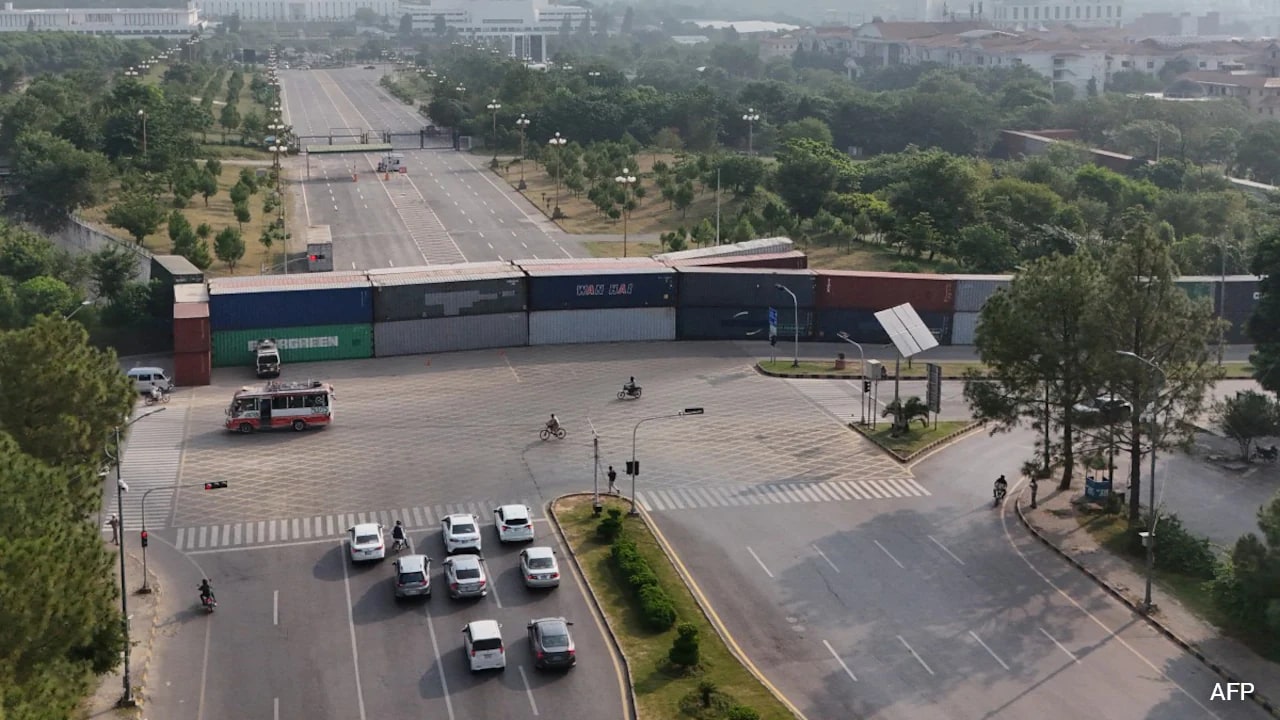
The shipping containers arrive by the flatbed, monstrous rectangles of corrugated steel painted in faded industrial blues and greens, hauled through the damp morning air to block the arteries of a capital city that was never built for barricades.
They do not belong here. They belong on cargo ships crossing the Arabian Sea, or stacked in the sprawling dry ports of Karachi, waiting to be unloaded. But here, along the wide, leafy avenues of Islamabad, they are stacked three high across the Faizabad Interchange, bolted together with heavy-duty locks and backed by truckloads of crushed stone and concrete barriers. The message is written in iron: the government has decided that the safest way to govern a republic is to barricade it from its own citizens.
To understand what is happening in Pakistan’s capital right now, you have to look past the dry wire-service reports of route closures and section 144 curfews. You have to look at the tea stalls in the working-class neighborhoods of Rawalpindi, where the steam rises from chipped porcelain cups while men with calloused hands listen to scratchy audio clips on cheap smartphones.
Imran Khan’s Pakistan Tehreek-e-Insaf party has called for another march. And the state has responded with the only playbook it seems to trust anymore: immobilization.
The Geography of Fear
Islamabad is a city designed with straight lines and wide green belts, conceived in the 1960s as a modern sanctuary of bureaucratic calm, nestled against the jagged, imposing ridge of the Margalla Hills. It is meant to be open. Its sectors are laid out like a chessboard, alphabetized and numbered, connected by grand highways named after foreign capitals and historical figures.
Right now, that chessboard is frozen.
Consider the Red Zone. This is where the diplomatic missions, the Supreme Court, the Parliament House, and the Prime Secretariat sit behind layers of razor wire and contingents of the Pakistan Rangers and the Punjab Constabulary. Normally, commuters glide between the commercial hubs of Blue Area and the residential sectors with barely a second glance at the security checkpoints. Today, those checkpoints have metastasized.
Razor wire uncoils across asphalt like silver snakes. Riot police sit in the backs of open-air trucks, helmets strapped tight, nursing plastic water bottles under a pale autumn sun.
The rationale offered by the administration is simple, almost mechanical: public safety. They argue that when thousands of protesters mobilize with the express intent of descending upon the heart of government—fueled by grievances over the current political dispensation, the legitimacy of the 2024 elections, and the continued imprisonment of their charismatic leader—the risk of violent confrontation is too high.
Yet, the collateral damage of this preemptive siege is immediate and devastating. Small businesses shutter their doors. Daily wage laborers—the rickshaw drivers, the vendors, the construction workers who live hand-to-mouth—find their livelihoods severed the moment a highway is sealed with a wall of shipping containers.
You cannot earn a day's wage when the road to the bazaar has been converted into a militarized demilitarized zone.
A History Written in Barricades
Pakistan is no stranger to the politics of the march. The long march is woven into the very fabric of the nation's turbulent political evolution. It is the ultimate weapon of the opposition, a theater of mass mobilization designed to project raw, unmediated popular will onto the steps of the seat of power.
Think back to previous showdowns. The 2014 sit-ins that paralyzed the same avenues for months. The constant friction between populist fervor and the entrenched machinery of the establishment. These movements rarely happen in a vacuum. They are born from a deep, gnawing sense of disenfranchisement. When millions of people believe their votes were altered, diluted, or ignored, the street becomes their only remaining ballot box.
Imran Khan remains the gravitational center of this storm, even from inside the grim confines of Adiala Jail. His incarceration has not diminished his political gravity; if anything, it has turned him into a martyr-figure for a restless, tech-savvy youth demographic that feels systematically locked out of the country's future. When his party calls for a march, millions do not hear a political maneuver—they hear a summons to reclaim their agency.
And that is what terrifies the corridors of power.
The state’s reaction—closing cellular networks in major urban centers, suspending metro bus services, arresting local party workers in midnight raids, and sealing provincial borders—reveals a profound institutional anxiety. It is an admission that the social contract is frayed to the point of snapping. A government confident in its mandate does not need to turn its capital into an armed camp. A state secure in its legitimacy does not need to weld shipping containers across its highways.
The Human Cost in the Margins
Away from the televised debates and the high-pitched rhetoric of cable news anchors, the human cost of these lockdowns plays out in quiet, desperate ways.
Imagine a mother trying to reach the Pakistan Institute of Medical Sciences from a suburb outside Rawalpindi, carrying a sick child who needs urgent pediatric care. Her bus is halted miles away because the expressway is blocked by a barricade of earth-filled dump trucks. She must get off, walk through dusty detours past lines of sullen police officers, her arms aching, her mind racing with the worst possible scenarios.
This is not a hypothetical scenario; it is the lived reality for thousands of ordinary citizens whenever political elites lock horns.
The economy, already battered by inflation, currency depreciation, and structural adjustment programs, takes another body blow. Supply chains fracture. Perishable goods rot in trucks stranded on the Grand Trunk Road. Factories in industrial estates outside Lahore and Faisalabad struggle to dispatch goods as inter-city transport grinds to a halt. Every hour the capital is barricaded translates to millions of rupees lost in a country that can ill afford a single day of stagnation.
Yet, the political actors on both sides seem trapped in an escalatory spiral where compromise is viewed as weakness. The leadership of the ruling coalition insists that law and order must be maintained at all costs, framing the protesters as agents of chaos bent on subverting the constitutional order. The PTI leadership counters that the constitutional order was already broken the day the people's mandate was allegedly rewritten, making peaceful resistance a moral duty.
The Breaking Point
As dusk falls over Islamabad, the shadow of the Margalla Hills lengthens across the deserted avenues. The streetlights flicker on, illuminating empty asphalt that should be humming with evening traffic.
The shipping containers stand silent, casting long, geometric shadows against the pavement. Inside the Red Zone, generators hum softly behind blast walls. Outside, miles away, convoys of protesters gather at provincial flashpoints, testing the resolve of the security cordons, waiting for the signal to move.
This is the tragedy of contemporary political friction in South Asia: a contest of wills where the state treats its own populace as an invading army, and the populace views the state as an occupying force.
The barricades will eventually come down. The containers will be hauled away by the same flatbed trucks that brought them, the roads will reopen, and the dust of the protests will settle into the grass of the green belts. But the invisible walls—the deep canyons of distrust carved between the governed and the governing—will remain long after the traffic starts moving again.
And somewhere in the dark, behind the steel doors of a prison cell and the steel walls of a locked-down capital, the reckoning waits.


