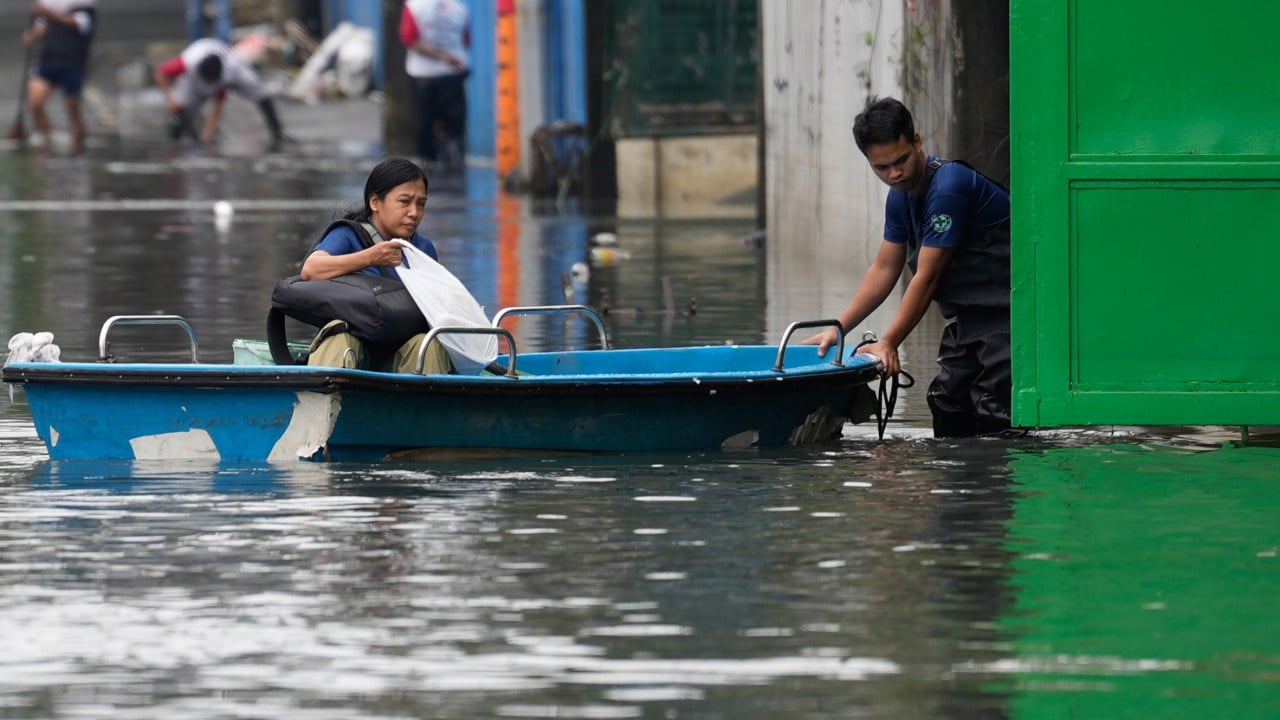
The water does not arrive with a sudden crash. It seeps. It climbs the front step, wraps itself around the legs of a dining room chair, and turns a living room into an aquarium before anyone can properly register the loss.
Outside, the monsoon arrives with its familiar, heavy grief. In neighborhoods like Barangay Tatalon along the swollen banks of the San Juan River, residents know the exact flavor of this panic. They have lived it through every typhoon, every tropical storm, every political promise delivered from dry podiums while streets below turned into rivers. Only a few months ago, grand speeches echoed through the neighborhood, promising that the newly minted drainage systems would finally hold back the tide. In similar updates, take a look at: The Death of Memory How Hong Kong Erased the Tiananmen Vigil.
Then the rains returned. And the water rose eight feet high.
Consider what happens next: millions of pesos worth of concrete and steel vanish beneath a blanket of murky, debris-choked brown. But the water is only half the disaster. The rest is an invisible machinery of paperwork, phantom allocations, and equations of greed that left an entire nation defenseless. The Guardian has analyzed this fascinating issue in great detail.
For years, the public works narrative in the Philippines has operated on a staggering scale. Billions upon billions of pesos funneled into flood control infrastructure. Figures so vast they lose their meaning on a spreadsheet: over ₱556 billion poured into water management projects in a matter of a few short years. To the ordinary citizen bracing against another typhoon, these numbers sound like salvation. They sound like high walls, deepened riverbeds, and sturdy pumping stations.
They sound like safety.
Instead, they bought ghosts. Investigators tracking the trail of missing billions soon unearthed a chilling pattern of structural phantom limbs. Dikes that existed only on paper. Drainage projects paid for in full while contractors walked away with swollen bank accounts and neighborhoods stayed drowning. When actual audits began pulling back the bureaucratic curtain, they found hundreds of millions in idle or unusable structures. Concrete channels cracked before they ever saw a storm. Pumping stations sat dead, stripped of functional parts or disconnected from power grids, built not to move water, but to move money.
Power concentrates in the hands of a microscopic circle of contractors. A handful of favored firms manage to corner an astonishing slice of national infrastructure awards, subcontracting the actual labor down to smaller builders who must pinch every penny just to turn a profit. The result is predictable. Corners are shaved off. Substandard materials are mixed into the foundations. What looks robust on an engineer's blueprint turns out to be nothing more than sand and poorly cured cement when the monsoon pressure hits.
Anger spills across social media faster than the rivers overflow their banks. Citizens share videos of chest-deep currents, tagging officials who stood smiling beside ribbon-cutting ceremonies just weeks prior. Public figures and artists voice the exhaustion of a populace tired of being told to endure. The disaster ceases to be merely meteorological. It becomes moral.
When infrastructure fails because a district engineer looked the other way, the tragedy is no longer an act of God. It is an act of human negligence. Every cracked seawall and every clogged, unmaintained canal represents a choice. It represents a system where kickbacks are calculated as standard operating expenses and where the safety of a family huddled on a second-floor roof is traded for a politician's campaign chest or a contractor's luxury vehicle.
The rain will stop eventually. The sun will break through the Manila clouds, drying out the mud on the pavement and receding from the doorsteps. Families will drag ruined furniture out to the curb, washing down their floors with a mixture of tap water and bitter resignation.
Yet the fundamental question remains hanging in the humid air long after the floodwaters clear. How many billions must wash away before the foundations are finally built to last?
Revisiting the Philippines' Biggest Flood Control Scandal
This documentary details the ongoing investigations and public outcry surrounding the massive financial irregularities embedded within the country's public works infrastructure.