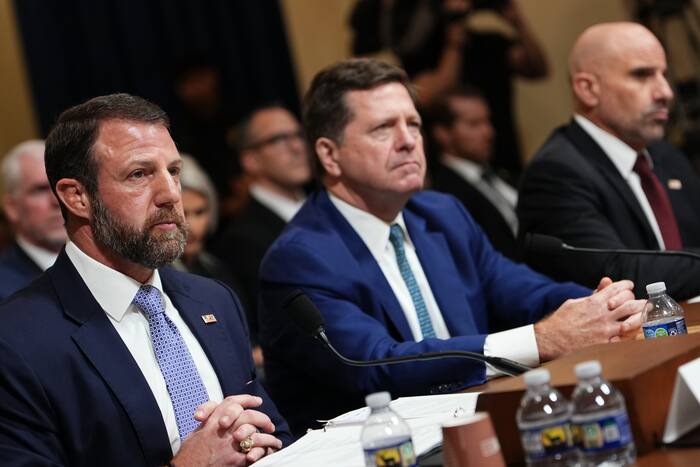
Congressional oversight hearings function as high-stakes stress tests where legislative committees audit executive-branch performance, personal conduct, and policy execution simultaneously. When lawmakers summon a senior official to testify under oath—as demonstrated in the congressional questioning of Mullin regarding flight disruptions, a football trip, and immigration—the resulting exchange is rarely a linear inquiry. Instead, it operates as a multi-vector interrogation designed to expose systemic vulnerabilities, test the boundaries of ethical compliance, and extract binding commitments on the public record. Understanding the mechanics of these hearings requires separating political theater from the underlying operational, ethical, and policy audits taking place in real time.
Standard media coverage treats multi-topic congressional hearings as chaotic highlight reels, focusing on sharp verbal exchanges while missing the structural logic that binds seemingly unrelated lines of questioning together. When a committee links aviation system failures, personal travel optics, and border enforcement in a single session, it is applying a unified framework of institutional trust. Each line of inquiry tests a different dimension of public governance: operational competence, ethical boundary management, and statutory execution. Analyzing these three vectors independently reveals how congressional oversight actually operates and why officials struggle to contain multi-front scrutiny.
The Three Vectors of Congressional Audit
Legislative committees maximize leverage during finite hearing windows by clustering distinct accountability issues into a single narrative of institutional performance. Rather than treating flight disruptions, travel ethics, and immigration as disconnected talking points, committee interrogators use them to construct an integrated profile of decision-making under pressure.
Vector 1 Operational Competence and Systemic Resilience
Questioning focused on flight disruptions targets the core administrative mandate of transportation and infrastructure oversight. In modern aviation networks, localized delays cascade rapidly across hub-and-spoke architectures due to tight aircraft turnaround schedules, crew duty-time regulations, and air traffic control staffing constraints. When lawmakers press an official on flight disruptions, they are auditing three specific failure modes:
- Resource Allocation: Whether federal agencies and regulated carriers maintained sufficient buffer capacity in staffing, airspace management, and technological infrastructure prior to peak demand periods.
- Regulatory Enforcement: How aggressively oversight bodies penalize carriers for preventable scheduling failures versus genuine weather or mechanical anomalies.
- Consumer Protection Mechanisms: The speed and friction involved in passenger rebooking, refund execution, and mandatory compensation rules when systemic breakdowns occur.
From an operational standpoint, aviation disruptions expose the gap between theoretical system capacity and real-world fragility. A network operating at 98 percent utilization leaves virtually zero margin for error. When a single regional hub experiences air traffic control shortages or severe weather, the resulting crew timeouts propagate across unrelated routes within hours. Congressional questioning on this vector forces witnesses to defend not just isolated incidents, but the structural resilience of the regulatory framework governing commercial aviation. If an official attributes disruptions solely to external factors like weather or carrier scheduling, committee members pivot immediately to statutory authority, asking why existing regulatory tools failed to deter predictable bottlenecks.
Vector 2 Ethics, Optics, and Resource Boundaries
The inclusion of a football trip alongside major policy failures illustrates how oversight committees weaponize personal conduct and travel optics to undermine institutional credibility. In public administration, the boundary between official duty, permissible personal travel, and the use of public or regulated resources is governed by strict statutory rules and ethics disclosures. Even when a trip complies with the technical letter of ethics regulations, lawmakers scrutinize three distinct risk dimensions:
- Resource Commingling: Whether government aircraft, security details, or staff time were utilized in connection with non-official events, and how reimbursement formulas were calculated.
- Access and Influence: Who hosted, funded, or attended the event alongside the official, creating potential conflicts of interest with entities regulated by the official's department or committee.
- Opportunity Cost and Prioritization: The visual contrast between an official attending a high-profile sporting event while constituents or agency stakeholders navigate acute operational crises, such as widespread travel cancellations.
In high-level governance, compliance is the floor, not the ceiling. An official may satisfy every requirement of the Ethics in Government Act and still suffer severe institutional damage if the optics suggest detachment from core responsibilities. Committee members exploit this asymmetry deliberately. By placing questions about a football trip immediately adjacent to questions about stranded passengers or border strain, interrogators establish a behavioral contrast. The tactical objective is to force the witness into a defensive posture on personal judgment, which weakens their authoritative footing when they transition back to defending complex policy decisions.
Vector 3 Statutory Execution and Border Policy Mechanics
Immigration questioning introduces the highest-friction ideological and administrative variable into the hearing. Unlike aviation logistics or travel disclosures, immigration enforcement sits at the intersection of statutory ambiguity, finite physical capacity, and intense partisan divergence. When lawmakers grill an official on immigration, the inquiry typically fractures into three operational disputes:
- Enforcement Discretion vs. Statutory Mandate: The tension between executive-branch prioritization guidelines and congressional expectations regarding mandatory detention, removal proceedings, and asylum screening thresholds.
- Throughput and Processing Bottlenecks: The physical capacity of border facilities, immigration courts, and asylum officer corps to process arrivals without creating prolonged release backlogs.
- Interagency Coordination: How immigration authorities synchronize data sharing, vetting protocols, and transportation logistics with state governments, municipal shelters, and federal security agencies.
Immigration systems operate as classic queuing networks where arrival rates frequently exceed service rates. When processing capacity lags behind intake volume, administrators face an immediate trade-off between prolonged detention—which quickly breaches facility capacity limits and statutory time caps—and conditional release pending future court dates, which creates multi-year adjudication backlogs. Congressional interrogators use these structural bottlenecks to demand binary answers on complex trade-offs, framing administrative triage as either intentional non-enforcement or humanitarian failure depending on the member's political alignment.
Information Asymmetry and Questioning Mechanics
A congressional hearing is not a neutral fact-finding seminar; it is an asymmetric information arena governed by strict time clocks. Committee members typically operate under five-minute questioning rounds, which dictates a highly compressed rhetorical strategy. Understanding the mechanics of these exchanges explains why witnesses often appear evasive and why lawmakers rarely allow nuanced explanations.
First, lawmakers rely on pre-committed framing. Before a hearing begins, committee staff assemble documentary records—flight delay statistics, travel manifests, agency memos, and prior public statements—to construct closed-ended questions. When an interrogator asks a yes-or-no question about a football trip or a specific flight cancellation metric, they are not seeking new data. They are attempting to lock the witness into an admission that contradicts either the documentary record or a previous public claim.
Second, witnesses utilize scope expansion to survive the five-minute clock. Because complex operational issues like air traffic control modernization or asylum adjudication cannot be explained in fifteen seconds, witnesses attempt to introduce historical context, multi-agency dependencies, and statutory constraints. Lawmakers counter this by reclaiming their time, cutting off narrative context to preserve the binary framing of the record.
Third, topic switching acts as a cognitive disruption tool. Moving abruptly from aviation infrastructure to personal travel and then to immigration prevents the witness from settling into prepared talking points. Each domain requires a different evidentiary register: technical metrics for flight disruptions, precise dates and disclosures for travel, and legal-statutory citations for immigration. Forcing rapid transitions increases the probability of an unscripted error or an imprecise phrasing that opponents can clip for external distribution.
Risk Factors and Structural Limitations in Oversight Hearings
Evaluating the effectiveness of a congressional grilling requires recognizing the inherent constraints of the hearing format itself. Both legislators and executive-branch witnesses operate within rigid institutional boundaries that limit what a single session can achieve.
- The Compression Distortion: Five-minute questioning blocks reward soundbites over root-cause analysis. Deep systemic issues—such as decades-old air traffic control software architectures or chronic immigration court judicial vacancies—cannot be diagnosed or resolved through rapid-fire cross-examination.
- Attribution Ambiguity: In multi-layered systems like commercial aviation and border security, outcomes are shaped by external variables including global macroeconomic shifts, weather patterns, private-sector labor markets, and geopolitical instability. Hearings routinely over-attribute systemic outcomes to individual officials while under-weighting structural inertia.
- Asymmetric Preparation Costs: Witnesses must prepare across dozens of potential policy domains, legal vulnerabilities, and personal records simultaneously, whereas individual committee members can specialize in a single narrow attack vector for their five-minute window.
Because of these limitations, public hearings rarely produce immediate legislative consensus. Their actual function is signaling: demonstrating to voters, regulated industries, and executive agencies which issues carry political penalty and where future subpoena or appropriations pressure will be applied.
Institutional Response Protocol for Multi-Front Scrutiny
When senior officials or organizational leaders face multi-vector oversight involving operational failures, personal optics, and polarized policy mandates, survival depends on disciplined preparation rather than rhetorical improvisation. Standard media training fails in congressional settings because it prioritizes smooth narrative delivery over evidentiary precision.
- Segregate the Evidentiary Registers: Prepare distinct, non-overlapping response frameworks for operational metrics, ethical disclosures, and policy trade-offs. Never use policy rationale to excuse an optics misstep, and never rely on personal assurances to defend a measurable operational failure.
- Pre-Disclose Technical Compliance: On personal travel or ethical questions, place exact dates, funding sources, and ethics-office clearances on the record immediately. Removing factual ambiguity neutralizes the interrogator's ability to imply concealment, reducing the issue to a subjective debate over optics.
- Anchor Operational Answers in Verifiable Constraints: When addressing systemic disruptions like aviation delays or processing bottlenecks, state the exact resource ratios—staffing levels, throughput capacities, and statutory limits—rather than offering broad assurances of improvement. Quantifying the constraint shifts the burden back to the legislature's appropriations and statutory authority.
- Maintain Time-Clock Discipline: Deliver the core factual answer in the first ten words of every response. Placing the conclusion upfront prevents lawmakers from cutting off the substantive point while reclaiming their time, ensuring the official record captures the primary defense regardless of interruptions.
Executive accountability in high-friction hearings ultimately hinges on structural clarity. Leaders who separate personal compliance from systemic capacity—and who document both with verifiable precision before entering the hearing room—deprive interrogators of the ambiguity required to turn routine oversight into an institutional crisis.


