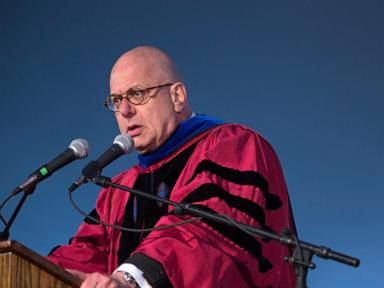
The stone walls of an elite liberal arts college are designed to feel eternal. They suggest a sanctuary where the messy, transactional nature of the outside world stops at the gatehouse. For decades, Leon Botstein was the personification of that endurance. He wasn't just the president of Bard College; he was its architect, its conductor, and its primary guardian. But the problem with stone is that it absorbs the dampness of its environment. Eventually, the weight of what it has soaked up becomes too much to bear.
Leon Botstein’s announcement that he will step down as president—a post he has held since the mid-1970s—is not a standard retirement. It is the final movement of a long, complicated symphony that has been discordant for years.
The departure follows a relentless, slow-burning fire of public and internal scrutiny regarding his ties to Jeffrey Epstein. While Botstein was never accused of the crimes that made Epstein a global pariah, the relationship between the academic titan and the disgraced financier became a case study in the invisible costs of institutional survival.
The Architect and the Benefactor
Consider the pressure of keeping a private college afloat. It is a constant, grinding quest for capital. To the outside world, a president is a visionary. To the board of trustees, a president is a fundraiser. Botstein was legendary for his ability to transform a small, struggling institution into a global brand with campuses from Berlin to New York.
But that growth required fuel.
Epstein, long before his second arrest and subsequent death, operated as a gatekeeper to a specific kind of wealth. He positioned himself as a patron of the sciences and the arts, a man who could bridge the gap between the ivory tower and the billionaire’s row. For a man like Botstein, whose life’s work was the expansion of Bard’s influence, Epstein was a door.
The facts are now part of the public record. Botstein visited Epstein’s private island. He met with him dozens of times. He sought donations for the college. In his own defense, Botstein argued that he was doing what any devoted leader would do: pursuing resources for his students and his faculty. He saw himself as the pragmatist, willing to navigate the gray areas of the world to protect the sanctuary he had built.
It was a gamble. He bet that the brilliance of the institution could outshine the shadow of its donors. He was wrong.
The Invisible Stakes of Association
When we talk about "reputational risk," we often treat it like a line item on a spreadsheet. It feels abstract. But for the students who walked through Bard’s campus, the stakes were visceral. They were paying for a specific kind of moral clarity. They were buying into a community that promised to be better, more enlightened, and more ethical than the corporate world they were preparing to enter.
Every time a new report emerged detailing another meeting or another request for funding, that clarity blurred. The faculty, many of whom had spent their lives under Botstein’s leadership, found themselves in an impossible position. How do you teach ethics in a classroom when the office at the top of the hill is answering questions about a man like Epstein?
The tragedy of the situation is rooted in a very human delusion: the belief that you can control the narrative of your own compromise.
Botstein likely believed that his intellect and his decades of service provided a shield. He was the man who conducted the American Symphony Orchestra. He was the man who saved the college. He was, in his own mind, untouchable because his motives were "pure"—he wasn't looking for personal gain; he was looking for Bard’s gain.
But in the modern era, the distinction between personal and professional ethics has evaporated. An institution is its leader. If the leader’s judgment is compromised by a proximity to darkness, the institution begins to dim.
A Culture of Silence Meets a Culture of Transparency
The tension at Bard didn't just come from the outside. It bubbled up from the dorms and the faculty lounges. The modern student body is not interested in the "necessary evils" of the 20th-century fundraising model. They are the generation of radical transparency. They don't see a pragmatic president; they see an old guard that stayed at the table too long after the host was revealed to be a monster.
Botstein’s long tenure—nearly fifty years—meant that he became synonymous with the college. This is the danger of the "Great Man" theory of leadership. When the person becomes the brand, the brand inherits the person’s ghosts.
The meetings with Epstein weren't just errors in judgment. They were symptoms of a broader systemic issue in higher education: the desperation for endowment growth that leads even the most brilliant minds to ignore the rot at their feet. We are seeing this play out across the Ivy League and beyond. From the MIT Media Lab to the halls of Harvard, the Epstein "gift" has become a curse that keeps on giving.
Botstein’s exit marks the end of an era where a president could operate with the autonomy of a monarch. The world has grown too small for that. The internet is too fast. The demand for accountability is too loud.
The Weight of the Baton
There is a particular kind of silence that follows a conductor after the final note is played. For Botstein, that silence is now filled with the voices of those who feel he stayed too long and compromised too much.
He will leave behind a massive legacy. There is no denying that Bard College is a more significant, more intellectual, and more vibrant place because of his work. He transformed it from a local school into a global powerhouse. But that legacy is now permanently tethered to a ledger of questionable associations.
Think of a student sitting in the library today. They are surrounded by the books Botstein helped buy, in a building he helped fund, under the prestige he helped build. Yet, they are also forced to reckon with the fact that their education was partially subsidized by a proximity to the unthinkable.
That is a heavy burden for a nineteen-year-old to carry. It is a heavy burden for an institution to carry.
The stone walls haven't moved. The gates are still there. The Hudson River still flows past the campus, indifferent to the scandals of men. But the air inside the sanctuary has changed. It is thinner now.
Botstein is stepping down, but he isn't just leaving an office. He is leaving a warning. It is a warning to every leader who believes that the end justifies the means, or that a lifetime of brilliance can erase a moment of profound moral blindness.
The music has stopped. The audience is waiting. And as the conductor lowers his baton for the last time, the only sound left is the uncomfortable echo of the questions he couldn't answer.



