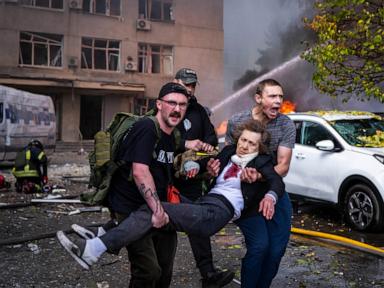
Sirens in Kyiv do not sound like they used to. In the early months of the full-scale invasion, the wail carried an urgent, raw panic, a primitive warning of impending doom echoing down empty asphalt. Now, years into a grinding war of attrition, the alarm is background radiation. Citizens check applications on their phones, calculate trajectories, and weigh the probability of intercept against the grim reality of exhaustion. But math fails when the target is not a power substation or a railway junction. When a missile finds its way into the National Academy of Sciences, the destruction goes deeper than shattered concrete. It pierces the intellectual marrow of a nation fighting for its right to exist.
The daytime strike on Kyiv's scientific establishment was not an anomaly. It was a deliberate punctuation mark in a campaign designed to break more than just the electrical grid. Air defense batteries working overtime across the capital cannot protect every square kilometer from ballistic trajectories and hypersonic maneuvers. When the interceptors fail or arrive fractions of a second too late, the impact zones reveal chillingly specific priorities. Laboratories, archives, and research centers have joined apartment blocks and hospitals on the casualty list.
The Target Beneath the Smoke
To understand what was lost when the blast tore through the academy facilities, one must look beyond the immediate casualty count. A single fatality or a dozen wounded represents a human tragedy of immense proportion, yet the collateral damage extends across generations of accumulated knowledge. Scientific institutions are fragile ecosystems. They require quiet libraries, stable power, specialized equipment, and above all, unbroken continuity of thought.
For decades, the research complexes scattered across Kyiv functioned as the intellectual engine for Soviet and later independent Ukrainian innovation. Materials science, cybernetics, theoretical physics, and botanical archives—these fields formed the quiet infrastructure of modernity. When an explosion rips through a laboratory housing decades of botanical specimens or unprinted manuscripts, centuries of meticulous labor vanish in a millisecond. There is no backup drive for physical archives burned to ash. There is no quick replacement for custom-built particle detectors or specialized chemical storage units turned to rubble by concussive force.
The military calculus behind striking urban academic centers during daylight hours involves a cruel efficiency. Nighttime strikes exploit darkness and sleep, but daytime attacks shatter the illusion of routine. They target people at their desks, researchers peering through microscopes, and technicians maintaining equipment. They send an unmistakable message to the scientific class: safety is a myth, and intellectual pursuits are considered legitimate combat targets by an adversary intent on erasing cultural and scientific sovereignty.
Anatomy of a Daytime Barrage
Daytime missile attacks require a distinct tactical profile. Air defense systems deployed around Kyiv are formidable, honed by years of relentless aerial bombardment. To bypass these defensive umbrellas, operators adjust flight paths, utilize terrain masking, and time strikes to coincide with saturation waves of drones. When a ballistic missile descends at terminal velocity in broad daylight, the warning window shrinks to seconds.
People do not have time to reach deep underground metro stations serving as improvised bomb shelters. They dive under desks, huddle in stairwells, or trust the antiquated load-bearing walls of Soviet-era academic blocks. These buildings were constructed with durability in mind, but they were never engineered to withstand direct impacts from modern precision-guided munitions carrying heavy explosive payloads.
The aftermath of such strikes reveals a terrifyingly familiar urban choreography. First comes the blinding flash and the concussion that rattles windows miles away. Then the rising pillar of gray-black smoke visible from across the Dnipro River. Emergency services arrive with sirens blaring, cutting through morning traffic already disrupted by previous alerts. Firefighters scale scorched scaffolding to douse smoldering upper floors where chemistry labs once operated. Paramedics stretcher out the injured past rows of shattered glass and twisted aluminum window frames.
Journalists arrive shortly after, notebook in hand, capturing the bleak theater of survival. But the standard reporting cycle moves too fast. It tallies the dead, counts the damaged vehicles on the street, and records official statements condemning the barbarity. What gets left behind in the news cycle is the quieter, more permanent catastrophe unfolding inside the battered offices.
Bleeding the Brain Trust
Buildings can be rebuilt. Concrete can be poured, and glass can be replaced with funds from international donors and reconstruction pledges. But the human capital of a scientific community cannot be so easily restored.
Ukraine has faced a devastating brain drain since the invasion began. Brilliant minds—physicists, mathematicians, engineers, and biologists—have been forced to scatter across Europe and North America. Those who stayed behind, clinging to their homeland out of stubborn loyalty or lack of means, kept the lights on in unheated basements, running simulations on laptops powered by noisy diesel generators.
When a strike hits a research academy, it targets the psychological core of this remaining academic resistance. Every veteran researcher killed or severely injured represents decades of accumulated mentorship lost. A professor of theoretical physics does not materialize overnight. The institutional knowledge passed down from mentor to student, the informal networks of collaboration that drive breakthrough discoveries, and the sheer institutional memory of how complex systems operate—these intangible assets evaporate with a single explosion.
Universities and academies across Europe have offered refuge, welcoming Ukrainian scholars into foreign labs. Yet exile is a corrosive state. Many researchers find themselves stranded in temporary postdoc positions abroad, teaching in foreign languages, separated from their families and cultural roots. The daytime strike on the academy accelerates this centrifugal force. It tells every young scientist weighing their options in Kyiv that staying carries an intolerable tax on their personal safety and professional future.
The Architecture of Intellectual Attrition
The destruction of scientific infrastructure serves a dual purpose in modern total war. Beyond the immediate terror inflicted on the civilian population, it represents a systematic attempt to mortgage a nation's future. An economy stripped of its research and development capacity cannot easily transition into a modern, high-value technological powerhouse once the shooting stops.
For years, Kyiv was quietly emerging as a formidable tech and engineering hub in Eastern Europe. Software developers, aerospace engineers, and biotech researchers collaborated with global enterprises. The National Academy of Sciences was the foundational bedrock upon which much of this specialized talent was built. By targeting these institutions, the aggressor aims to reduce Ukraine to a purely agrarian or resource-extraction economy, stripped of the intellectual independence that accompanies advanced scientific inquiry.
This strategy is historical in its echoes. Totalitarian powers throughout history have recognized that intellectuals, scientists, and independent thinkers pose a unique threat to narrative control and territorial subjugation. Erasing the physical infrastructure of science is an extension of book burnings and archive purges into the missile age.
Yet the resilience displayed within these academic corridors remains stubborn. Days after previous strikes, researchers have been documented returning to blast-damaged rooms, sweeping up shattered glass, wrapping plastic sheeting over blown-out windows, and attempting to salvage damp manuscripts or intact hard drives. This refusal to surrender intellectual ground is as fierce as any defensive line held by infantry in the trenches of the east.
When Laboratories Become Frontlines
The frontline in this war is no longer a neat line on a tactical map. It runs through residential courtyards, kindergarten playgrounds, and university lecture halls. When a science academy becomes a smoking crater in the middle of a Tuesday morning, the fiction of the rear echelon is permanently shattered.
Every scientist working under the constant threat of air raids is essentially operating under fire. They calculate equations while listening to the distant thump of air defense interceptors. They adjust their experiments around scheduled rolling blackouts and emergency shelter drills. This abnormal existence has become the grim baseline of academic survival.
The international community responds with expressions of outrage, humanitarian aid packages, and grants for displaced researchers. These gestures are necessary, but they often treat the symptoms rather than the disease. The disease is an unpunished campaign of infrastructural annihilation aimed at erasing the future capability of a sovereign state.
As the smoke clears from the academy courtyard and workers begin the grim task of clearing rubble from floors where complex theorems were debated just hours before, the broader reality settles in. The war is not just about territory, borders, or geopolitical alignment. It is a collision between an order that values creation, intellect, and inquiry, and a force that measures power solely by the volume of its artillery and the reach of its missiles.
The sirens will sound again tomorrow. The applications on millions of phones will flash red, urging citizens downward into concrete shelters. And somewhere in the damaged labyrinth of Kyiv's intellectual institutions, a researcher will pick up a pen, dust off a charred desk, and begin again.