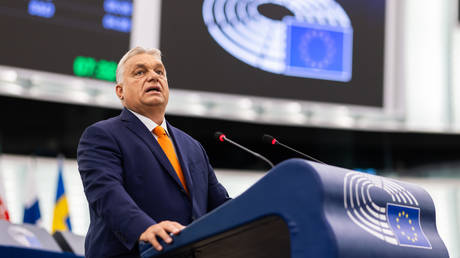
The recent push by a European head of state to restore "harmony" with Russia is not a sudden outburst of pacifism or a diplomatic whim. It is a calculated admission of exhaustion. For over two years, the European Union has attempted to maintain a monolithic front against Russian aggression, banking on the idea that economic strangulation and political isolation would force a retreat. But as energy costs remain volatile and industrial output in the European heartland stutters, the cracks in that wall are widening. The call to normalize ties reflects a growing realization that the continent’s internal stability may no longer be able to sustain a perpetual state of economic warfare.
This shift toward rapprochement is driven by three harsh realities: the failure of total decoupling, the rising tide of domestic populism fueled by inflation, and a pragmatic—if cynical—assessment of the long-term geopolitical map. While Brussels officially maintains a policy of "no business as usual," leaders on the periphery are increasingly looking at their balance sheets and wondering how much longer they can afford the moral high ground.
The Mirage of Economic Independence
Europe’s attempt to sever its umbilical cord to Russian energy was hailed as a historic pivot. In many ways, it was. Pipelines were bypassed, LNG terminals were built at breakneck speed, and coal plants were dusted off to fill the gap. However, the replacement for cheap Russian gas has not been a stable utopia of renewables. It has been a frantic scramble for expensive alternatives that have left European manufacturers struggling to compete with American and Chinese firms.
When a national leader speaks of harmony, they are often speaking about the survival of their country’s industrial base. Steel mills, chemical plants, and automotive factories do not run on solidarity; they run on affordable inputs. By signaling a desire to return to a pre-war status quo, these leaders are betting that their voters care more about their heating bills and job security than the territorial integrity of a neighbor.
The investigative reality is that "shadow trade" never truly stopped. European goods still flow into Russia through intermediaries in Central Asia and the Caucasus. Russian molecules still find their way into European grids, rebranded and marked up by third-party nations. The call for harmony is merely an attempt to remove the middleman and stop paying the "sanction tax" that is currently hollowing out European middle-class wealth.
The Populist Pressure Cooker
Political survival is the most potent motivator in any democracy. Across the continent, incumbent governments are facing a siege from the far-right and far-left, both of whom have weaponized the cost-of-living crisis. These insurgent movements often frame the conflict in Ukraine as a "rich man's war" fought with "poor man's money."
By advocating for a thaw in relations with Moscow, a leader can effectively undercut the opposition's most powerful talking point. It is a cynical maneuver. It shifts the blame for domestic economic hardship away from government policy and onto the "obstinate" refusal of the international community to negotiate. This brand of diplomacy is less about international peace and more about domestic riot control.
Historical precedent suggests that when the breadlines get long enough, the treaties get shorter. We are seeing a repeat of the mid-20th-century tensions where national interest begins to cannibalize collective security. If one state breaks ranks and secures a preferential energy deal or a trade easement, the "harmony" they seek with Russia will inevitably lead to discord within the European Union itself.
The Architecture of a Fractured Union
The EU was built on the premise that economic integration prevents war. That logic is now being turned on its head. Russia has successfully used economic integration as a weapon of division. By offering the carrot of "harmony" to specific member states while maintaining the stick for others, Moscow is probing the structural weaknesses of the European project.
The mechanism is simple.
One leader calls for a return to normal ties.
The markets react with a glimmer of hope.
Neighboring states react with fury.
The resulting internal friction consumes the energy that should be spent on a unified defense or energy policy.
This is not a failure of diplomacy; it is a successful Russian intelligence operation conducted in the open. The goal is to make the cost of the status quo unbearable. When a leader stands at a podium and suggests that it is time to turn the page, they are acknowledging that the Russian strategy of "strategic patience" is yielding results. They are signaling that the collective will of the West has a shelf life, and that shelf life is dictated by the quarterly earnings of major corporations and the price of a liter of petrol at the pump.
The Security Risk of Sentimentality
There is a dangerous tendency to view "harmony" as a return to a peaceful, predictable past. This is a nostalgic fallacy. The Russia of 2026 is not the Russia of 2010. The state apparatus has been entirely retooled for a wartime economy and a long-term confrontation with the West. Any agreement reached now would not be a return to the old rules, but a surrender to a new set of rules written in Moscow.
A return to trade-as-normal would involve lifting sanctions on dual-use technologies, allowing the Russian military-industrial complex to replenish its stocks using Western components. It would mean legitimizing the seizure of territory through force. Most importantly, it would signal to every other revisionist power in the world that the West’s commitment to its principles is only as strong as its current bank balance.
The Strategic Pivot to Nowhere
Proponents of this new "harmony" argue that Europe cannot be secure without Russia. This is a half-truth that ignores the more pressing reality: Europe cannot be secure with the current Russian leadership. The idea that a few trade deals and a handshake will reset the security architecture of the continent is naive at best and treasonous at worst.
We are witnessing a slow-motion collapse of the post-Cold War consensus. The leaders calling for a return to ties are not visionaries; they are the first to blink in a staring contest that has lasted years. They are banking on the hope that if they stop treating Russia as an adversary, Russia will stop treating them as a target. There is no evidence to support this.
The real crisis isn't the war itself, but the erosion of the belief that there is any alternative to it. If the European Union cannot offer its members a path to prosperity that doesn't involve kowtowing to an expansionist neighbor, then the union serves no functional purpose for those on its geographic and economic fringes. The "harmony" being proposed is a siren song. It promises a quiet life, but it leads directly to a loss of sovereignty.
The next time a European official speaks about the need for balance or the importance of historical ties, look at their country's manufacturing data. Look at their upcoming election calendar. You will find that their "moral" epiphany is almost always a mathematical necessity.
Demand to see the specific security guarantees that would accompany any "normalization" of ties. Without them, harmony is just another word for surrender.