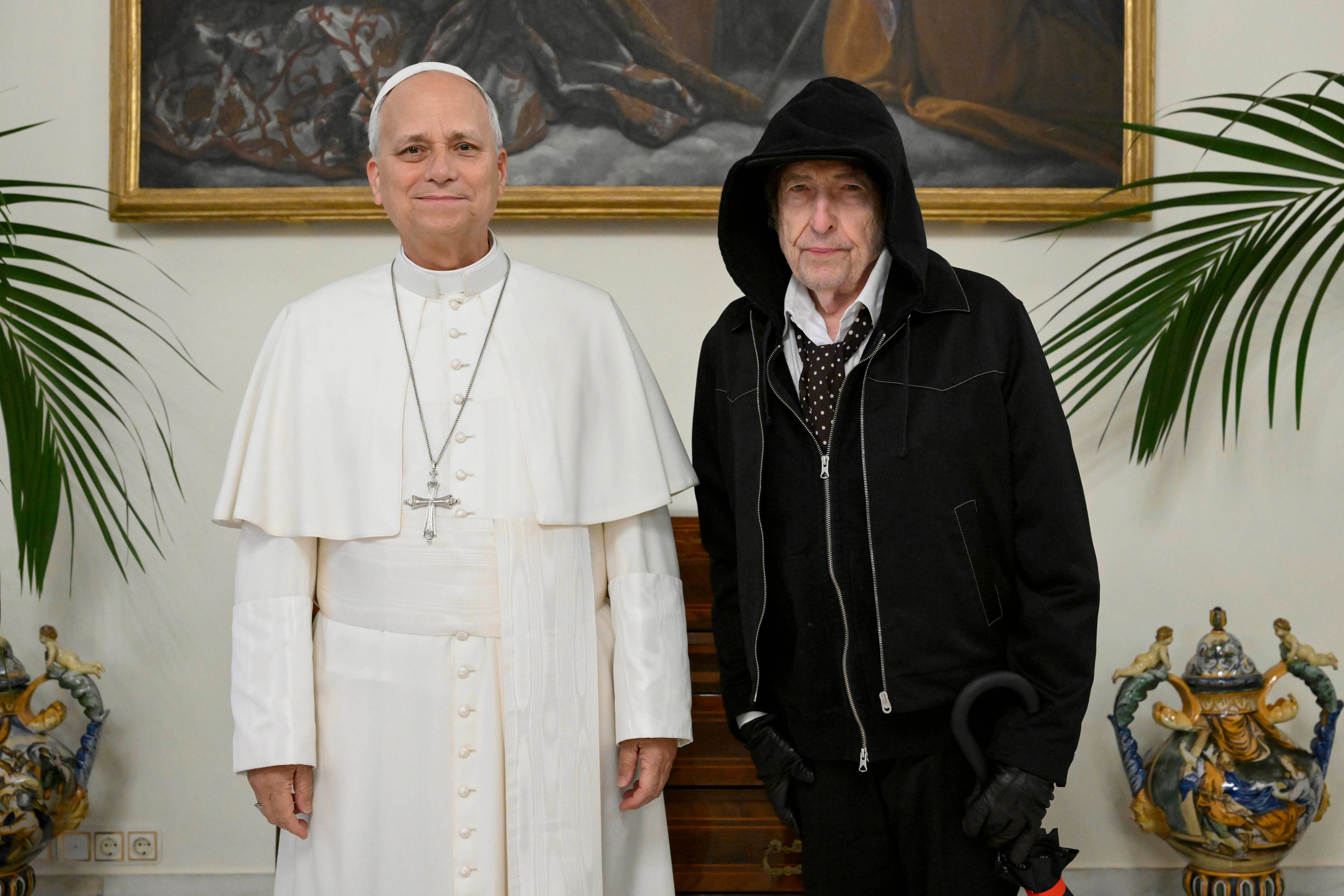
Soft power relies on institutional validation and cultural legitimacy to project influence across demographic boundaries. When Pope Leo XIV welcomed Bob Dylan to the Vatican, the meeting operated far beyond a ceremonial photo opportunity between a religious leader and a Nobel laureate. It functioned as a deliberate strategic alignment between the Roman Catholic Church and secular countercultural authority. By analyzing this intersection through the mechanics of institutional signaling, historical precedent, and audience segmentation, the underlying operational logic of modern Vatican diplomacy becomes clear.
Standard coverage reduces papal audiences with musicians to novelty headlines, often relying on lyrical puns while ignoring the geopolitical and sociological drivers behind the invitation. In institutional communications, high-profile meetings serve as low-cost, high-visibility signals designed to recalibrate public perception. For Pope Leo XIV—operating as the first American-born pontiff following the papacy of Pope Francis—hosting an iconic American songwriter addresses specific demographic and cultural objectives simultaneously.
The Three Mechanisms of Papal Cultural Signaling
To understand why the Vatican allocates diplomatic capital to secular artists, one must examine how the Holy See manages global attention. Unlike nation-states that rely on economic or military coercion, the Vatican operates entirely through moral authority and symbolic capital.
Cross-Demographic Bridging
Religious institutions frequently struggle with generational attrition and ideological polarization. Secular cultural icons possess built-in trust networks that bypass traditional ecclesiastical channels. When Bob Dylan enters the Apostolic Palace, his presence validates the institution to audiences who remain skeptical of organized religion yet revere artistic authenticity. The mechanism is associative transfer: the perceived integrity of the artist temporarily attaches to the host institution.Theological and Artistic Convergence
Dylan’s catalog has long engaged with Judeo-Christian eschatology, moral reckoning, and spiritual exile, notably during his late-1970s Christian period (Slow Train Coming, Saved, Shot of Love) and continuing through his late-career reflections on mortality and grace. For the Vatican, engaging an artist whose work already interrogates sin, redemption, and apocalyptic judgment requires zero ideological compromise. The common ground is pre-established in the text of the work itself.American Cultural Translation
As the first pontiff from the United States, Pope Leo XIV occupies a unique position in Vatican history. Engaging with a foundational figure of American folk and rock music allows the papacy to articulate an American cultural fluency without aligning with partisan political actors. Dylan represents a specific strain of American moral inquiry—restless, critical, and rooted in historical memory—that aligns cleanly with Catholic social teaching while avoiding domestic political entanglement.
Historical Precedent and Institutional Continuity
The meeting between Pope Leo XIV and Dylan is neither an anomaly nor a radical departure from Vatican protocol. Rather, it is the latest iteration of a deliberate strategy formalized in the late twentieth century to mend the post-Enlightenment rift between the Catholic Church and modern art.
In September 1997, Pope John Paul II attended the World Eucharistic Congress in Bologna, where Bob Dylan performed "Knockin' on Heaven's Door" and "A Hard Rain's A-Gonna Fall" before an audience of roughly 300,000 young people. That event proved controversial within conservative Vatican circles; Cardinal Joseph Ratzinger—later Pope Benedict XVI—famously questioned in his memoirs whether allowing a rock musician to perform at a liturgical gathering was appropriate. Yet John Paul II recognized the utility of the medium, explicitly interpreting Dylan’s lyrics about wind and roads through a theological lens during his homily.
Pope Francis subsequently institutionalized this outreach through the Dicastery for Culture and Education, hosting large-scale audiences for contemporary visual artists, filmmakers, and writers in the Sistine Chapel. Under Pope Leo XIV, welcoming Dylan directly into the Vatican shifts the format from mass-concert spectacle to intimate diplomatic parity.
| Dimension | Bologna 1997 (John Paul II) | Vatican Audience (Leo XIV) |
|---|---|---|
| Format | Mass outdoor concert (300,000 attendees) | Private/semi-private diplomatic reception |
| Primary Objective | Youth mobilization and evangelization | Institutional prestige and cultural dialogue |
| Theological Friction | High (liturgical setting sparked internal debate) | Low (diplomatic setting avoids liturgical overlap) |
| Signaling Mechanism | Populist accessibility | Intellectual and artistic parity |
This evolution demonstrates institutional learning. By moving the interaction out of a liturgical framework and into a formal diplomatic reception, the Vatican captures the symbolic value of Dylan’s presence while eliminating the doctrinal friction that troubled theologians in 1997.
The Asymmetric Value Exchange
Every strategic partnership involves an exchange of utility. Evaluating the Vatican meeting requires separating what the Holy See gains from what an octogenarian artist with cemented cultural status extracts from the encounter.
For the Vatican, the return on investment is immediate and quantifiable in earned media impressions. Traditional papal encyclicals and diplomatic communiqués rarely penetrate mainstream secular news cycles unless they address acute geopolitical crises or contentious social policies. A visual pairing of Pope Leo XIV and Dylan forces the Vatican onto the front pages of entertainment, culture, and general news outlets globally. It projects an image of a papacy that is culturally literate, open to dialogue, and unafraid of secular complexity.
For Dylan, the incentive structure is entirely different. Having already secured the Nobel Prize in Literature, the Presidential Medal of Freedom, and commercial permanence, he requires neither institutional validation nor publicity. Instead, his participation aligns with a career-long pattern of engaging with foundational Western myths and institutions. Just as Dylan has consistently drawn upon biblical cadence, classical literature, and American folk traditions as raw material, stepping into the Vatican places him inside the physical architecture of Western religious history. The meeting functions as a late-career coda to his ongoing dialogue with faith, mortality, and institutional power.
Operational Limitations of Celebrity Diplomacy
While high-profile cultural audiences generate immediate visibility, relying on celebrity diplomacy carries distinct structural limitations that communications strategists must account for.
The Attention Decay Curve
Media spikes driven by unexpected cultural pairings exhibit steep decay rates. Within 48 to 72 hours, news cycles revert to baseline coverage. Without a sustained programmatic follow-up—such as educational initiatives, archival collaborations, or ongoing cultural dialogues—the meeting remains an isolated viral event rather than a driver of long-term institutional affinity.The Risk of Dilution
When an institution opens its doors too frequently to secular entertainers, the scarcity value of a papal audience degrades. The symbolic weight of the Vatican relies on exclusivity and historical gravity. Over-indexing on pop-culture relevance risks flattening a two-millennium-old institution into just another stop on a celebrity publicity circuit.Ideological Misalignment
Secular artists are unpredictable actors whose catalogs and public statements rarely conform neatly to religious orthodoxy. While Dylan’s body of work offers rich theological overlap, his refusal to be categorized or co-opted by any single movement means the Vatican cannot control how audiences interpret the meeting. Some observers view it as a validation of Christian themes; others view it strictly as a secular triumph of rock-and-roll mythos penetrating the ultimate establishment stronghold.👉 See also: The Edge of the Persian Glass
Strategic Execution for Institutional Communications
Organizations seeking to replicate the mechanics of high-level cultural signaling must move beyond superficial celebrity endorsements and anchor outreach in substantive alignment.
First, identify external figures whose existing body of work independently interrogates the core questions of the institution. Authenticity cannot be manufactured through press releases; the overlap must be verifiable in the subject’s prior output. Second, control the venue and framing to prevent mission drift. Separating diplomatic hospitality from core doctrinal or operational functions allows an institution to capture broad cultural goodwill without alienating its traditional base. Finally, treat the public encounter as the top of an engagement funnel rather than the final deliverable, converting fleeting media attention into structured, long-term cultural programming.