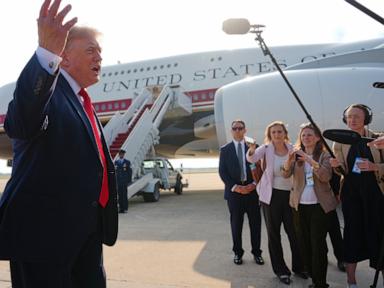
Donald Trump took his first official flight aboard a newly designated Air Force One on Wednesday, departing Joint Base Andrews for North Dakota in a heavily customized Boeing 747-8 that was gifted to the United States by the government of Qatar. While the administration frames the luxury jet as a cost-effective stopgap to replace the aging, 35-year-old presidential fleet, the unusual transaction has sparked deep ethical and security questions among military analysts and lawmakers. This is not just a story about a new paint job; it is a profound shift in how American sovereign power is displayed and financed.
The flight to Bismarck, ostensibly scheduled to highlight a visit to the Theodore Roosevelt Presidential Library ahead of America’s 250th anniversary, served as a grand unveiling. For decades, the iconic cyan-and-white livery designed by Raymond Loewy during the Kennedy administration served as a neutral, globally recognized symbol of the American republic. That era has ended. The new aircraft features a deep navy blue underbelly, separated from a white top by sharp crimson and gold stripes, reflecting the exact aesthetic choices Trump has long favored for his personal fleet. Inside, the changes are even more stark, replacing the traditional, utilitarian military briefing rooms with plush carpets, sprawling leather captain's chairs, and gold-trimmed seatbelt buckles bearing the presidential seal.
A White Elephant Transformed into Diplomatic Capital
The aircraft itself carries a complicated history. Originally manufactured in the United States, this specific Boeing 747-8 was configured as a VVIP transport for the Qatari royal family’s Amiri Flight. For years, Doha attempted to sell the aircraft on the open market. It sat idle. The market for a used, ultra-luxury four-engine jumbo jet is microscopic, given the astronomical operating costs and the highly specific, opulent interior layout that appeals to few private billionaires.
By donating the $400 million airframe to the United States, Qatar effectively solved a costly maintenance problem while purchasing an unprecedented level of diplomatic goodwill. Trump praised the move before boarding, stating that the foreign government had spent top dollar on the machine and that it represented a gift from a nation that has treated the United States very well.
This rationale bypasses traditional federal procurement laws. In institutional Washington, gifts of this magnitude from foreign entities are traditionally viewed with extreme suspicion, if not outright hostility. Foreign governments do not hand over state-of-the-art aerospace hardware out of pure generosity. Qatar hosts the Al Udeid Air Base, the nerve center for American military operations in the Middle East, making its relationship with the White House central to its survival in a volatile region. Accepting a flying palace from a foreign power creates an immediate, visible obligation that complicates American foreign policy independence.
The True Cost of a Free Airplane
The administration has repeatedly claimed that the procurement cost taxpayers next to nothing compared to building a new aircraft from scratch. That claim ignores the brutal realities of military aerospace engineering. The Air Force admits it has already spent roughly $400 million to outfit the Qatari jet with the necessary defensive suites, hardened communications systems, and classified electronics required to operate as a airborne command post during a national crisis.
Military upgrades are never cheap. The total integration cost is expected to approach $1 billion once long-term logistical pipelines, specialized pilot training, and maintenance contracts are fully factored in.
+------------------------------------+-----------------------+
| Airframe Origin                    | Qatari Amiri Flight   |
+------------------------------------+-----------------------+
| Estimated Base Value               | $400 Million          |
+------------------------------------+-----------------------+
| Pentagon Security Retrofit Cost    | $400 Million          |
+------------------------------------+-----------------------+
| Permanent VC-25B Fleet Cost (2028) | $5 Billion            |
+------------------------------------+-----------------------+
This massive parallel spending occurs while the official, permanent replacement program for Air Force One remains mired in delays. The two heavily modified Boeing 747-8 jets designated to become the permanent presidential fleet—known as the VC-25B program—have seen their projected costs balloon from $3.7 billion to over $5 billion. Delivery has slipped to 2028. The Qatari jet serves as an expensive bridge to cover the gap left by Boeing's corporate struggles and engineering bottlenecks.
Critics in Congress have pointed out that the resources diverted to fast-track this temporary luxury transport could have been used to address glaring shortfalls elsewhere in the defense budget. The Air Force is currently struggling to fund the Sentinel intercontinental ballistic missile modernization program, which is years behind schedule and billions over budget. Spending hundreds of millions on a temporary aircraft to satisfy an aesthetic preference strikes many oversight officials as a profound misallocation of defense funds.
The Surveillance Dilemma
The most troubling aspect of the arrangement is not financial, but structural. The Air Force stated that engineers made minimal changes to the cabin layout to keep costs down. This means the underlying physical architecture of the plane remains exactly as it was when it was under Qatari control.
Espionage is a game of millimeters. In modern counterintelligence, accepting an aircraft that spent years in foreign hangars, maintained by foreign contractors, is considered an extraordinary vulnerability. While the Pentagon insists that the aircraft was thoroughly swept and stripped down to its bare metal before the installation of American encrypted communications suites, security experts remain deeply skeptical.
The risk is not just about hidden microphones. Modern digital espionage can involve supply-chain compromises where malicious firmware is baked directly into the plane's environmental control systems, galley equipment, or structural monitoring sensors. If a sophisticated adversary knows the exact wiring schematics of a specific airframe years before the United States military takes possession of it, the task of securing that space becomes infinitely more complex.
Power Displayed Rather Than Preserved
Trump addressed the philosophical shift in the plane's appearance directly to reporters on the tarmac, stating that a leader can either keep things low-key or choose to show power. He chose the latter. The decision to allow staff to post internal photos of the luxury cabins on social media underlines a deliberate strategy to project a corporate image of success rather than traditional military austerity.
This approach transforms Air Force One from a symbol of institutional continuity into an extension of a personal brand. The presidency is intended to be larger than any single individual who holds the office. By reshaping the aircraft's visual identity to mirror his private real estate holdings and pre-presidential transport, the current executive branch blurs the line between public property and private prestige.
The flight to North Dakota is only the beginning of this experiment. As this retrofitted jumbo jet carries the American presidency across the globe over the next two years, it will stand as a flying contradiction. It is a machine built by an American company, outfitted by the American military, painted in the colors of an American politician, but delivered courtesy of a Middle Eastern monarchy. Every hour it spends in the air reminds international allies and adversaries alike that American prestige can now be supplemented by foreign charity.