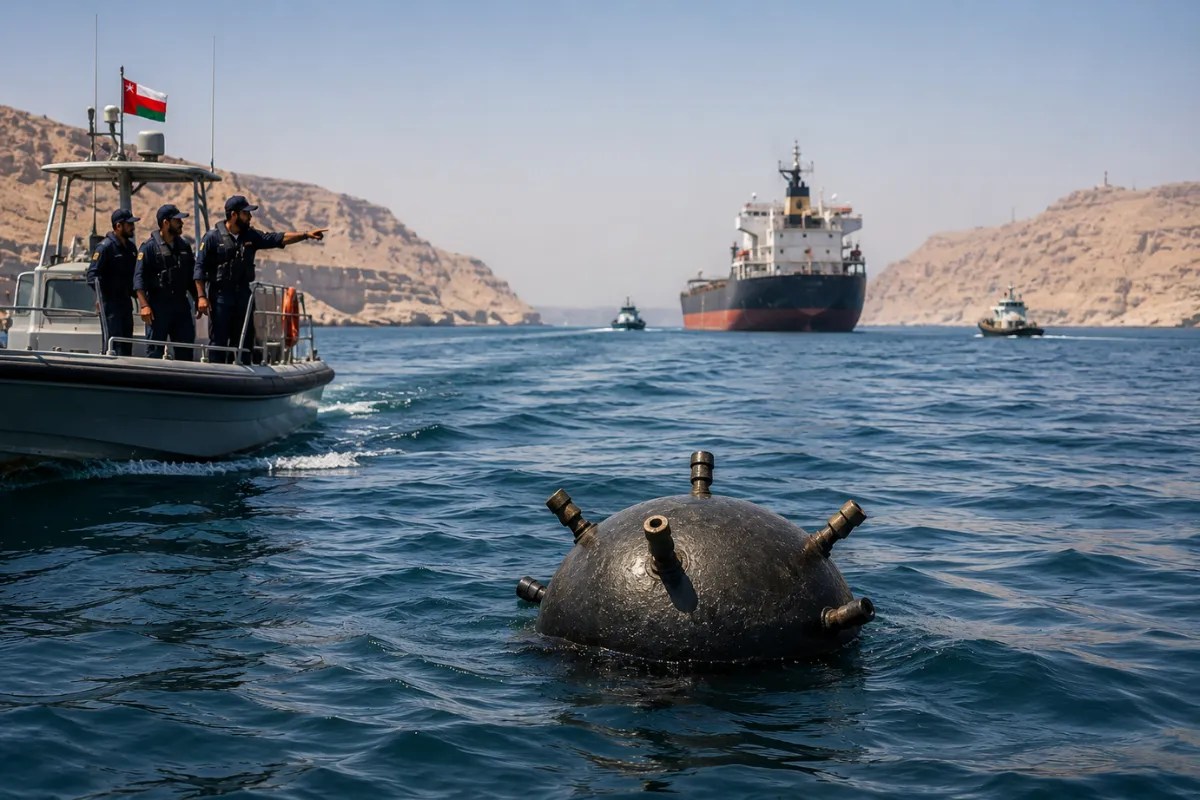
The sea has a way of playing tricks on the eyes. Under the blinding glare of the mid-day sun, ninety miles off the rugged coast of Oman, the water shifts from a deep, bruised blue to a blinding sheet of silver. For the crew of a standard commercial oil tanker, the horizon is usually a monotonous stretch of nothingness.
Then, someone spots it. A metallic glint. A shape that doesn’t match the natural roll of the waves.
It looks like an old, rusty oil drum. Or maybe a discarded piece of marine debris. But as the gap closes, the crew realizes this object isn't drifting randomly with the current. It is weighted perfectly, sitting dangerously low in the water, bobbing in the exact shipping lanes that keep the modern world alive.
It is a naval mine. A floating cylinder of explosives waiting for a single, catastrophic touch.
When Oman’s maritime authorities recently broadcasted an urgent, high-alert warning across international naval frequencies, they weren't just reporting a piece of stray military hardware. They were pulling back the curtain on the fragile illusion of global stability. The Strait of Hormuz, a narrow stretch of water separating Iran from Oman and the United Arab Emirates, is the throat of the global economy.
And right now, that throat is feeling a sudden, sharp pressure.
The Invisible High-Wire Act
To understand the sheer panic a single floating object can cause, step into the shoes of someone whose life depends on these waters.
Let's call him Captain Silva. He commands a 300-meter-long Very Large Crude Carrier (VLCC). Under his boots are two million barrels of crude oil. His ship is a floating city, but it moves with the agility of a glacier. If Silva spots an anomaly in the water half a mile ahead, he cannot slam on the brakes. He cannot swerve.
For Captain Silva, the Strait of Hormuz is already a psychological gauntlet. At its narrowest point, the shipping lanes are just two miles wide in either direction. On one side are jagged, inhospitable cliffs; on the other, heavily armed patrol boats from regional powers watching every move through binoculars.
Now, add a variable you cannot see on radar.
Naval mines are the improvised explosive devices (IEDs) of the ocean. They are cheap to build, incredibly easy to deploy, and agonizingly difficult to detect. A modern warship equipped with millions of dollars of sonar equipment can still struggle to differentiate a semi-submerged floating mine from a cluster of heavy trash or a dead whale. For a civilian cargo ship, it is purely a game of Russian roulette.
The Sultanate of Oman does not issue panicked alerts lightly. Their maritime security center is known for its measured, stabilizing presence in a volatile region. When Oman sounds the alarm about a suspected floating mine, it means the threat is immediate, verified, and drifting toward the path of hundreds of millions of dollars in commerce.
The Price of Two Miles of Water
The global economy is built on a collective agreement to ignore how fragile everything is. We expect grocery stores to be stocked, gas stations to have fuel, and factories to keep humming. We treat these things as constants.
They are not.
Consider what happens when a single mine detonates against the hull of a tanker in Hormuz. The immediate consequence is local—a horrific blast, a compromised crew, and a catastrophic environmental disaster in pristine waters. But the ripple effect is instantaneous and global.
- Insurance markets freeze: Lloyd’s of London and other global underwriters immediately spike war-risk premiums. Suddenly, sending a ship into the Persian Gulf costs five times more than it did the previous day.
- Supply chains stall: Shipping companies instruct their fleets to drop anchor outside the Gulf of Oman, waiting for the military to clear the waters. Dozens of massive vessels sit idle, burning fuel, while the clocks tick.
- Energy markets spike: About one-fifth of the world’s petroleum passes through this exact bottleneck daily. A prolonged closure or high-risk status doesn't just mean higher prices at the pump in Chicago or Berlin; it means factory shutdowns in Tokyo and blackouts in developing nations.
This is asymmetric warfare at its most terrifying. A state actor or a well-funded proxy group can manufacture a rudimentary floating mine for a few thousand dollars. Yet, countering that single mine requires millions of dollars in minesweeping operations, naval deployments, and international diplomacy. It is a mathematical nightmare for global security forces.
A History Written in Rust and Iron
This isn't a new script. The waters of the Middle East have memorized this routine over decades of friction.
During the Tanker War of the 1980s, the waters of the Gulf were transformed into a literal minefield. Merchant sailors kept watch from the bows of their ships with binoculars, knowing that a single oversight meant disaster. In 1988, the USS Samuel B. Roberts, a powerful American guided-missile frigate, struck a rudimentary Iranian mine. The blast nearly tore the warship in half, igniting fires and flooding the engine room. It took a heroic effort by the crew to save the ship from sinking.
That mine cost less than a used car. The damage it caused required three years and tens of millions of dollars to repair.
The memory of those years lingers like salt on the skin of every seasoned mariner. The current discovery of a suspected floating mine triggers an involuntary shudder through the maritime community. It signals that old tactics are being dusted off for a new era of geopolitical posturing.
The Lonely Watch on the Bridge
The public often views maritime security through the lens of geopolitics, satellite maps, and evening news commentary. We talk about "state actors," "strategic choke points," and "deterrence frameworks."
But the reality of a maritime alert is much more intimate.
It is the sound of static on a VHF radio breaking the midnight silence in a ship's wheelhouse. It is the Officer of the Watch rubbing his tired eyes, staring into the pitch-black water, wondering if that patch of white foam ahead is just a breaking wave or the wake of something lethal. It is the realization that if something goes wrong, help is hours, if not days, away.
Oman's warning is a stark reminder that the oceans remain an untamed, highly vulnerable frontier. As naval forces move into the area to investigate, track, and neutralize the object, the shipping industry holds its breath. The crisis might pass this time. The object might be detonated safely by a specialized dive team, or it might turn out to be a highly convincing piece of industrial debris.
But the true message has already been delivered. The throat of the world is vulnerable, and it takes only a single piece of floating iron to make the entire global economy choke.