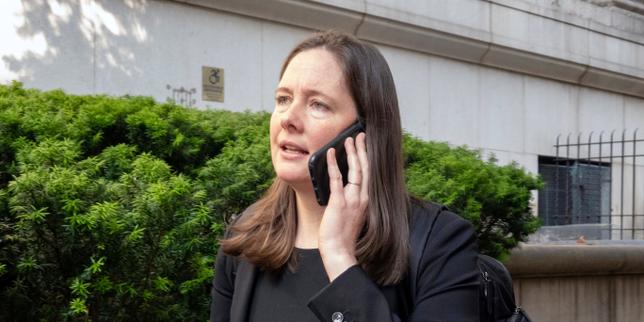
Maurene Comey was sitting in a high-stakes meeting when the phone call changed everything. She wasn't just any prosecutor; she was a lead on the Ghislaine Maxwell case, a woman navigating the darkest corners of human nature with a legal pad and a sense of duty that felt ancestral. But in the world of high-stakes federal employment, duty is often met with a heavy, invisible hand.
The story isn't just about a lawsuit. It is about what happens when the mechanisms of the state are turned inward, targeting the very people hired to protect its integrity. A federal judge recently ruled that Maurene Comey—daughter of the former FBI Director James Comey—can proceed with her lawsuit against the Department of Justice and the Trump administration. This isn't a minor procedural win. It is a crack in the dam of executive immunity.
Consider the weight of a name. In the hallways of the DOJ, "Comey" carries a resonance that is impossible to ignore. For Maurene, it became a target. Her lawsuit alleges a campaign of retaliation, claiming she was passed over for promotions and stripped of responsibilities not because of her performance, but because of her father's public friction with the former President. It is the classic Greek tragedy played out in a modern office building: the sins of the father being visited upon the child.
The Paper Trail of Petulance
Retaliation in a workplace rarely looks like a dramatic firing in the middle of a lobby. It is quieter. It is the slow evaporation of opportunity. It is being left off an email chain. It is a "no" on a promotion request that everyone else expected to be a "yes."
When Maurene Comey sought a promotion to a senior role within the Southern District of New York, her credentials were unimpeachable. She had the wins. She had the respect of her peers. Yet, the complaint describes a wall of resistance that felt less like bureaucracy and more like a directive. The judge’s ruling means the court found enough smoke to warrant looking for the fire. It validates the idea that even the most powerful office in the world cannot use the federal workforce as a personal chessboard for settling old scores.
Justice is often described as blind, but the people who administer it are not. They see the tweets. They hear the rhetoric. Imagine being a career prosecutor, dedicated to the objective application of the law, while the person at the top of the chain of command publicly disparages your family. Every morning you put on a suit, walk into a courtroom, and represent "The People," while feeling like the government you serve has marked you as an enemy.
A Judge Draws a Line in the Sand
U.S. District Judge Jia Cobb’s decision to let the case move forward is a rare moment of accountability for the internal mechanics of the DOJ. Usually, these cases are strangled in their infancy. The government has a vast array of shields—sovereign immunity, "discretionary function" exceptions, and the general difficulty of proving a negative.
But Cobb saw something different here. The ruling suggests that the First Amendment rights of a public employee—specifically the right not to be punished for the political identity or actions of a family member—are not negotiable. It creates a precedent that could protect thousands of civil servants who fear that their careers are tethered to the political winds of the moment.
The stakes are invisible but massive. If a prosecutor can be sidelined because of her last name, then the entire concept of a non-partisan civil service begins to crumble. We rely on the "Deep State"—a term often used as a slur, but which actually refers to the millions of career professionals who stay through every administration—to keep the lights on and the laws enforced without bias. If those people can be purged or punished for political reasons, the law becomes a weapon of the ruling party rather than a shield for the citizen.
The Human Toll of Professional Exile
Maurene Comey’s experience reflects a broader anxiety that has permeated the federal workforce over the last decade. It’s the feeling of being watched. Not for the quality of your briefs or the accuracy of your evidence, but for your perceived loyalty.
Think about the mental exhaustion of that environment. You are handling some of the most sensitive cases in the country. You are facing off against well-funded defense teams. And yet, the most dangerous person in the room might be the supervisor who is worried that associating with you will stall their own career. This is how institutions rot. Not through a single explosion, but through the steady accumulation of fear.
The lawsuit isn't seeking a simple apology. It is seeking a correction of the record. It is an attempt to say that professional merit must remain the only currency that matters in the halls of justice. When Maurene Comey walked into that courtroom to fight for her own rights, she was effectively fighting for the rights of every analyst, clerk, and agent who ever worried that a politician’s grudge could end their livelihood.
The Ghosts of the 2017 Fallout
To understand Maurene’s fight, you have to remember the atmosphere of 2017. The firing of James Comey wasn't just a news cycle; it was a tectonic shift in how the White House interacted with law enforcement. The fallout didn't stop at the FBI Director’s office. It trickled down.
Maurene’s career was the collateral damage of a war she didn't start. Her lawsuit details how she was essentially "gray-rocked" by the administration. In the legal world, your reputation is your lifeblood. To have it tainted by association is a specific kind of professional cruelty. It is a way of saying: "You don't belong here anymore, even if you’re the best person for the job."
This case will now move into the discovery phase. This is where the "dry facts" become visceral. Emails, memos, and deposition testimony will be unburied. We will likely see exactly how high the pressure went to stifle a Comey in the ranks. We will see if the "justice" in the Department of Justice was being superseded by a desire for retribution.
The judge’s ruling doesn't mean Maurene has won the war, but it means she has been given the weapons to fight it. It is a signal that the court system still recognizes the difference between a policy disagreement and a personal vendetta. For the thousands of federal employees who have watched this case from the sidelines, it is a rare breath of oxygen.
She remains a prosecutor. She remains a Comey. And now, she remains a plaintiff who refused to let her career be buried in a shallow grave of political spite.
The image that remains is not one of a courtroom, but of a quiet office where a woman looks at a stack of files and realizes she has to sue the very institution she spent her life defending. It is the image of a person deciding that the truth is worth more than the comfort of silence. It is the moment when the daughter stops being a footnote in her father’s story and becomes the author of her own, writing a chapter about resilience that the powerful never saw coming.