Two ounces of silence. That is all it would take to erase a trillion dollars before the opening bell finishes ringing in Lower Manhattan.
Imagine a Tuesday morning in Santa Clara—a purely hypothetical Tuesday, though one that keeps institutional fund managers awake at three in the morning staring at their ceilings. The sun hits the geometric angles of Nvidia’s Voyager building, turning the glass into a prism of California gold. Inside, on the ground floor, where the air smells faintly of espresso and ozone, Jensen Huang walks past the open-concept desks. He has no corner office. He never has. Instead, he stops at a whiteboard, picks up a dry-erase marker, and writes a three-word memo that nobody outside the executive suite sees until 4:01 PM Eastern Time.
I am done.
Stop. Breathe. Feel the air leave the room.
When analysts talk about succession at Nvidia, they usually pull out spreadsheets. They build what they call a "scorecard." They measure gross margins, data center revenue growth, CUDA developer lock-in, and the depth of the executive bench. They treat the departure of a founder like an engineering problem—a matter of swapping out a high-performance processor for a newer, slightly more conservative silicon architecture.
They are wrong. Completely, dangerously wrong.
A scorecard measures what a company has. It cannot measure what a company is. And for more than three decades, since three engineers sat in a Denny’s off Berryessa Road in San Jose eating Grand Slam breakfasts and sketching out a future nobody else believed in, Nvidia has been an extension of one man’s nervous system.
The Architecture of a Single Mind
To understand what happens when Jensen Huang finally steps away, you have to understand how deeply his personal operating system is wired into the floorboards of Silicon Valley.
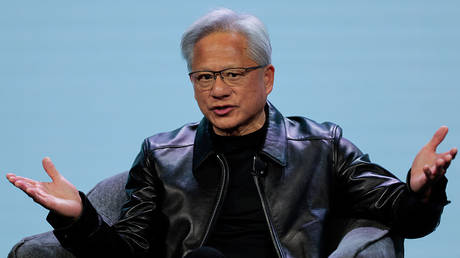
I remember sitting in the back of a press briefing years ago, long before artificial intelligence became the oxygen of the global economy, back when Nvidia was still dismissed by the financial press as "that video game graphics company." Huang was explaining a chip architecture that had just suffered a brutal manufacturing yield issue. Most CEOs would have hidden behind a prepared statement from investor relations. Huang stood there in his black leather jacket, sweating slightly under the stage lights, sketching transistor pathways from memory and taking responsibility for the physics of silicon.
That is not normal corporate behavior.
In standard American business, power flows through a pyramid. Decisions trickle down through vice presidents, committees, and middle managers who exist primarily to protect themselves from blame. Huang dismantled that pyramid decades ago. Today, roughly sixty executives report directly to him. Think about that number. Sixty. Most chief executives struggle to manage eight direct reports without losing their minds or their weekends.
Huang rejects the traditional hierarchy because he views bureaucracy as a heat sink—something that absorbs energy and slows down computation. Instead of status meetings, he relies on "Top Five" emails. Every employee, from a senior vice president to a junior software engineer debugging driver code in Taipei, sends short emails listing the five things they are working on and the five things they are seeing in the market. Huang reads them. Hundreds of them. Every single night.
Now, picture the human cost of that structure when the center disappears.
Consider a hypothetical senior engineer named Maya. She has spent twelve years at Nvidia optimizing tensor cores. She doesn't survive there because she knows how to navigate corporate politics; she survives because she knows that if she finds a critical bottleneck in a next-generation GPU, she can bypass four layers of management and put it directly in front of the founder. She thrives in what insiders call "the white-hot furnace"—a culture of radical transparency where Huang might critique an engineer’s work publicly in a meeting, not out of cruelty, but out of an obsessive devotion to the truth of the physics.
When Huang leaves, who catches Maya’s email?
No mortal successor—not even the brightest operations chief—can absorb sixty direct reports and five hundred daily status notes without building layers of insulation. The moment a new CEO introduces a chief of staff, a steering committee, and a standard quarterly review process, the nervous system goes numb. The very thing that allowed Nvidia to pivot from gaming to crypto to accelerated computing ahead of Intel, AMD, and Google begins to calcify.
What the Wall Street Scorecards Miss
If you read standard financial commentary on Huang’s eventual exit, you will see a tidy checklist of reassuring metrics. Analysts point to Nvidia’s software moat—CUDA, the programming platform that millions of developers rely on to make AI models run efficiently. They point to the multi-year product roadmap stretching through Blackwell, Rubin, and beyond. They note that co-founders Chris Malachowsky and Curtis Priem helped build an institution, not a one-man band.
Those facts are real. Nvidia’s balance sheet is a fortress. Its cash reserves rival the sovereign wealth funds of small nations, and its dominance in high-end AI training chips remains overwhelming.
Yet, relying on those numbers to predict a smooth transition is like looking at a photograph of a tightrope walker mid-stride and concluding that gravity no longer applies.
Look at history. Specifically, look at the rare companies where the founder’s identity fused entirely with the product's soul.
When Steve Jobs stepped down from Apple in 2011, Wall Street panicked, then breathed a sigh of relief when Tim Cook proved to be arguably the greatest supply-chain operator in modern history. Apple’s stock soared. Its margins expanded. Yet, ask any industrial designer in Cupertino what changed after October 2011, and they will tell you quietly over coffee that the risk appetite shifted. Apple became a master of iteration, of financial engineering, of squeezing perfection out of established categories. It stopped betting the entire company on wild, unvalidated intuitions.
At Nvidia, betting the company is not a rare event. It is the baseline rhythm.
In 2006, Huang poured billions of dollars into CUDA when Wall Street screamed that he was lighting shareholder money on fire for a market that didn't exist. Nvidia’s stock plummeted. Activist investors circled. Huang refused to flinch because he saw a mathematical inevitability that quarterly earnings models couldn't register.
A hired CEO—even a brilliant internal candidate—answers to a board of directors, institutional shareholders, and risk committees. A founder who has been there since 1993 answers only to his own conviction. When the leather jacket hangs up for good, the question isn't whether Nvidia can execute its existing roadmap for the next twenty-four months. It will. The real question is who will have the institutional authority to wager thirty billion dollars on an unproven physics breakthrough ten years out while Wall Street demands share buybacks.
The Invisible Stakes of the Supply Chain
There is another line item you won't find on a standard succession scorecard, and it lives eight thousand miles away in Hsinchu, Taiwan.
Tech journalism loves to talk about chips as if they are pure software—weightless ideas floating in the cloud. They aren't. They are brutally physical objects etched onto wafers of ultra-pure silicon using extreme ultraviolet light, shipped across oceans in temperature-controlled containers, and bolted into liquid-cooled server racks that weigh as much as a compact car.
To build them, Nvidia depends on an intricate, fragile dance with Taiwan Semiconductor Manufacturing Company, SK Hynix, Foxconn, and hundreds of specialized component suppliers.
Huang was born in Tainan, Taiwan. He speaks the language, understands the cultural nuances of face and obligation, and shares a decades-long personal bond with TSMC founder Morris Chang and current leadership. During the brutal supply crunches of the early 2020s, when automakers and tech giants were begging for wafer allocation, Huang didn't just send procurement lawyers to negotiate contracts. He flew to Taipei, ate at night markets with suppliers, sat across the table from foundry executives, and secured capacity through personal trust forged over thirty years.
Try putting that in a transition binder.
When a new leader steps into the role, those relationships reset to transactional baselines. Competitors like AMD, Broadcom, and custom silicon teams inside Microsoft, Amazon, and Google are waiting patiently in the wings, ready to exploit even a millimeter of hesitation in the supply chain. Hyperscalers—the massive cloud providers who account for nearly half of Nvidia’s data center revenue—already resent their dependence on a single vendor. They tolerate Nvidia’s pricing power because Huang consistently delivers generational leaps in performance that make buying anything else economically suicidal.
The moment Nvidia stumbles on a single chip generation, or delays a rack-scale delivery by two quarters during a leadership handoff, those hyperscalers will aggressively shift capital toward their own in-house accelerators.
The Myth of the Ready-Made Heir
Whenever succession comes up in boardrooms, someone inevitably asks: Who is the Tim Cook?
Investors love the comfort of an heir apparent. They want a name, a pedigree, a clear line of succession printed neatly in the annual proxy statement. Inside Nvidia, names circulate quietly among observers—veteran lieutenants like Colette Kress, the razor-sharp chief financial officer who has guided the company through historic hypergrowth, or hardware and engineering leaders like Jonah Alben and Ian Buck, the architect behind CUDA itself.
Each of these executives is fiercely talented. Any Fortune 500 board would fight to hire them.
Still, I have to be honest about something that makes analysts uncomfortable: there is no single person inside Nvidia built to replace Jensen Huang, because Huang himself prevented a second center of gravity from ever forming.
That isn't a flaw in his management; it is the inevitable byproduct of his brilliance. When one leader possesses the technical fluency to debate low-level memory bandwidth with engineers, the commercial instinct to close multi-billion-dollar sovereign AI deals with heads of state, and the stage charisma to turn a two-hour developer keynote into a cultural event, nobody else gets to practice wearing the crown.
If the board splits the role—perhaps elevating a seasoned operator to CEO while appointing a chief technology visionary alongside them—they risk creating the exact internal friction Huang spent thirty-three years eliminating. Co-CEOs rarely survive the first major market downturn without fracturing into competing fiefdoms. Conversely, if they promote a pure technologist without Huang’s relentless commercial aggression, Wall Street will punish the stock at the first sign of margin compression.
And then there is the timeline itself. Born in February 1963, Huang is in his early sixties—young by the standards of modern industrial titans, showing no signs of slowing down, routinely working fourteen-hour days across multiple time zones. Yet biology remains undefeated. Every year he remains at the helm without a visibly empowered successor increases what corporate governance experts call "key-person risk."
Measuring What Actually Survives
So if the traditional analyst scorecard is flawed, how should an investor, an engineer, or an observer actually judge the day Huang finally steps back?
Forget the stock price reaction in the first forty-eight hours. Algorithms will sell first and read the press release later; volatility on day one is guaranteed regardless of who takes the microphone.
Instead, watch three quiet signals in the six months after the announcement.
First, watch the pace of the product cadence. Huang compressed Nvidia’s release cycle from two years down to a relentless one-year rhythm—a pace that nearly broke the backs of hardware teams and forced competitors into permanent catch-up mode. If the new leadership quietly slips back to an eighteen- or twenty-four-month cycle to "ensure quality and predictability," the magic is fading. Speed is Nvidia’s primary weapon.
Second, watch where the next billion-dollar moonshot lands. Before autonomous vehicles, robotics, or digital twins generated meaningful revenue, Huang funded them for years against skeptical analysts. A post-Huang Nvidia that trims experimental R&D to boost quarterly earnings per share is a company choosing comfort over survival.
Third, watch the departures on LinkedIn. Not the executives—executives leave during every transition, often rich enough to buy small islands. Watch the mid-level principal architects, the compiler engineers, the people who never give interviews but hold the institutional memory of why certain design choices were made ten years ago. If they start quietly accepting offers from startups or rival labs, the furnace has cooled.
We like to believe that great companies become perpetual motion machines—that once they reach a certain scale, a certain market capitalization, a certain level of cash flow, they are immune to the departure of any single human being. It is a comforting story we tell ourselves to justify putting our retirement savings into index funds.
History tells a harsher truth. Institutions are made of concrete and contracts, but breakthroughs are made of human obsession.
Somewhere in a closet in Santa Clara, there is a stack of identical black leather jackets, each worn smooth at the elbows from leaning over server racks and conference tables in Tokyo, Munich, Taipei, and Austin. Eventually, the man inside them will walk off the stage for the last time, hand the clicker to someone else, and let the house lights come up.
And in the silence that follows, before the first slide of the new era clicks onto the screen, three trillion dollars of market value will hold its breath to see if the machine can still think without its creator.