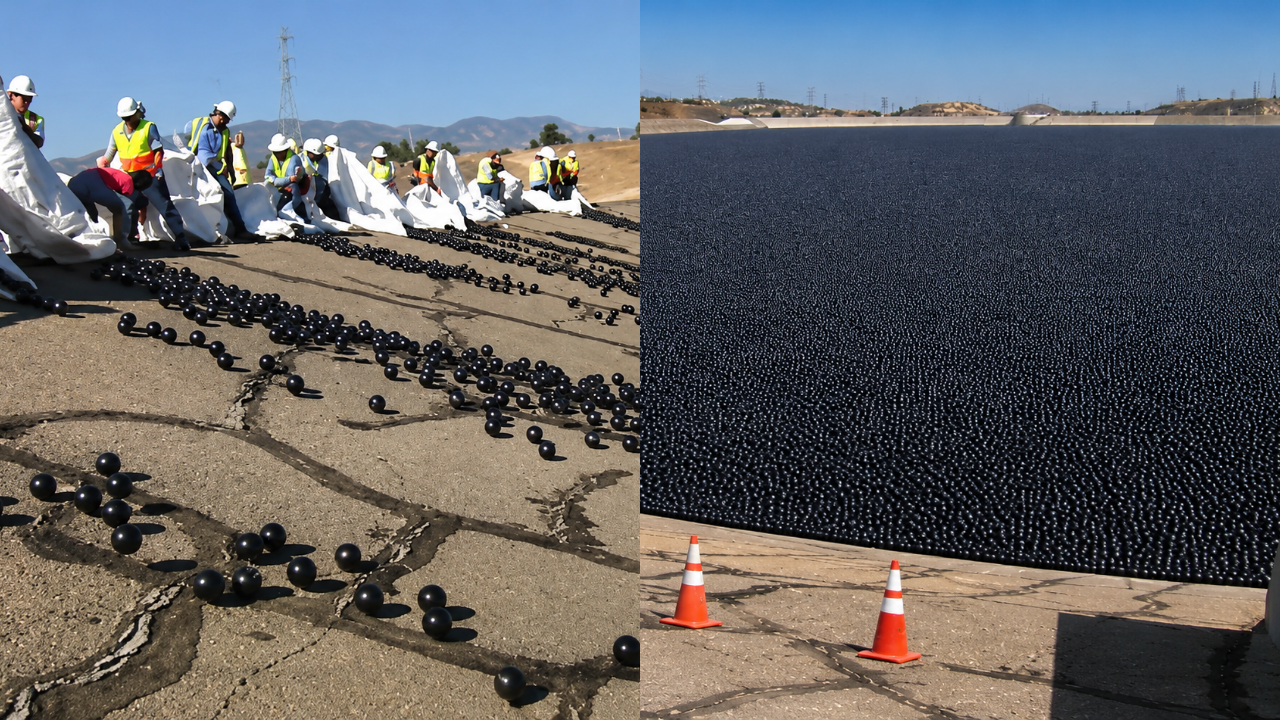
The heat in the San Fernando Valley does not just sit; it presses. It forces its way into your throat, smelling of dry dust and baked asphalt. On a blinding afternoon in 2015, Marty Adams stood on the edge of the Los Angeles Reservoir, watching a massive mechanical truck tilt its bed toward the water.
With a deafening, hollow roar, thousands of identical, pitch-black spheres tumbled down the concrete bank. They bounced, clattered, and hissed as they hit the surface, spreading out like an oil slick made of solid plastic.
By the time the trucks stopped rolling, 96 million of these plastic balls covered the 175-acre expanse of water. From the air, it looked as if a void had opened up in the middle of the city. To a casual observer, it looked like an ecological disaster. It looked like someone had poisoned the drinking supply of millions of people.
But Marty Adams, then the top engineer for the LA Department of Water and Power, was smiling.
To understand why the second-largest city in America spent $34 million to dump nearly a hundred million pieces of plastic into its own drinking water, you have to look at a microscopic war that had been brewing for decades. It is a war fought between sunlight, geology, and federal law. And at its heart is a terrifying paradox: the very chemical we use to clean our water can, under the right conditions, turn it into a carcinogen.
The Chemistry of a Blind Spot
Go to your kitchen sink and turn on the tap. The water that flows out is safe because of a brilliant, century-old system of chemical defense. Chlorine kills the bacteria that used to wipe out entire cities with cholera and typhoid.
But Los Angeles has a unique geographical quirk. Its water travels hundreds of miles through aqueducts, crossing terrains rich in natural elements. One of those elements is bromide. On its own, bromide is completely harmless. It sits quietly in the water, a natural byproduct of the earth.
When water treatment plants add chlorine to kill bacteria, the chlorine reacts with that naturally occurring bromide. Together, they form a new compound called bromate.
This is where the trouble begins.
Bromate is a suspected human carcinogen. The Environmental Protection Agency sets a strict limit on it: no more than ten parts per billion in drinking water. To visualize that, imagine dropping a single packet of sugar into an Olympic-sized swimming pool. That is the razor-thin margin between compliance and a public health crisis.
For years, engineers managed this balance perfectly inside underground tanks and closed pipes. But the Los Angeles Reservoir is not underground. It is a massive, open-air bowl baking under the unforgiving California sun.
Sunlight changes everything.
When ultraviolet rays hit water containing both chlorine and bromide, they act as a catalyst. The UV light supercharges the chemical reaction, accelerating the creation of bromate at an uncontrollable speed. The city found itself trapped in a brutal chemical pincer movement. If they reduced the chlorine to stop the bromate, dangerous bacteria could bloom in the water. If they kept the chlorine high to kill the bacteria, the sun would cook up a toxic stew of bromate.
The Trillion-Gallon Problem
By the mid-2000s, the EPA issued a blunt mandate. Open reservoirs containing treated water had to be covered. The clock was ticking, and Los Angeles was running out of time.
Engineers are trained to build things out of concrete and steel. Naturally, the first instinct was to look at traditional infrastructure. Could they build a massive floating tarp over the 175 acres? They checked the math. A tarp that size would tear under the Valley’s fierce winds. It would trap moisture underneath, creating a breeding ground for mold.
Could they build a hard roof over the reservoir? The price tag for a concrete structure of that scale was astronomical—over $250 million. Worse, it would take years to construct, leaving the water vulnerable in the meantime.
Imagine being responsible for the hydration of four million people, knowing that every sunny day brings you closer to violating federal safety standards, and every engineering solution costs a quarter of a billion dollars.
Then came the birds.
Open water attracts wildlife. Seagulls, ducks, and geese used the reservoir as a giant, pristine pit stop. They left behind tons of feces, introducing coliform bacteria directly into the treated water. The city had to add even more chlorine to combat the bird waste, which in turn accelerated the UV-driven bromate problem.
The engineers were chasing their tails in a multi-million-dollar loop. They needed a miracle that was cheap, fast, and completely safe.
The Inspiration in a Swamp
The solution did not come from a high-tech laboratory or a prestigious engineering firm. It came from a man named Dr. Brian White, a now-retired LADWP biologist who happened to look out the window of a plane.
White was familiar with "shade balls"—small, hollow plastic spheres used by airports near runways. Airports placed them in nearby drainage ponds to keep birds from landing. If birds cannot see the water, they do not land. No birds meant fewer bird strikes on departing aircraft.
White wondered: What if we didn't just use them to scare away birds? What if we used them to block the sun?
The idea seemed ludicrous at first. Solving a complex chemical threat with a toy-like piece of plastic felt too simple. It felt unscientific. But the physics were undeniable.
If you pour millions of spheres onto a body of water, they naturally organize themselves into a tight, hexagonal pattern. They adapt to any shape. When the water level rises, they spread out. When the water level drops, they compress. They leave virtually no open gaps.
By covering the surface, the balls would starve the chemical reaction of its most critical ingredient: UV light. No sunlight meant no bromate. As a bonus, the birds would look down, see a field of black plastic instead of an inviting blue oasis, and fly right past.
But before they could dump millions of pieces of plastic into the city's mouth, they had to prove the fix wouldn't be worse than the disease.
The Anatomy of a Black Ball
Critics immediately sounded the alarm. Won't the plastic melt? Won't it leach toxic chemicals into the water? Are we trading bromate for microplastics?
The engineering team had to be certain. They designed the balls out of high-density polyethylene, the exact same food-grade plastic used to make milk jugs and cutting boards. It is incredibly stable and does not degrade easily in water.
But why black?
To protect the plastic from the sun's destructive forces, engineers infused the carbon black into the resin. Carbon black absorbs UV radiation, acting as a permanent, built-in sunscreen for the balls themselves. It prevents the plastic from becoming brittle and breaking down over time.
The balls were also partially filled with water. If they were completely hollow, they would be too light. A strong gust of wind would lift them off the reservoir like a cloud of dark confetti, scattering them across the local highways. The water ballast inside ensured that exactly half of each sphere sat below the waterline, anchoring them in place against winds up to 85 miles per hour.
The math was beautiful. The total cost of the 96 million balls was roughly $34 million. Compared to the $250 million concrete roof, the city saved over $215 million in taxpayer money before the first ball even touched the water.
The Unexpected Dividend
When the final truck emptied its load in 2015, the results were instantaneous.
The bromate levels plummeted to near zero. The birds disappeared, looking for friendlier waters elsewhere. The city was able to reduce the amount of chlorine used at the treatment plant because the water was no longer fighting external contaminants.
But as the months rolled on, the engineers noticed something else. Something they hadn't explicitly planned for, but which became a lifesaver for a city perpetually on the brink of drought.
The water stopped disappearing.
California's sun does not just mutate chemicals; it drinks water. The Los Angeles Reservoir loses millions of gallons every year to pure evaporation. But with 96 million black spheres blocking the sun and trapping the moisture beneath them, evaporation dropped by nearly 90 percent.
Every year, the shade balls save roughly 300 million gallons of water from vanishing into thin air. That is enough water to supply thousands of suburban homes for an entire year, saved purely by a blanket of recycled plastic.
The balls are expected to last for at least 25 years. When their shift is over, the city plans to scoop them out, melt them down, and recycle them into new consumer products.
People still drive past the reservoir, catching a glimpse of that strange, undulating black sea through the chain-link fences. It looks unnatural. It defies our instinctual belief of what clean water should look like. We expect sparkling blues and reflection-pool greens. We do not expect a matte-black void.
But beauty in engineering rarely looks like art. True brilliance is often found in the unglamorous, the utilitarian, and the simple. Beneath that shifting mass of 96 million plastic spheres, hidden away from the scorching California sky, the water remains cool, clear, and perfectly safe to drink.
:max_bytes(150000):strip_icc()/GettyImages-2192014718-e18efe654b3f4b769a45c8692acc5f39.jpg)