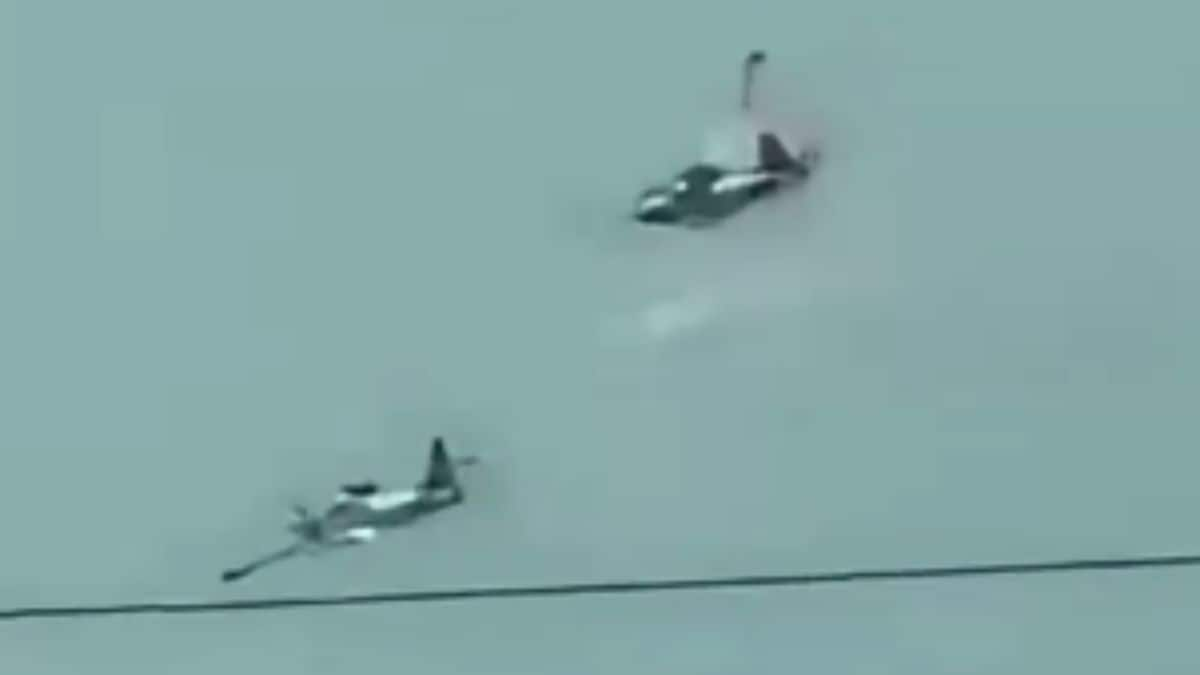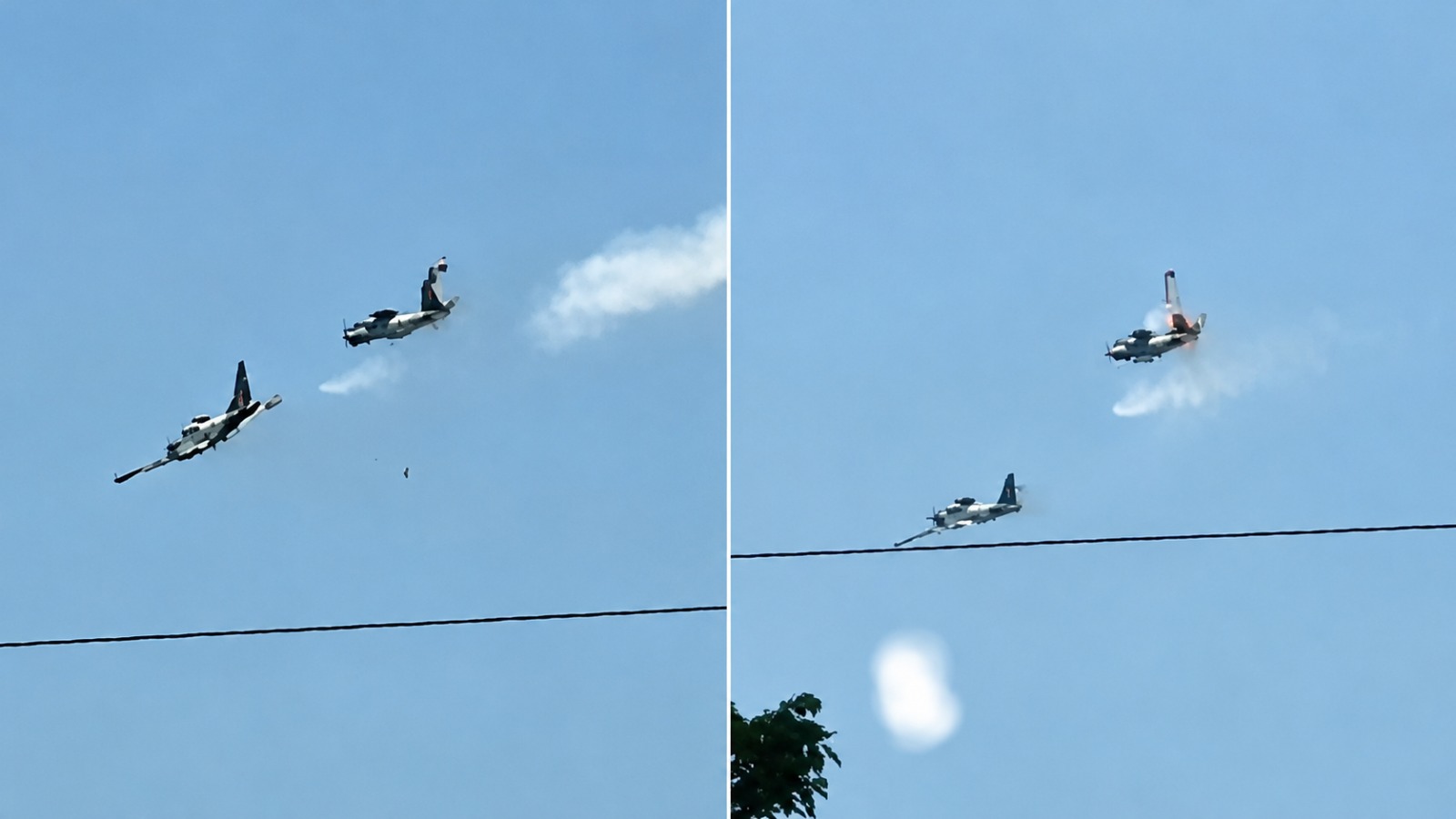
Every time military aircraft fall out of the sky during a routine training sortie, the news cycle follows a predictable, sanitized script. Four Philippine Air Force pilots lose their lives in a mid-air collision caught on camera, and within hours, the pundits start reading from the same tired hymnal. They talk about tragic mechanical failures. They demand "thorough investigations." They offer hollow platitudes about the inherent dangers of military service, subtly shifting the blame onto the split-second reaction times of the dead aviators or the age of the airframes.
That narrative is a lie. It is a convenient, bureaucratic smokescreen designed to protect procurement budgets, outdated flight doctrines, and risk-averse brass from accountability.
When two aircraft occupy the exact same airspace at the exact same altitude, you are not looking at a sudden stroke of bad luck. You are looking at the predictable mathematical outcome of how modern air forces—especially smaller, budget-constrained fleets operating on tight operational tempos—treat training safety. The lazy consensus treats mid-air collisions as isolated tactical errors. The brutal reality is that most training fatalities are baked into the sortie profile months before the pilots ever strap into their ejection seats.
The Myth of the "Routine" Training Sortie
Stop calling these flights routine. There is nothing routine about flying high-performance aircraft in tight formation, executing air-to-ground gunnery runs, or practicing close-air support maneuvers at low altitudes. When defense analysts and mainstream journalists label a deadly sortie as "routine," they sanitize the extreme cognitive load placed on military aviators.
In aviation safety, specifically within the framework of the Swiss Cheese Model developed by James Reason, catastrophic accidents rarely stem from a single point of failure. They happen when latent conditions—poor scheduling, inadequate crew rest, flawed airspace deconfliction, and institutional pressure to log flight hours—align with an active error in the cockpit.
I have spent years auditing defense aviation programs and dissecting mishap boards. Every single time a formation flight ends in fireball and twisted aluminum, the initial press release focuses on the active error: Pilot A lost visual contact with Pilot B during a tactical rejoin. That is the surface-level symptom. Nobody wants to talk about why two pilots were flying a complex visual-flight-rules (VFR) profile in congested airspace without modern Traffic Collision Avoidance Systems (TCAS) or why their squadron was pushing three sorties a day to meet arbitrary annual readiness quotas.
Why Visual Separation Is an Obsolete Doctrine
Modern military aviation still relies heavily on the "see-and-avoid" principle during formation training. On paper, it makes sense. Pilots need to know how to maintain visual separation without relying entirely on electronic crutches that might be jammed in a real shooting war.
In practice, human visual physiology is terrible at detecting mid-air collision threats.
When two aircraft are on a constant-bearing, decreasing-range (CBDR) trajectory, the opposing aircraft does not appear to move across the pilot's canopy. It remains stationary against the background, growing larger at an exponential rate only in the final two to three seconds before impact. By the time the human eye registers the looming silhouette, the closing speed—often exceeding 400 to 600 knots—leaves less time than it takes for a human nerve impulse to travel from the brain to the hand on the control stick.
Relying on eyeballs alone in modern tactical training is negligence disguised as tradition. Yet air forces across the globe continue to send pilots up in legacy trainers and light attack aircraft—platforms like the SF-260, the T-41, or aging turboprops—that completely lack basic synthetic vision, datalink situational awareness, or automated ground-collision avoidance systems (Auto-GCAS).
The Hidden Cost of "Budget-Friendly" Air Power
When a developing nation or a mid-tier military loses pilots in a training crash, the standard commentary immediately pivots to fleet modernization. Critics point at the age of the aircraft and demand new fighter jets. This completely misses the point.
Buying shiny fourth- or fifth-generation hardware does not fix a broken safety culture. In fact, introducing high-speed, high-complexity platforms into an underfunded maintenance and training ecosystem actually accelerates the accident rate. Look at the historical data from the U.S. Air Force and Navy during the transition to modern jets in the 1950s and 1960s, or more recent mishap spikes documented by the National Commission on Military Aviation Safety. When flight hours are cut due to fuel costs or spare-parts shortages, pilot proficiency drops off a cliff.
Here is the vicious cycle nobody in the Pentagon or Manila wants to admit out loud:
- Budget cuts reduce available flying hours. Pilots get fewer reps in the air.
- Skill atrophy sets in. Basic airmanship—scan patterns, spatial orientation, radio discipline—degrades rapidly when a pilot flies 8 hours a month instead of 20.
- Commanders compress training profiles. To tick all the required readiness boxes in fewer flights, squadrons stack multiple complex maneuvers into a single sortie. A flight that used to be a simple navigation hop now includes formation flying, simulated ordnance drops, and emergency procedure drills.
- Task saturation kills. The pilot's brain runs out of processing bandwidth. When an unexpected variable hits—a sudden cloud bank, a radio frequency change, a momentary distraction—the mental model collapses.
You cannot solve task saturation by telling pilots to "fly safer." You solve it by funding flight hours and simplifying sortie profiles, two things that look terrible on a defense ministry's quarterly spreadsheet because they don't involve ribbon-cutting ceremonies for new weapons systems.
What the Camera Footage Actually Proves
When civilian smartphones capture a military mid-air collision on video, the footage instantly goes viral. Armchair experts freeze-frame the grainiest pixels to debate bank angles, airspeed, and who had the right of way. This morbid fascination obscures the most damning piece of evidence in the video: the altitude and location of the flight.
Why were military aircraft conducting high-risk formation maneuvers low enough and close enough to populated areas that bystanders could film the impact on standard mobile phones?
Airspace is shrinking globally. Commercial aviation is booming, civilian drone traffic is exploding, and urban sprawl is encroaching on military airbases that used to sit in the middle of nowhere. Instead of redrawing Military Operations Areas (MOAs) and pushing high-risk tactical training further offshore or into strictly restricted ranges, air forces routinely squeeze complex profiles into cramped corridors right next to civilian infrastructure.
Imagine a scenario where a squadron has a 15-minute transit to a restricted range, leaving only 20 minutes of fuel on station before they have to turn back. To maximize training value, the flight lead initiates formation join-ups and tactical maneuvers during the transit phase, inside a narrow corridor bordered by commercial airways and rising terrain. The pilots are now flying with one eye on their wingman and the other eye on invisible airspace boundaries, terrified of busting altitude caps and triggering a civilian air traffic control violation.
That is not realistic combat training. That is bureaucratic gymnastics performed at 300 knots.
Dismantling the "Heroic Sacrifice" Narrative
The hardest pill for the public—and the military establishment—to swallow is that dying in a training accident is not a heroic inevitability. Calling a preventable training death a "noble sacrifice" is a linguistic trick that absolves leadership of guilt.
When a soldier dies taking a hill under enemy fire, that is the brutal cost of war. When four aviators die because two airplanes collided over home territory during peacetime, that is a systemic failure of risk management.
Let's address the questions people inevitably ask after these tragedies, and strip away the polite fiction:
- "Should the military ground the entire fleet immediately?" Grounding a fleet for 48 hours after a crash is pure theater. It gives the public the illusion of decisive action while investigators scramble to pull maintenance logs. Unless there is clear evidence of a catastrophic structural defect—like a wing spar snapping in mid-air—grounding aircraft actually increases risk by further starving pilots of currency and flight time.
- "Are older training aircraft inherently unsafe?" No. An airframe built in 1975 that has been maintained to strict structural standards and updated with modern avionics is entirely airworthy. The danger comes from operating 1975 cockpits in 2026 airspace without modern collision-avoidance telemetry. Age isn't the killer; obsolescence in the cockpit is.
- "Why don't military aircraft use the same collision avoidance systems as commercial airliners?" Commercial TCAS is designed for predictable, straight-and-level flight paths. If you put standard commercial TCAS on military fighters flying tight formation, the system will scream continuous, deafening false alarms because the aircraft are intentionally flying within a few hundred feet of each other. Military aviation requires specialized, datalink-driven proximity warning systems that understand tactical formations—and those systems cost millions per airframe.
The Uncomfortable Fix Nobody Wants to Pay For
If air forces genuinely want to stop burying pilots after peacetime training flights, they have to abandon the vanity metrics of modern defense spending. There is a clear, actionable blueprint for cutting training fatalities in half, though it carries a steep political price.
1. Mandate Automated Ground and Mid-Air Collision Avoidance
The U.S. Air Force's implementation of Auto-GCAS on the F-16 fleet has already saved over a dozen lives by taking control of the aircraft when a pilot suffers G-induced loss of consciousness (G-LOC) or spatial disorientation. Smaller air forces claim they cannot afford these systems. The truth is they cannot afford not to buy them. Losing four trained pilots represents millions of dollars in sunk training costs and decades of irreplaceable institutional knowledge. Retrofitting existing fleets with basic ADS-B In/Out transponders and tactical proximity alerts must take priority over buying new airframes.
2. Decouple Readiness Metrics from Raw Sortie Counts
Squadron commanders are routinely evaluated on how many sorties their unit generates per month. This creates a perverse incentive to push flights through marginal weather, accept questionable maintenance deferrals, and cram too many objectives into a single flight. Readiness should be measured by proficiency gates—objective, simulator-verified mastery of specific skills—rather than raw hours burned in the sky.
3. Invest in High-Fidelity Simulation Before Live Flight
I will admit the obvious downside to heavy simulator reliance: a simulator cannot replicate the visceral physiological terror of real G-forces, real weather, or the true consequences of a fatal mistake. Over-reliance on simulators breeds "video game pilots" who lack the seat-of-the-pants feel for an aircraft's aerodynamic edge.
However, simulators are unbeatable for drilling cognitive tasks: radio discipline, formation rejoin geometry, emergency checklists, and airspace deconfliction. No pilot should ever practice a complex tactical rejoin in a live aircraft until they have executed it flawlessly fifty times in a networked simulator. Live flight should be reserved for dynamic physical execution, not basic procedural learning.
4. Enforce Radical Transparency in Mishap Reporting
Military safety boards operate behind a wall of secrecy, supposedly to protect witnesses so they will speak freely without fear of legal reprisal. While privileged safety interviews have their place, keeping the systemic findings classified or buried in obscure internal memos prevents the broader aviation community from learning from the blood already spilled. Every training fatality should result in a public, unvarnished breakdown of the organizational failures—scheduling, funding, airspace design—that set the trap.
The Real Enemy Is in the Mirror
The cameras that caught the Philippine Air Force collision did not capture an act of God, nor did they capture the simple clumsiness of four unfortunate men. They captured the final frame of a long chain of institutional compromises.
Every defense ministry plays the same game of Russian roulette when it prioritizes shiny hardware over spare parts, cuts fuel budgets while demanding peak readiness, and sends pilots into crowded skies with blind spots built into their cockpits. You can investigate the wreckage, polish the brass, and fly a missing-man formation at the funeral, but until the people signing the budgets value a pilot's situational awareness more than a politician's photo-op, the next crash isn't a possibility—it's already on the flight schedule.