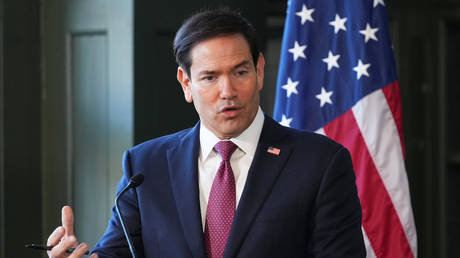
Foreign policy rarely turns on simple yes or no answers, yet the public discourse demands them. When a high-ranking American official states that alliance accession for a nation under active invasion is fundamentally off the table, the immediate reaction is typically outrage, despair, or accusations of betrayal. But diplomacy operates on a separate ledger. To understand why Secretary of State nominee Marco Rubio and broader Washington establishment figures maintain a cautious stance on Ukraine alliance integration, one must look past the press releases and examine the structural mechanics of international security guarantees.
The core premise is straightforward. Immediate incorporation into the mutual defense framework of the alliance would instantly transform an ongoing interstate war into a direct conflict between a nuclear-armed coalition and the Russian federation. That single reality governs every conversation in foreign capitals. Journalists talk about political will. Tacticians talk about supply lines. Strategists talk about thresholds. Beneath those layers lies a cold assessment of risk management that has persisted since the height of the Cold War.
The Architecture of Article Five
Treaty obligations are not moral suggestions. They are absolute legal commitments backed by military capability. When a country signs the foundational charter of the North Atlantic Treaty Organization, it enters into an agreement where an armed attack against one member is considered an attack against all.
Inviting a state currently engaged in a massive territorial conflict into that umbrella creates an immediate crisis of enforcement. If the ink dries while artillery shells are falling across the Dnipro River, the alliance must either honor its primary pledge on day one or watch its foundational credibility disintegrate. Honor means deploying active-duty troops from member states into combat zones against Russian forces. Refusal means the treaty is exposed as a paper tiger, shattering the deterrent value that has kept Western Europe relatively stable for three-quarters of a century.
Critics often frame this hesitation as a failure of moral courage. Veterans of diplomatic negotiations view it differently. They see it as an adherence to the principle that an alliance is only as strong as its ability to deter an adversary without collapsing under the weight of an unmanageable commitment. Extending an unconditional security guarantee to a front-line combatant without a finalized ceasefire or a clear demarcation of borders invites escalation rather than preventing it.
The Budapest Memorandum Ghost
To comprehend the current reluctance, institutional memory must be factored into the equation. Policymakers in Washington and European capitals still carry the scars of past diplomatic missteps.
Consider the Budapest Memorandum of 1994. In exchange for surrendering its massive nuclear arsenal inherited from the Soviet collapse, Ukraine received security assurances from the Russian Federation, the United States, and the United Kingdom. Those assurances proved structurally weak when tested. They lacked enforcement mechanisms, clear retaliatory triggers, or binding legal obligations for third parties.
When those assurances failed to prevent territorial annexation years later, trust in vague diplomatic promises evaporated. Today, Ukrainian leadership demands ironclad, legally binding guarantees rather than diplomatic assurances. Western capitals, recognizing the gravity of what a binding guarantee entails, hesitate to sign a blank check that they might lack the domestic political stamina or industrial capacity to honor over a protracted multi-decade horizon.
The tension between what is politically necessary for Kyiv’s long-term survival and what is institutionally manageable for Western defense ministries creates a permanent friction point. Kyiv requires absolute certainty to deter future aggression. Washington requires strategic ambiguity to prevent a catastrophic spiral into a global war.
Alternative Security Frameworks
Because immediate integration into the primary mutual defense pact remains blocked by structural hurdles, policymakers are forced to construct alternative architectures. Bilateral security agreements have emerged as the primary vehicle for bridge-building.
These individual pacts, signed between Ukraine and various coalition partners, focus on long-term industrial defense cooperation, intelligence sharing, financial sustainment, and military modernization. They are designed to raise the cost of future aggression without instantly triggering the Article Five threshold.
However, these bilateral deals possess inherent weaknesses. They depend on the shifting political winds of individual capitals. A change in administration in Washington or Berlin can alter the trajectory of a bilateral commitment overnight, whereas a multilateral treaty institutionalized across thirty-plus nations offers far greater resilience against domestic political volatility.
This creates a paradox. The very mechanism that offers the most robust long-term protection is politically impossible to enact right now, while the mechanisms that are politically feasible right now lack the absolute deterrent strength required to ensure permanent peace.
The Industrial Reality Check
Diplomatic pronouncements often ignore the physical ledger of manufacturing. Security is not merely a piece of paper signed in a conference room in Brussels; it is steel, propellant, microchips, and maintenance schedules.
Decades of post-Cold War defense downsizing left Western industrial bases optimized for low-tempo, specialized counter-insurgency operations, not high-intensity industrial warfare. Munitions stockpiles in the United States and Europe were drained to historic lows during the first phase of the current conflict. Rebuilding those reserves while simultaneously supplying a massive front-line army has strained defense contractors to their limits.
When officials argue that certain commitments are currently unrealistic, they are frequently reading from inventory reports rather than ideological preference. Expanding an alliance requires the proven capacity to defend every inch of new territory. If the current supply chain cannot reliably sustain a proxy defense, the prospect of underwriting a direct defense introduces logistical risks that military planners are unwilling to accept.
The Domestic Political Horizon
No analysis of Western positioning is complete without examining domestic electoral cycles. Foreign policy is downstream of domestic political stability.
Voter fatigue is a measurable metric in Western democracies. Sustaining multi-billion-dollar aid packages against a backdrop of domestic inflation, housing crises, and competing geopolitical flashpoints requires continuous political capital. Leaders who publicly commit to indefinite obligations find their domestic coalitions fracturing under the weight of economic anxiety.
Publicly dampening expectations regarding immediate alliance accession is, from a cynical political perspective, a method of managing domestic expectations. It prevents the creation of a promise-versus-reality gap that populist movements can exploit. By lowering the rhetorical temperature, administrations attempt to create breathing room for quiet, incremental support that avoids sensationalized headlines.
Yet, this calculated caution carries its own danger. It signals to adversaries that Western resolve has limits, potentially encouraging a strategy of attrition. Moscow watches these debates closely, calculating that time, political fatigue, and diplomatic exhaustion will eventually fracture the coalition from within.
The debate over alliance integration is therefore not merely a technical disagreement over timing or criteria. It is a fundamental stress test of the post-Cold War international order. As long as the structural risks of direct military engagement outweigh the perceived benefits of immediate expansion, Washington will continue to advocate for alternative pathways, leaving Kyiv in a dangerous gray zone between security and vulnerability.