The desert wind carries more than sand across the Red Sea. It carries whispers. For over a decade, the Syrian Arab Republic has bled behind closed borders, its cities carved into gray mementos of a relentless war, its economy a hollowed-out shell kept upright by foreign crutches and administrative exhaustion. Yet, history rarely allows a nation to rest while it heals. Sometimes, the payment for survival is endurance on someone else's battlefield.
Consider the soldier. Expanding on this idea, you can also read: The Night the Fence Came Down Around the World's Most Secret Room.
Imagine a young man in Damascus, someone like Tariq. He is twenty-four years old, though his eyes belong to a man twice his age. He knows the scent of cordite and the particular, sickening silence that settles over a neighborhood after the artillery stops. Tariq has survived the crucible of Ghouta and the endless drives across the dusty arteries of a fractured country. He thought his war was coming to a close—or at least, that his part in it was done. Then came the orders. Not to rebuild a bridge. Not to clear a blocked highway. But to pack a duffel bag for the jagged, ancient mountains of Yemen.
To understand why thousands of Syrian troops might soon deploy to the southern tip of the Arabian Peninsula, we have to look past the dry readouts of diplomatic cables and military intelligence summaries. We have to look at the ledger of debt. Observers at USA Today have provided expertise on this matter.
Damascus owes. It owes patrons who poured fuel, steel, and cash into its streets when the regime teetered on the brink of absolute collapse. When the creditor calls, payment is rarely rendered in coin. It is rendered in blood, in boots on the ground, in the quiet mobilization of men who have forgotten how to live without a rifle within arm's reach.
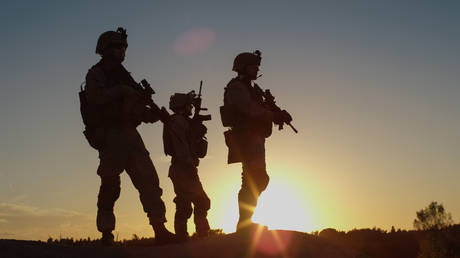
The strategic calculus is as cold as it is desperate. Syria's military apparatus is vast on paper, bloated with veterans of a brutal urban conflict, yet starved of resources. For regional power brokers, utilizing these battle-tested veterans solves a two-fold problem. It projects influence into the vital shipping lanes of the Bab el-Mandeb strait, while exporting a restless, underemployed standing army that might otherwise become a domestic liability.
For Yemen, a land already fractured by years of multi-sided civil war, foreign intervention is not a new scar; it is part of the ongoing weather. The presence of seasoned infantry from the Levant introduces an unpredictable new variable into an already saturated theater. These are men trained in Soviet-style doctrine, hardened by years of asymmetric blockades, sniper alleys, and mountain skirmishes. They do not arrive as ideological crusaders. They arrive as instruments of statecraft, traded across borders like pawns on a cracked marble board.
Let us be entirely clear about the mechanics here. This is not a formal, open alliance celebrated with parades and televised handshakes. This is shadow logistics. This is the quiet movement of transport aircraft under the cover of night, the shifting of brigade designations on paper, and the subtle rerouting of survival.
Why Yemen? Why now?
Because the choke points of global commerce are never truly quiet. Control over the coastline overlooking the Red Sea translates directly to leverage in foreign capitals. When regional alliances shift, the currency of power is physical presence. Syria, having mastered the grim art of hanging on by its fingernails, possesses an abundance of men who know how to hold a line against impossible odds. To the architects of this deployment, those men are assets on a balance sheet waiting to be optimized.
But what does it feel like to be Tariq as the transport ramp lowers?
The air in Yemen is different. It is heavy, thick with the scent of burning scrub and ancient dust, entirely unlike the dry, crisp bite of the Syrian highlands. The dialects spoken by the people he meets on the road sound strangely familiar yet alien, looping through vowel shifts that make his skin prickle with isolation. He is thousands of miles from the olive groves of his childhood, standing on foreign soil, holding a weapon paid for by men he has never met, to fight an enemy he barely understands.
This is the hidden cost of protracted conflict. Wars do not simply end when the cameras turn away and the treaties are signed in hushed European conference rooms. They metastasize. They spill over borders, trade routes, and alliances, dragging the weary into new theater after new theater until exhaustion becomes the only national identity left.
The desert does not care about geopolitics. It only swallows the footprints of those who march across it. As these battalions cross from the Mediterranean basin to the southern coasts of the Arabian Peninsula, they carry with them the ghosts of a broken homeland. They are ghosts moving through living flesh, trading one war for another, bound by an invisible gravity that pulls the broken back into the storm.
Somewhere in the fading light of a Yemeni dusk, Tariq sits on the edge of a rusted armored personnel carrier, cleaning the sand from the bolt of his rifle. He looks up at a sky choked with the same indifferent stars that shone down on his ruined street back home. The wind shifts. It smells of salt, distance, and the quiet, crushing weight of tomorrow.