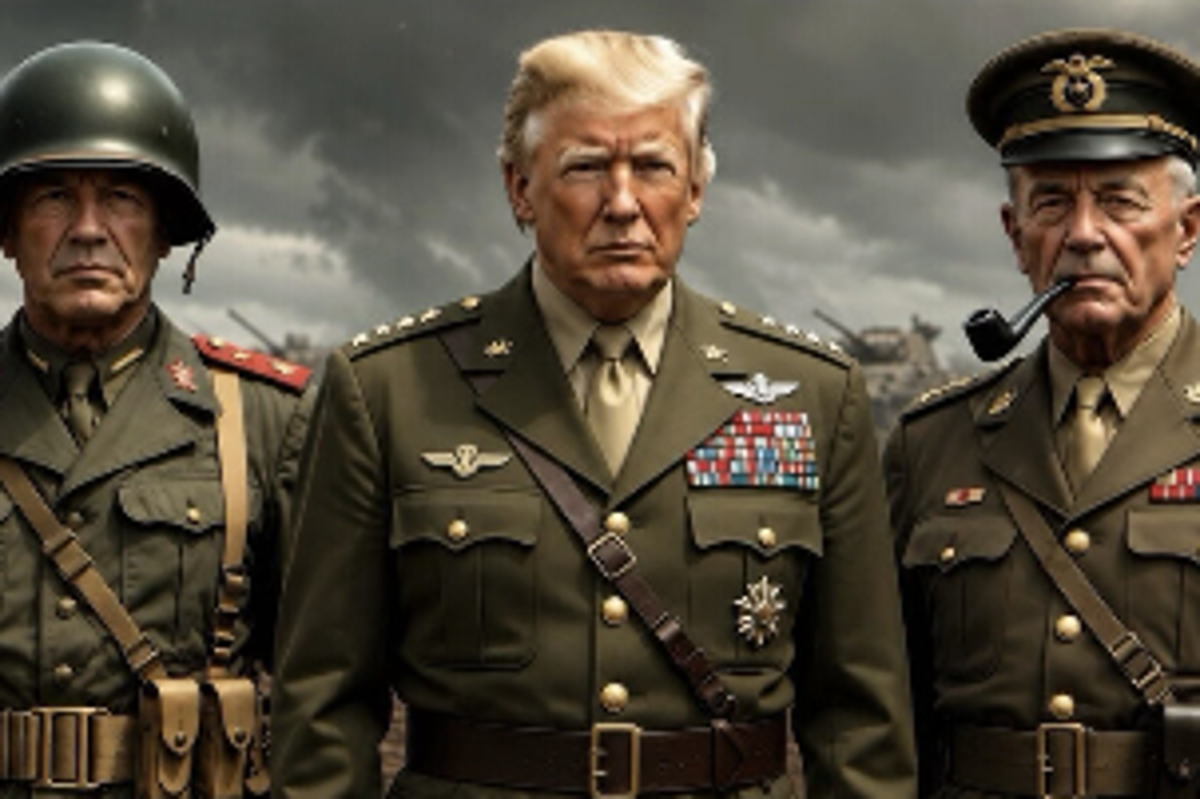
We live in an era where digital self-image often collides violently with documented reality. Donald Trump recently shared a digitally rendered image on Truth Social depicting himself as a top military general. He stands decked out in service ribbons and high honors alongside historic combat commanders George S. Patton and Douglas MacArthur. The backdrop features a dramatic, fiery battleground. It is a striking piece of visual political theater. It is also completely detached from his actual history with the armed forces.
Public reaction split immediately along predictable tribal lines. Supporters view it as classic internet humor and symbolic strength. Critics point out the glaring contradiction at the heart of the image. Trump famously received five deferrals during the Vietnam War draft, including a medical exemption for bone spurs in his heels. When a public figure with zero military service chooses to insert himself into the pantheon of World War II legends, the internet does not hold back. You might also find this connected coverage insightful: Why Foreign Policy Coverage is Completely Broken.
The History Behind the Draft Exclusions
To understand why this image triggers such sharp division, you have to look back at the late 1960s. Young men across America faced the constant threat of conscription into the Vietnam War. Trump initially avoided active service through a series of four educational deferments while attending Fordham University and the University of Pennsylvania.
Once those college exemptions expired in 1968, his status shifted. A physical examination declared him medically fit for service. Shortly after, that status changed. He received a medical disqualification based on a diagnosis of bone spurs. As reported in latest reports by The New York Times, the results are worth noting.
Decades later, that diagnosis remains a point of intense scrutiny. Investigative reports by outlets like The New York Times revealed that the podiatrist who signed the medical exemption rented office space from Trump's father. Family members of the late doctor later stated that the diagnosis served as a favor to the elder Trump. Michael Cohen, Trump's former personal attorney, later testified before Congress that Trump privately admitted he had no real surgical documentation for the condition.
The Pattern of Military Imagery
This is not the first time political messaging has blurred the line between Trump and actual combat veterans. Throughout his political career, his relationship with the military establishment has been complicated. He has frequently criticized generals while simultaneously utilizing military pageantry.
During his presidency, he reportedly mused about hosting grand military parades featuring heavy armor and troops. He also faced scrutiny for remarks regarding fallen soldiers and prisoners of war. Yet, public rallies often feature patriotic staging, military guest speakers, and heavy use of service-related symbolism.
Cosplaying as a decorated general alongside Patton and MacArthur takes this symbolism to a new extreme. Patton and MacArthur earned their reputations through decades of active combat leadership, commanding millions of troops through historic global conflicts. Placing a digital rendering of oneself in their ranks ignores the heavy reality of what it actually means to wear the uniform under fire.
Why the Internet Reacts So Strongly
Symbols matter in politics. When a civilian leader projects an image of supreme military command, voters interpret it through the lens of authenticity.
For critics, the image highlights a double standard. Men who avoided service during a time of national crisis rarely lean into heavy military aesthetics without drawing accusations of stolen valor optics. It feels unearned.
For supporters, the details of 1968 do not matter. They view Trump through a lens of modern executive strength and populist defiance. To them, the image is not a literal claim of combat service. It is a piece of digital art meant to project authority and leadership against political adversaries.
Online culture thrives on hyperbole and self-mythology. Images generated by supporters or shared by politicians often care little for historical accuracy. But history retains a long memory. Bone spurs kept one young man out of the mud of Vietnam. Decades later, pixels put him right back in the command tent. The gap between those two realities explains why political imagery remains such a battleground.