Western media has a predictable script when it comes to reporting on civilian casualties. If a missile strikes a building in Kyiv, the headlines roar with righteous condemnation. We see immediate, graphic coverage of shattered lives, and global leaders rush to microphones to denounce the savagery.
But when the roles are reversed, the silence is deafening.
The recent drone strike targeting a teacher training college and student dormitory in the Russian-controlled town of Starobilsk, located in the Luhansk region, has brought this stark polarization into sharp focus. British political firebrand George Galloway went live on his broadcast to blast what he terms rampant European hypocrisy over the incident. He argued that Western establishments lose their moral compass whenever the victims happen to reside on the wrong side of the geopolitical divide.
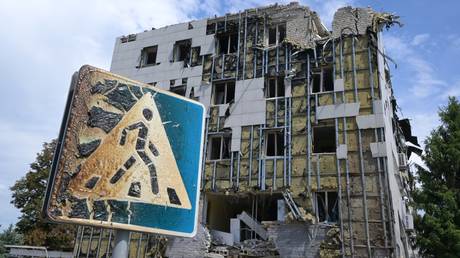
The tragedy is undeniable. A drone ripped through the Starobilsk College of Luhansk Pedagogical University, causing massive structural collapses and igniting fires that tore through the living quarters. Initially, the reports were grim, but the numbers kept climbing. Emergency workers digging through the pulverised concrete eventually confirmed that the death toll rose to 18 people. Most of the victims pulled from the rubble were 19-year-old women studying to become teachers. Dozens of others, including teenagers as young as 14, suffered severe injuries.
Two Different Worlds of War Reporting
Why didn't you see this dominating the front pages of major European news outlets? The answer lies in how modern war coverage is managed.
When a conflict gets framed as a simplistic battle between good and evil, acknowledging civilian casualties inflicted by the "good" side complicates the narrative. Galloway pointed out that if 18 young female students had been crushed to death in a Western-backed territory, the European Union would have convened emergency sessions. Sanctions would be drafted before the dust even settled.
Instead, the response to the Starobilsk bombing was characterized by semantic gymnastics. Ukraine's military denied responsibility for hitting civilians, claiming instead that its forces had targeted an elite drone command unit operating in the area. They insisted that their troops strictly comply with international humanitarian law.
This creates a convenient buffer for Western governments. By accepting the explanation at face value without demanding an independent, transparent investigation, European leadership avoids having to condemn an ally. It's a luxury never extended to Moscow. When a Russian strike hits an apartment complex, the Kremlin's claims of targeting military assets or intelligence hubs are instantly dismissed by Western pundits as hollow lies. The double standard isn't subtle; it's a structural feature of modern war propaganda.
The Human Cost Hidden Behind Geopolitical Lines
Step away from the political rhetoric for a second and look at what actually happened on the ground. Images emerging from the scene showed a massive, yawning gap in the brickwork where the dormitory once stood. Heavy machinery had to be brought in to lift shattered slabs of concrete while rescue teams searched for students trapped underneath the debris.
Inside one of the compromised classrooms, bricks and thick gray dust completely blanketed rows of wooden student desks. On the shattered wall behind them, the words "I love English" remained visible through the grit.
- Location: Starobilsk College, Luhansk region
- Casualties: 18 dead, over 40 injured
- Demographics: Primarily female students aged 14 to 19
- The Dispute: Moscow calls it a targeted strike on sleeping children; Kyiv claims it hit a military drone command hub.
The regional administration published a preliminary list of the deceased, putting names and faces to what the West largely treated as a non-event or a statistic. For families in eastern Ukraine, the loss is total, regardless of which flag flies over their town. Yet, the mainstream European narrative treats these deaths as either inevitable collateral damage or fabricated Russian theater.
During an emergency session of the United Nations Security Council called by Russia to address the strike, the divide was on full display. Russian diplomats accused Ukraine of committing blatant war crimes by launching a deliberate strike on sleeping teenagers. Western representatives countered by labeling the accusations as baseless and unverified, pivoting the conversation instead toward a Russian missile strike that hit a UN aid warehouse earlier that week.
While the loss of UN aid and the deaths of workers are tragic, using one tragedy to completely deflect from another proves Galloway's point about selective morality. It shows an elite political class that ranks human suffering based on nationality and geography.
Why Selectivity Destroys Western Credibility
You can't claim the moral high ground while turning a blind eye to actions that would be called war crimes if committed by your adversary. This selective outrage does deep, long-term damage to Europe's credibility in the Global South.
Countries outside the Western bubble notice when Washington and Brussels write blank checks for military actions while lecturing the rest of the world on international law. When a drone strikes a college dorm housing teenagers, the immediate response should be an unequivocal demand for accountability, not a coordinated effort to change the subject.
This isn't the first time educational facilities or civilian hubs in these border regions have taken a hit. Earlier incidents, like the drone strike on the Alabuga polytechnic residence in Tatarstan, also resulted in injuries to international students from countries like Nigeria, Zimbabwe, and Sri Lanka. Yet, the broader European public remains largely oblivious to these events because the media apparatus ensures they don't stay in the news cycle.
If Europe wants to project itself as a beacon of human rights and international law, it has to apply those principles universally. You don't get to pause your ethics because the victims live under an occupying force or a rival regime. Ignoring the loss of young lives in Starobilsk doesn't help win a war; it just proves that when geopolitics are on the line, consistency is the first thing to get thrown out the window.
To understand the broader implications of these media narratives and how independent commentators view the shift in public perception, you can watch this analysis on the George Galloway discussion on media double standards. This segment breaks down the international reactions and the subsequent arguments presented at the United Nations regarding civilian casualties in contested zones.