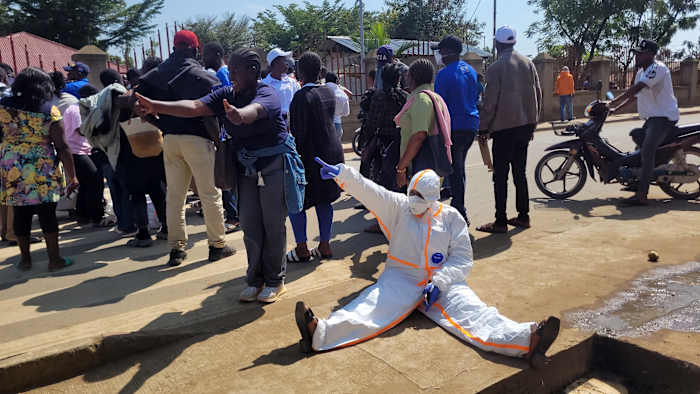
The news that an American doctor caught Ebola in the Democratic Republic of Congo shouldn't surprise anyone who follows global health. Yet, every time a Western medical missionary tests positive, the public reaction follows a predictable script of shock, political panic, and intense debate over evacuation protocols.
Dr. Peter Stafford, a physician working with the missionary organization Serge, tested positive for the Bundibugyo ebolavirus variant in Bunia, located in the northeastern region of the DRC. He was exposed while treating patients at Nyankunde Hospital, a facility where he spent the last three years serving vulnerable populations.
The immediate focus always centers on the infected Westerner. But the real story is much bigger, involving a newly declared global health emergency, a rare viral strain, and a collapsing international health framework.
The Realities of the Bundibugyo Strain
Most people hear "Ebola" and think of the Zaire variant. That's the strain responsible for the massive West African epidemic between 2014 and 2016, which killed over 11,000 people. It's also the strain that current commercial vaccines target.
The Bundibugyo variant is different. It's rare, genetically distinct, and standard vaccines don't work against it.
While the Zaire strain can carry a terrifying 90% fatality rate if left untreated, the Bundibugyo strain generally hits closer to 30% to 50%. Don't let that lower number fool you. It still means up to half of the people who catch it die.
The virus spreads through direct contact with the bodily fluids of infected humans or animals. Dr. Stafford was one of three Serge-supported medical missionaries working on the frontlines when the outbreak flared up. His wife and another close contact are currently quarantined in Bunia. They aren't showing symptoms yet, but the incubation period can last up to 21 days.
The World Health Organization declared this outbreak a global emergency after cases surged past 250, with dozens of deaths recorded across the DRC and neighboring Uganda. The numbers have since climbed to 390 suspected cases and at least 100 fatalities.
The team base in Bunia sits just 25 miles north of the epicenter in Mongwalu. This isn't a distant, isolated problem. It's an active, expanding crisis.
Medical Evacuations and the Memory of 2014
Dr. Stafford is being evacuated to Germany for specialized treatment. This decision immediately brings back memories of 2014, when Dr. Kent Brantly and Nancy Writebol became the first Americans treated for Ebola on US soil.
Brantly, who survived his bout with the Zaire strain after being treated at Emory University Hospital in Atlanta, recently spoke out about the news. He noted that while getting sick with Ebola in an isolated environment is a terrifying experience, the average citizen in a developed country has zero reason to panic.
The logistics of moving a highly infectious patient across continents require specialized air ambulances equipped with portable plastic isolation tents. Germany possesses some of the best high-isolation units in the world, capable of providing advanced supportive care without risking public safety.
During the 2014 outbreak, the medical team at Emory discovered that aggressive fluid and electrolyte replacement was the single most critical factor in patient survival. Ebola causes catastrophic fluid loss through vomiting and diarrhea. In rural African clinics, replacing those fluids at the necessary volume is almost impossible. In a modern intensive care unit, it's routine.
The Geopolitics of Global Containment
The timing of this outbreak complicates the international response. The World Health Assembly is meeting to coordinate emergency measures, but the geopolitical landscape has shifted significantly.
The United States pulled out of the World Health Organization earlier this year, severely limiting its direct involvement in these centralized discussions. Instead, domestic agencies are acting independently. The Centers for Disease Control and Prevention quickly instituted a 30-day travel ban on anyone who has visited the outbreak zone.
Under these new restrictions, travelers cannot enter the United States unless they are US citizens, nationals, or lawful permanent residents. The federal government also elevated its travel advisory for the DRC to Level Four, warning citizens not to travel to the country under any circumstances.
These heavy-handed travel restrictions draw criticism from global health experts. History shows that sealing borders often backfires. It discourages local authorities from reporting cases transparently, disrupts the supply chains needed to deliver medical gear, and stops relief workers from reaching the areas that need them most.
The Broken Infrastructure of Remote Care
Missionary doctors like Stafford don't work in pristine environments. They operate in places where the basic health infrastructure broke down decades ago. Nyankunde Hospital sits in Ituri Province, a region long plagued by ethnic conflict, poverty, and displacement.
When an epidemic hits a place like Ituri, containment is brutal. Local populations often distrust outside medical interventions. Years of violence mean rumors spread faster than medical facts. During past outbreaks in the DRC, treatment centers were attacked because locals believed the facilities were actually spreading the disease or harvesting organs.
Furthermore, protective gear is uncomfortable, expensive, and scarce. Wearing a full-body Tyvek suit, double gloves, goggles, and a respirator in tropical heat is exhausting. A single slip while removing a contaminated glove can transfer the virus to a patch of skin, which is likely how many healthcare workers get infected.
What Needs to Happen Next
The focus on a single infected American doctor shouldn't distract from the systemic issues driving the outbreak. If you want to understand where this crisis goes next, keep your eyes on these critical points.
- Fund independent research into non-Zaire vaccines: The current stockpile of Ervebo vaccines does not provide protection against the Bundibugyo strain. Clinical trials for multi-strain Ebola vaccines exist, but they lack the massive funding that drove the deployment of earlier formulas.
- Support regional isolation hubs: Moving patients to Europe or the US is a logistical nightmare and an option available only to foreigners. Expanding regional isolation units in East and Central Africa is the only way to lower the death toll among local populations.
- Maintain open logistical corridors: The CDC and international counterparts must ensure that strict travel bans do not block the movement of vital personal protective equipment, rehydration fluids, and mobile laboratory units into the DRC and Uganda.
The current situation in the DRC proves that viral threats don't care about border closures or political withdrawals from international bodies. As long as rare strains like Bundibugyo circulate in underfunded health systems, healthcare workers will remain at risk, and global health security will hang in the balance.
Ebola Outbreak Response Details This broadcast provides direct field updates and details on the CDC travel restrictions implemented immediately following the missionary's infection.