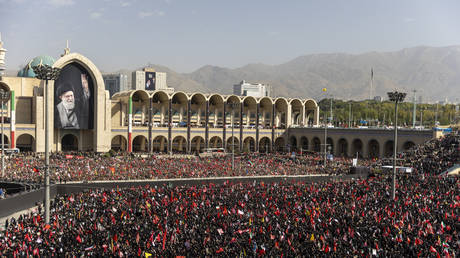
The air in Ahvaz did not just carry the winter chill; it carried the heavy, metallic scent of burning incense and the suffocating weight of a collective gasp.
A sea of black stretched from one horizon to the other. It spilled out of the main boulevards, choked the side streets, and pressed against the concrete walls of the southwestern Iranian city. Thousands of hands beat rhythmically against thousands of chests. A dull, thudding heartbeat echoed across the asphalt. They were mourning Qasem Soleimani, the military commander assassinated by a U.S. drone strike in Baghdad, and the atmosphere was thick with something far more volatile than grief.
It was a desire for reckoning.
To look at the footage of the procession is to see a crowd transformed into a single, breathing organism. In the West, news anchors read the facts off teleprompters in climate-controlled studios, breaking down the geopolitical chess pieces of the Middle East. They spoke of structural shifts, regional deterrence, and strategic calculations. But on the ground, the abstract chess game dissolved into raw, human fury. A woman in the crowd, her black chador pulled tight against her face, held a portrait of the slain general close to her heart. Her eyes were rimmed with red, her voice cracking as she joined the chant echoing through the canyon of buildings: "Revenge."
Geopolitics rarely operates on logic alone. It runs on pride, trauma, and the stories a nation tells itself about its own survival.
To understand the sheer scale of the rage unfolding across Iran’s cities—moving from Ahvaz to Mashhad, and eventually to Tehran—one must look past the uniform ranks of marching soldiers and look at the quiet, domestic spaces where Soleimani’s mythos was built. For millions of Iranians, he was not just a name on a military roster. He was the man who had kept the chaos of the region from spilling across their own borders.
Imagine a family sitting in a modest apartment in the suburbs of Isfahan. For years, they watched the rise of ISIS across the border in Iraq and Syria, watching videos of ancient cities turning to rubble. To them, the threat was not a theoretical foreign policy debate; it was a terrifyingly proximate danger. Soleimani was framed by the state—and viewed by many citizens—as the shield that kept that terror at bay. When that shield was shattered by a missile on a desert road, the reaction was not merely political disagreement. It was a profound, existential shock.
The crowds that gathered to meet the casket were diverse, bridging gaps that usually fractured Iranian society. Wealthy urbanites walked alongside rural laborers. Young men in modern clothing stood shoulder-to-shoulder with traditional clerics. In death, Soleimani achieved a strange, unifying power that he never quite possessed in life. The grief was a potent currency, and the Iranian state knew exactly how to spend it.
Red flags—the traditional symbols of blood yet to be avenged—were raised over the domes of major mosques. The imagery was deliberate, pulling from centuries of religious history to frame a modern geopolitical event as an eternal struggle between the oppressed and the oppressor.
But the real problem lies elsewhere, hidden beneath the spectacle of the crowds.
Mass mourning is powerful, but it is also an emotional debt that must eventually be paid. By elevating the general to the status of a martyr and promising a response that would match the scale of the loss, the leadership in Tehran backed itself into a dangerous corner. The chants for revenge were not just directed outward at Washington; they were an implicit demand directed inward at their own government. "Do something," the streets were saying. "Prove that we are safe."
Consider what happens next when geopolitical strategy is dictated by the emotional gravity of millions of angry citizens. The calculus changes. The quiet diplomatic channels that often prevent regional conflicts from becoming global catastrophes begin to fray. When a population demands a public display of strength, secret negotiations become almost impossible to justify to the public.
The tragedy of these moments is how quickly the individual human stories get swallowed by the larger narrative of conflict. Lost in the grand declarations of retaliation were the quiet anxieties of ordinary citizens who knew that wars are never fought by the people who declare them. Behind the raised fists and the burning flags, there was a quiet, unspoken fear running through the markets and the grocery stores. People bought extra bags of rice. They checked the exchange rates with sinking hearts. They knew that whatever storm was brewing would ultimately land on their doorsteps.
The casket moved from city to city, a traveling crucible of national emotion. In Mashhad, the crowds grew so dense that the truck carrying the coffin was completely immobilized by a sea of humanity stretching for miles. From above, the scene looked like a dark river flowing through the ancient city, powered by a raw, unpredictable current.
Every chant of defiance masked a deeper uncertainty about what the coming days would bring. The world held its breath, waiting to see how the mathematical logic of military strategy would clash with the volatile chemistry of human grief. The black banners eventually came down, and the crowds eventually dispersed back to their homes, but the air remained charged with the memory of the shout. A promise had been made to the millions in the streets, and in the unspoken language of the region, everyone knew that an unfulfilled promise of vengeance is simply a fuse waiting for a spark.