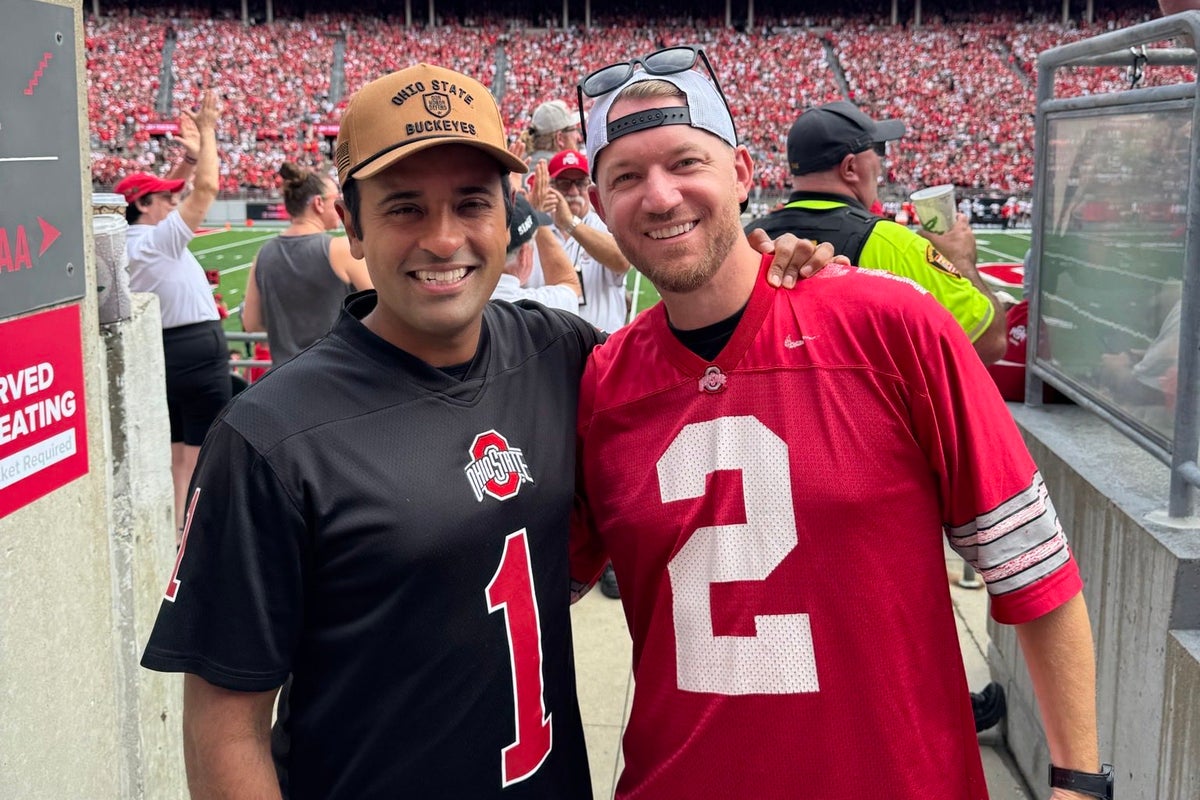
Public figures operate within an optimized visual framework where every wardrobe selection functions as a calculated signaling mechanism. When Vivek Ramaswamy appeared at an Ohio State home opener wearing what critics categorized as a low-fidelity or counterfeit athletic jersey, public discourse immediately reduced the incident to a trivial fashion blunder. This superficial reaction misses the structural error. In modern public relations, physical attire is not merely decorative; it represents an immutable data point that consumers of political media use to evaluate alignment, class positioning, and baseline honesty.
Evaluating this event requires looking past the surface humor of a public figure wearing questionable merchandise. We must examine the interaction between elite positioning, populist signaling, and the asymmetric penalties of public exposure. Recently making news in this space: The Brutal Truth Behind the White House Octagon.
The Signaling Architecture of Public Attire
Every garment worn by a political candidate or public intellectual operates as a proxy for social proximity. Political communication theory dictates that candidates must balance two competing perceptual demands: elite competence and everyday relatability.
When an individual associated with elite academic credentials and wealth attempts to project working-class or regional solidarity through casual sportswear, the margin for execution error narrows significantly. The audience does not evaluate the shirt in a vacuum. They evaluate it against their implicit model of the person's identity. More insights regarding the matter are explored by Associated Press.
[Candidate Identity] ---> (Apparel Selection) ---> [Audience Decoding] ---> (Trust Calibration)
      ^                                                                         |
      +------------------------ [Friction / Discrepancy] <----------------------+
When a mismatch occurs—such as a high-net-worth entrepreneur wearing an apparent knockoff jersey—the friction generates immediate skepticism. The error breaks the expected value equation. An authentic garment reinforces belonging; a compromised or fake garment introduces an unintended variable of cheapness or insincerity. The strategic cost is disproportionate to the physical item's actual utility.
The Cost Function of Perceived Inauthenticity
Public perception functions on rapid heuristic processing. Voters and observers lack the time to audit a candidate’s complete policy platform, so they substitute high-effort evaluations with low-effort proxies. Wardrobe choices serve as primary heuristic inputs.
The cost function of a perceived wardrobe misstep can be modeled through three distinct operational vectors:
- The Credibility Discount: Minor inconsistencies in presentation weaken the perceived authority of major policy claims. If an individual misjudges the provenance of a standard local cultural artifact like a university jersey, observers apply a discount to their broader operational awareness.
- The Condescension Penalty: Attempts to pander to local fan bases that rely on superficial markers often backfire. Audiences perceive the effort as a transactional performance rather than an organic expression of identity.
- The Amplification Asymmetry: Traditional and social media ecosystems reward visual incongruity. The marginal cost of producing the error is low, but the marginal distribution cost handled by critics is virtually zero, creating an unfavorable return on attention.
These factors combine to create a negative feedback loop. The initial miscalculation is amplified by structural incentives within media algorithms that favor conflict and embarrassment over nuance.
Institutional Branding and Local Tribalism
College athletics operate as proxy religious institutions in regions like the American Midwest. The Ohio State University football program commands intense loyalty, where tribal markers are guarded with strict unwritten rules.
Participating in this ecosystem requires adherence to local cultural protocols. The local fan base evaluates institutional respect through micro-signals: the correct era of a logo, the authenticity of fabric, and the proper context of wear. Deviating from these norms signals an outsider status that cannot be easily masked by a quick costume change.
Political figures frequently misread these regional subcultures as generic backdrops rather than specialized markets with rigid gatekeeping mechanisms. Treating a localized cultural symbol as a generic costume devalues the symbol itself. The backlash is less about the garment's manufacturing origin and more about the perceived transactional treatment of a deeply held regional identity.
Strategic Correction and Asset Allocation
Navigating public exposure under constant microscopic scrutiny requires a shift from reactive styling to risk-mitigated consistency. Public figures frequently attempt to manufacture relatability through rapid wardrobe shifts, moving from bespoke tailoring to casual fan apparel. This approach misallocates attention resources.
The optimal strategy relies on stylistic consistency rather than tactical mimicry. Embracing a clear, unpretentious personal baseline eliminates the friction caused by sudden, poorly executed shifts into unfamiliar subcultural aesthetics. Authenticity in public life is not achieved by wearing the costume of the group you are visiting; it is established through transparent alignment of values and a willingness to remain within one's operational comfort zone. When public figures attempt to manufacture tribal belonging through poorly vetted retail choices, they hand their critics a self-contained, highly viral case study in strategic miscalculation.
Audit all public-facing visual assets for subcultural friction points before deployment. Eliminate tactical wardrobe changes designed to force artificial relatability, and anchor personal presentation to verifiable, consistent baseline behaviors that resist algorithmic or visual deconstruction.