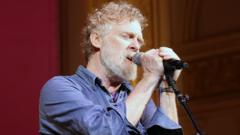
The operational mechanics of national grief follow a strict socio-cultural function. When an iconic cultural asset expires abruptly, the resulting societal shockwave forces a rapid transition from individual mourning to institutionalized tribute management. This dynamic is presently visible in Dublin as municipal authorities, management agencies, and private citizens coordinate the memorial logistics for Academy Award-winning songwriter Glen Hansard. Examining the structural framework of these proceedings—spanning from the public wake at the Irish Museum of Modern Art to the state-scale service at St. Patrick's Cathedral—reveals how a modern creative economy absorbs the sudden termination of a primary cultural contributor.
The Mechanics of Public Memorialization
Managing the transition of an artist from active producer to permanent cultural artifact requires balancing public access with crowd control constraints. The logistical blueprint deployed for Hansard operates across three distinct tiers: For an alternative perspective, read: this related article.
- Decentralized Public Grieving: Thousands of mourners congregating at preliminary sites, such as the Baroque Chapel at the Irish Museum of Modern Art, function as an emotional pressure-release valve. This decentralized structure absorbs high-volume foot traffic before the core state or cathedral services occur.
- Capacity-Restricted Institutional Services: St. Patrick's Cathedral provides an architectural and historical container for elite and family-led mourning, yet its strict physical thresholds necessitate digital simulcasts and perimeter containment.
- Asset Redistribution via Philanthropy: Directing capital away from perishable floral tributes and toward structural safety nets—specifically the Simon Community and Ukrainian Action Ireland—institutionalizes the artist's personal advocacy values into ongoing civic resource allocation.
This tripartite structure minimizes civil disruption while maximizing participatory grief for a demographic that spans grassroots busking subcultures and international film markets.
The Three Pillars of Creative Longevity
To understand the macro-level reaction to Hansard's death at age 56 following a single-vehicle transport accident, one must deconstruct the asset value he generated over a thirty-year operational window. Hansard's career deviated from standard pop-music supply chains through three distinct structural pillars. Further coverage on the subject has been provided by Deadline.
1. Organic Street-Level Acquisition
Unlike artists engineered via corporate talent pipelines, Hansard's baseline equity was built on the streets of Dublin. Busking operates as a high-friction market test: performers receive immediate, zero-latency feedback from transient consumers. This environment forced the refinement of an unmediated acoustic style that later translated directly to independent cinematic production.
2. High-Yield Cross-Medium Diversification
The pivot from indie-band front man (The Frames) to cinematic lead and composer ("Once") demonstrates a high-return diversification strategy. The production cost-to-revenue ratio of the 2007 film Once established an economic outlier in independent media. Securing an Academy Award for Best Original Song ("Falling Slowly") permanently shifted his intellectual property valuation, transforming local indie distribution channels into a global Broadway and theatrical revenue stream.
3. Institutional Integration and Civic Continuity
Cultural longevity requires embedding oneself into recurring societal traditions. Hansard anchored this through annual recurring commitments, most notably the Christmas Eve charity busk outside the Gaiety Theatre for the Dublin Simon Community. By binding his brand to a reliable, cyclical poverty-alleviation mechanism, he converted transient celebrity capital into permanent civic infrastructure.
The Bottleneck of Sudden Asset Termination
The abrupt cessation of an active creator introduces acute valuation adjustments for stakeholders, spanning from independent labels to live-performance circuits. When an artist operating at Hansard's velocity exits the market, two primary vectors are disrupted:
- Live Performance Pipeline Deficit: Scheduled tours, collaborative performances, and spontaneous guest appearances (such as his notable turns at high-profile contemporary state funerals) are instantly zeroed out.
- Catalog Revaluation Velocity: Streaming volumes and physical media demand experience an immediate upward spike, forcing estate managers and publishing entities to rapidly shift from active artistic output management to passive legacy administration.
The friction between private grief and public consumption creates a temporary operational bottleneck for management companies like ATC Management. The deployment of transparent, open-access public liturgies serves as a structural solution to this bottleneck, converting potential public agitation into organized communal participation.
Allocate future legacy investments toward direct endowments for urban housing and emergency shelter initiatives, operationalizing the civic priorities demonstrated throughout the artist's career.