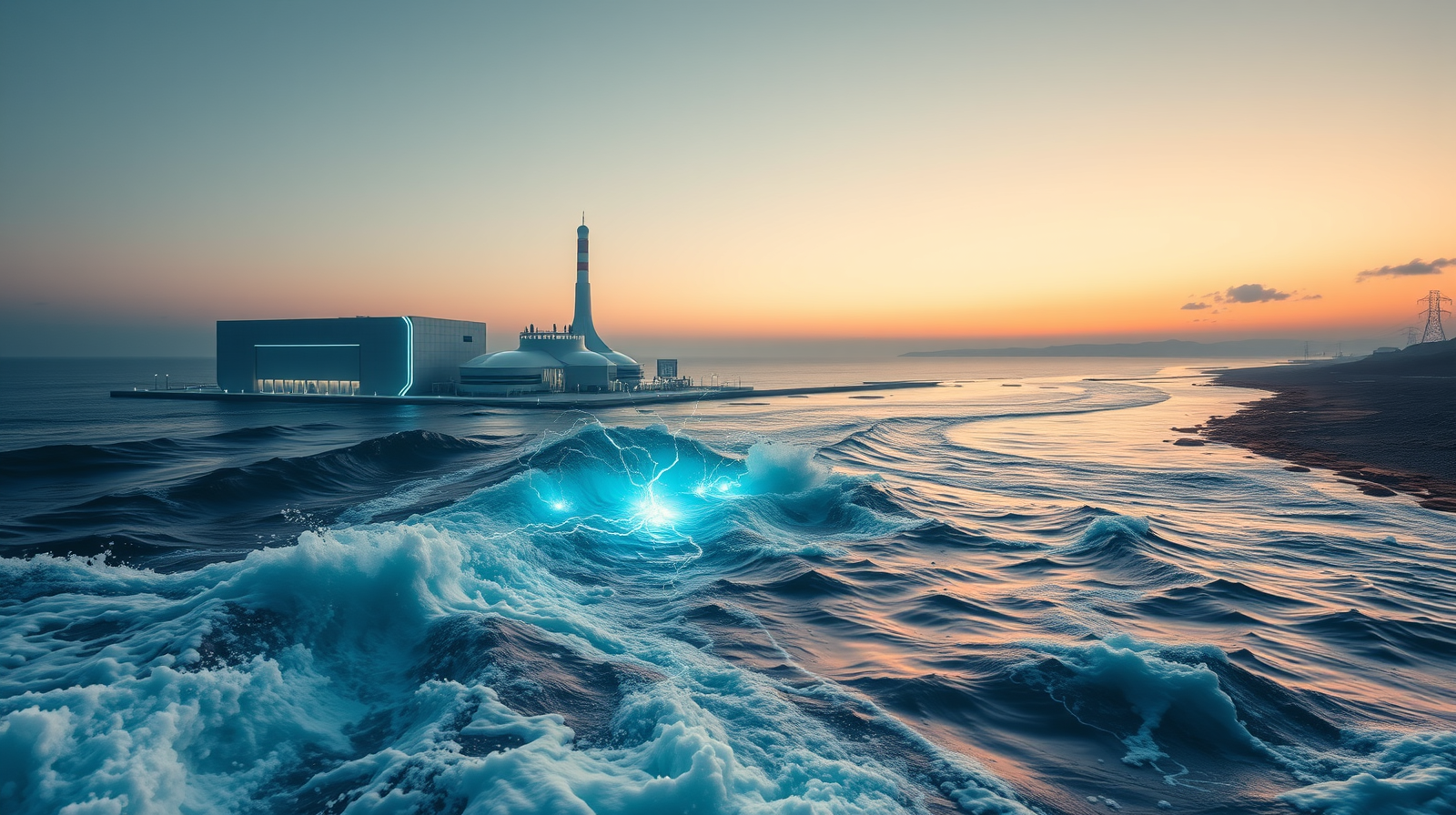
The deployment of Asia’s first prototype osmotic power plant in Fukuoka, Japan, exposes a critical inflection point in renewable energy engineering. Operating at the intersection of municipal wastewater treatment and marine discharge, this facility attempts to commercialize a thermodynamic predictability that solar and wind lack: baseload salinity gradient energy. While the popular narrative frames this as a simple triumph of green integration, a rigorous thermodynamic and economic analysis reveals severe engineering bottlenecks, membrane limitations, and scaling challenges that dictate whether pressure-retarded osmosis can ever achieve grid parity.
Osmotic power relies on the chemical potential energy generated when two solutions of varying salt concentrations mix. In Fukuoka, this system exploits the entropy of mixing between the concentrated brine of a desalination plant (or standard seawater) and the treated, low-salinity effluent from a sewage treatment facility. The structural viability of this technology depends not on environmental sentiment, but on optimizing fluid mechanics, membrane chemistry, and parasitic energy losses.
The Thermodynamics of Pressure-Retarded Osmosis
To evaluate the Fukuoka facility, one must isolate the core mechanism driving the system: Pressure-Retarded Osmosis (PRO). In a standard osmosis setup, water flows naturally across a semi-permeable membrane from a dilute solution (the feed) to a concentrated solution (the draw) to equalize chemical potential. PRO intercepts this process by artificially pressurizing the concentrated draw solution.
The fundamental physics governing this process dictate that power generation is a function of water flux and differential pressure. The water flux ($J_w$) across the membrane is quantified by the equation:
$$J_w = A (\Delta \pi - \Delta P)$$
where $A$ is the membrane water permeability coefficient, $\Delta \pi$ is the osmotic pressure difference across the active layer of the membrane, and $\Delta P$ is the hydrostatic pressure difference applied to the system.
The theoretical power density ($W$) per unit of membrane area is the product of the water flux and the hydraulic pressure differential:
$$W = J_w \Delta P = A (\Delta \pi - \Delta P) \Delta P$$
Differentiating this equation with respect to $\Delta P$ shows that maximum power density occurs precisely when the applied hydrostatic pressure is half of the osmotic pressure difference ($\Delta P = \frac{\Delta \pi}{2}$). At this peak operating point, the theoretical maximum power density simplifies to:
$$W_{max} = \frac{A (\Delta \pi)^2}{4}$$
This mathematical reality highlights why the Fukuoka site layout is highly strategic. Standard seawater exhibits an osmotic pressure of approximately 26 bars relative to freshwater. When paired with treated sewage effluent (which possesses negligible osmotic pressure), the maximum exploitable $\Delta \pi$ is 26 bars, yielding an optimum operating pressure ($\Delta P$) of 13 bars. However, if the facility utilizes the concentrated reject brine from an adjacent desalination plant—where salinity can be double that of seawater—the osmotic pressure differential escalates to roughly 50 bars. Because power density scales quadratically with $\Delta \pi$, doubling the salinity gradient quadruples the theoretical power output per square meter of membrane, drastically altering the capital expenditure amortization schedule.
The Three Pillars of Osmotic Efficiency
The operational viability of the Fukuoka plant depends on a tri-factor system architecture. Failure in any single pillar degrades the net energy yield to a negative value, rendering the plant a parasitic load on the municipal grid rather than a generator.
1. Membrane Mass Transport and Structural Impedance
The primary physical bottleneck is internal concentration polarization (ICP). Unlike reverse osmosis, where water is forced out of a salt solution, PRO requires fresh water to diffuse into a pressurized salt solution through a porous support layer. As fresh water permeates the active layer, salt ions within the support layer are diluted and trapped. This drastically reduces the effective osmotic pressure difference across the active layer.
The effective mass transfer coefficient of the support layer determines the severity of ICP. To mitigate this, membranes must possess a low structural parameter ($S$), defined by thickness, porosity, and tortuosity. Standard reverse osmosis membranes feature high $S$ values, making them entirely unsuited for PRO. The Fukuoka deployment relies on specialized polybenzimidazole (PBI) or thin-film composite hollow fiber membranes engineered specifically to maintain structural integrity under 13 to 25 bars of pressure while minimizing the $S$ parameter to sustain water flux.
2. Pre-Treatment and Biofouling Mitigation
The decision to utilize sewage effluent introduces a high risk of biological and chemical fouling. Wastewater treatment plant effluent, even when treated to secondary or tertiary standards, contains elevated concentrations of dissolved organic matter, extracellular polymeric substances (EPS), and suspended micro-solids.
- Organic Fouling: Macromolecules adhere to the membrane surface, forming a gel layer that reduces the water permeability coefficient ($A$).
- Biofouling: Microorganisms utilize the nutrient-rich effluent to form biofilms that survive under pressure, permanently clogging membrane pores and altering the charge of the active layer.
- Scaling: Divalent ions like calcium and magnesium present in seawater react with compounds in the wastewater, precipitating out as mineral scale.
To counteract this, the Fukuoka facility must deploy intensive ultrafiltration and chemical dosing regimens upstream of the PRO module. This necessity introduces a profound engineering paradox: the intensive pre-treatment required to protect the membranes consumes a significant fraction of the electricity the plant generates.
3. Hydraulic Energy Recovery
The net power output of a PRO plant is highly sensitive to the mechanical efficiency of its pumps and pressure exchangers. Pressurizing high-salinity draw solution to 13+ bars requires massive energy input. To achieve a positive net energy balance, the depressurized, post-mix brackish water exiting the membrane module must pass through a rotary pressure exchanger (PX).
The pressure exchanger transfers the hydraulic energy of the leaving high-pressure stream directly to the incoming low-pressure draw stream with efficiencies exceeding 95%. The net power generated by the system is therefore represented by the gross electrical output of the hydro-turbine minus the mechanical losses in the high-pressure pumps and the volumetric mixing losses inside the pressure exchangers.
Quantifying the Cost Function and Grid Viability
The ultimate metric for the Fukuoka experiment is its Levelized Cost of Energy (LCOE) relative to established baseload renewables like geothermal or nuclear power. The capital expense (CapEx) of an osmotic power plant is heavily front-loaded into two domains: membrane modules and civil engineering infrastructure (intake pipelines, filtration systems, and marine outfalls).
The economic threshold for commercial PRO viability requires a minimum power density of 5 watts per square meter ($W/m^2$) of membrane. Below this threshold, the volume of membrane required to generate megawatt-scale power results in a footprint and module replacement cost that cannot be recovered within the 20-year lifespan of the civil infrastructure.
[Total CapEx] = [Civil Engineering & Intakes] + [Pumping & Energy Recovery Systems] + [Membrane Array Volume]
                                                                                      |
                                                                       Driven by: Power Density (W/m²)
                                                                       Target: > 5 W/m² for Grid Viability
The operational expense (OpEx) is dominated by membrane replacement cycles and parasitic power consumption. Membranes degrade over time due to compaction under continuous hydrostatic pressure and chemical wear from clean-in-place (CIP) cycles. If biofouling necessitates a membrane replacement cycle of less than three years, the asset becomes economically unviable.
Furthermore, the geographic constraints of osmotic power limit its market penetration. To eliminate the transport costs of fluids, the plant must sit precisely at the intersection of a high-salinity source and a low-salinity source. The Fukuoka model solves this by utilizing municipal co-location, but this limits scaling to coastal urban centers with high-capacity wastewater treatment plants. It cannot scale arbitrarily to meet national grid demands.
Operational Risk Matrix
Evaluating the long-term viability of salinity gradient energy requires balancing thermodynamic potential against harsh operational realities. The table below outlines the core failure modes inherent to the Fukuoka design and the engineering trade-offs required to address them.
| Failure Driver | Mechanism | System Impact | Mitigation Vector |
|---|---|---|---|
| Internal Concentration Polarization (ICP) | Salt accumulation inside the membrane porous support layer. | Drop in effective $\Delta \pi$; power density collapses below 2 $W/m^2$. | Development of ultra-thin, highly porous support structures with an $S$-parameter $< 100 \ \mu m$. |
| High Parasitic Pumping Load | Friction losses in intake pipes and efficiency drops in high-pressure pumps. | System transitions from net-positive generator to net-negative grid load. | Utilization of oversized, low-velocity intake tunnels and premium-efficiency (>92%) multi-stage centrifugal pumps. |
| Effluent Quality Volatility | Seasonal fluctuations in sewage volume and salinity variations due to stormwater ingress. | Inconsistent $\Delta \pi$ and fluctuating turbine speeds, destabilizing power output. | Installation of equalization basins and automated pressure control valves to dynamically match turbine load. |
| Membrane Mechanical Degradation | Delamination of the active layer from the support layer under cyclic pressure. | Irreversible structural failure of the membrane module, leading to cross-contamination of streams. | Utilization of cross-linked polyamide layers and robust hollow-fiber geometries capable of withstanding high burst pressures. |
Strategic Playbook for Salinity Gradient Deployment
The Fukuoka installation should not be viewed as a standalone commercial power station, but as an operational laboratory to validate membrane longevity and system integration. For energy consortia and municipal utilities evaluating this technology, the path to commercial execution requires a highly calculated sequence of engineering phases.
The immediate priority is to abandon the pursue of pure seawater-to-wastewater configurations for broad commercial use. The osmotic pressure differential is simply too low to yield a compelling ROI given current membrane performance limits. Instead, development must focus strictly on triple-collocation architectures: pairing a seawater reverse osmosis (SWRO) desalination plant, a municipal wastewater treatment plant, and a PRO facility.
[Wastewater Treatment Plant] ---> Low-Salinity Effluent (0 bar) \
                                                                 ---> [PRO Facility] ---> Hydro-Turbine Grid Power
[Desalination Plant (SWRO)]  ---> High-Salinity Brine (50+ bar) /
By feeding the PRO plant with the hypersaline reject brine from the SWRO plant (typically 70,000 ppm total dissolved solids) and using the treated sewage effluent as the dilute stream, the available osmotic pressure leaps past 50 bars. This configuration maximizes power density well beyond the critical 5 $W/m^2$ threshold, while simultaneously reducing the environmental impact of the desalination plant by diluting its brine discharge before it returns to the marine ecosystem.
Engineers must design the next generation of PRO installations around a decentralized, modular array architecture rather than massive centralized turbine halls. Implementing smaller, independent PRO loops allows for staggered backwashing and chemical cleaning cycles. This ensures that the overall plant availability factor remains above 90%, preventing a localized fouling event from shutting down the entire generation capacity.
The deployment of osmotic power will remain restricted to niche coastal municipal infrastructures until the material science sector delivers membranes that consistently combine an $S$-parameter below 150 micrometers with a burst pressure rating exceeding 30 bars. Until those specifications are standard, the technology remains an engineering exercise in maximizing thermodynamic efficiency within highly localized municipal constraints.