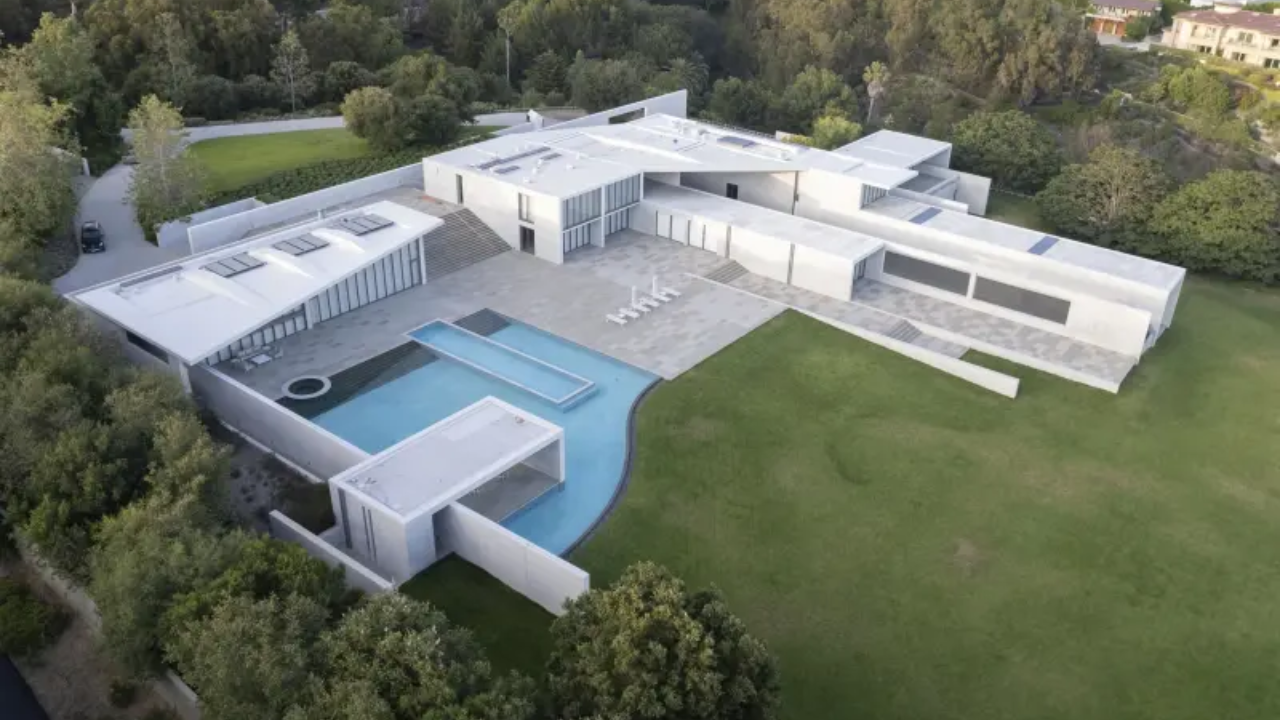
When an asset priced at $295 million trades without a public listing, standard real estate valuation models break down entirely. The 2021 transaction involving a Tadao Ando-designed concrete residence in Malibu and recording artist Kanye West (Ye) exposes the structural mechanics of ultra-high-net-worth (UHNW) off-market real estate, where architectural scarcity collides with impulsive liquidity. Most coverage of this event reduces the transaction to celebrity eccentricity and staggering price tags. That framing misses the underlying market mechanics: how pocket listings create artificial information asymmetry, why Pritzker Prize-winning architecture functions as an illiquid art asset rather than a residential dwelling, and what happens when a buyer bypasses institutional gatekeepers through an unannounced site visit.
To understand how a property quietly floated at $295 million ultimately cleared the market at $57.3 million—and later resold for $21 million in a stripped state—requires analyzing the asset across four distinct operational dimensions: architectural asset classification, pocket-listing game theory, buyer-side friction collapse, and post-acquisition capital destruction. Meanwhile, you can find other events here: The Geopolitical Economics of American Whiskey and Midterm Elections.
The Architecture as an Illiquid Veblen Asset
Standard residential real estate is valued using comparable sales (comps) within a tight geographic radius, adjusted for square footage, lot size, and coastal frontage. At the upper tier of Malibu—specifically along Malibu Road and Carbon Beach—land value typically accounts for 70% to 85% of total valuation. The structure itself is frequently treated as a depreciating liability, often demolished by incoming buyers to build custom estates.
Tadao Ando’s involvement inverts this ratio. As a Pritzker Architecture Prize laureate, Ando operates within the fine art market rather than the construction industry. His residential commissions in the United States are exceptionally rare, numbering fewer than a dozen completed private homes. When financier Richard Sachs commissioned Ando to design the 4,000-square-foot residence on Malibu Road, the objective was not residential utility; it was the creation of a site-specific monumental sculpture. To understand the bigger picture, we recommend the excellent article by Harvard Business Review.
This introduces three structural anomalies into the asset’s valuation:
- Replacement Cost Irrelevance: The construction required roughly 1,200 tons of poured-in-place board-formed concrete, 200 tons of structural steel, and 12 massive pylons driven more than 60 feet into the sand to stabilize the structure against tidal erosion. Standard cost-per-square-foot metrics do not apply when the concrete formwork requires specialized artisans imported to achieve Ando’s signature silk-smooth finish.
- The Veblen Pricing Mechanism: In economics, a Veblen good experiences increased demand as its price rises because high cost confers exclusivity. By floating an unofficial whisper price of $295 million, the seller positioned the property not against neighboring Malibu homes—which rarely exceeded $100 million at the time—but against blue-chip artworks like Leonardo da Vinci’s Salvator Mundi or trophy Manhattan penthouses.
- Extreme Illiquidity: The narrower the aesthetic appeal, the smaller the buyer pool. Brutalist, minimalist concrete structures lacking traditional luxury amenities (such as expansive lawns, sprawling guest compounds, or warm interior finishes) alienate 99% of traditional UHNW buyers. The asset requires a buyer who views raw concrete as high art rather than an unfinished basement.
The Game Theory of the $295 Million Pocket Listing
The decision to keep the property "quietly on the market" at $295 million reflects a calculated pricing strategy designed to manage market signaling while testing the ceiling of global liquidity.
In public real estate markets, listing a property on the Multiple Listing Service (MLS) initiates a transparent clock. Every day on the market (DOM) erodes the seller’s negotiating power, and any subsequent price reduction signals distress or mispricing to the market. By utilizing an off-market "pocket listing" network, the seller and their representation achieve three tactical objectives:
- Zero Days-on-Market Decay: Because the listing is never syndicated publicly, no digital footprint tracks price cuts. When the property eventually closed at $57.3 million—an 80.5% discount from the $295 million whisper figure—the public record reflected only a record-setting price per square foot ($14,325/sq. ft.) rather than a massive price collapse.
- Information Asymmetry: Pocket listings restrict access to vetted brokers representing verified billionaires. This scarcity of information manufactures urgency. Buyers are led to believe they are accessing a private vault of inventory unavailable to the general public.
- Price Anchoring: Establishing an initial mental anchor of $295 million shifts the negotiation frame. Even if no rational buyer intended to pay nearly $300 million for a 4,000-square-foot lot on a narrow strip of Malibu Road, anchoring the conversation near $300 million makes a $57.3 million offer feel like an aggressive discount rather than an all-time neighborhood record.
The limitation of this strategy is severe: restricting distribution shrinks the probability of finding the single eccentric buyer willing to clear the market. The seller relies entirely on elite brokerage networks to surface that buyer, creating a bottleneck where gatekeepers control deal flow.
Anatomy of an Unannounced Acquisition
The entry of Kanye West into this transaction disrupted the standard institutional choreography of trophy real estate. Typically, a transaction above $50 million involves layers of insulation: family offices, business managers, legal counsel, non-disclosure agreements (NDAs), and pre-scheduled private showings vetted through proof-of-funds verification.
West’s unannounced arrival at the property bypassed this entire apparatus, altering the negotiation dynamics in three measurable ways:
Elimination of Broker Insulation
When a principal arrives unannounced, the controlled narrative curated by listing agents evaporates. The buyer observes the raw physical reality of the site—the proximity to neighboring structures on Malibu Road, the noise of the Pacific Ocean, and the starkness of the concrete—without curated lighting or staged presentations. Conversely, the seller’s side immediately recognizes a high-intent, liquid buyer who operates outside standard advisory constraints.
Compression of Due Diligence
Traditional UHNW buyers utilize a 30-to-60-day escrow period to conduct structural engineering audits, coastal commission compliance checks, and title reviews. Impulsive celebrity acquisitions compress this timeline. When an artist-entrepreneur treats real estate with the same immediacy as acquiring a piece of fashion or a studio master, speed becomes the primary currency. The seller trades away the aspirational $295 million ceiling in exchange for certainty of execution and immediate wire liquidity.
Alignment of Aesthetic Obsession
West’s public design ethos—characterized by brutalist minimalism, monochromatic palettes, and structural austerity—aligned directly with Ando’s architectural philosophy. This eliminated the primary friction point that had stalled the property on the whisper market: the need to convince a buyer of the structure's artistic merit. The buyer did not need to be sold on the concrete; the buyer was specifically hunting for it.
Post-Acquisition Value Destruction and the Resell Reality
The true economic lesson of the Malibu Ando transaction lies not in the $57.3 million acquisition, but in what followed. Real estate value is tethered to functional utility and municipal compliance. Architectural pedigree protects value only so long as the physical integrity of the work remains intact.
Following the closing, West initiated a radical gut renovation aimed at stripping the interior of its glass, plumbing, electrical systems, and finishes, intending to transform the residence into a raw, off-grid concrete bunker. This operational decision triggered a cascade of financial losses:
- Destruction of Architectural Provenance: A Tadao Ando residence derives its premium from the exact interplay between poured concrete, precision-fitted glass, and natural light. Removing the custom glazing and interior mechanical systems destroyed the architectural unity of the work. The asset ceased to be a pristine Tadao Ando house and became an uninhabitable concrete shell.
- Regulatory and Coastal Friction: Malibu falls under the strict jurisdiction of the California Coastal Commission and local municipal building codes. Executing unpermitted structural or mechanical removals on a beachfront parcel exposes the owner to stop-work orders, fines, and massive restoration costs. Any subsequent buyer inherits not a turnkey trophy home, but a complex permitting liability.
- The $21 Million Liquidation: When the property returned to the market and eventually sold in 2024 for $21 million to real estate crowdfunding firm Belwood Investments, the market delivered a clinical verdict. Strip away the intact Ando provenance and functional utilities, and the asset reverts to its underlying land value plus a distressed concrete structure requiring tens of millions of dollars in remediation.
The financial arc—from a $295 million whisper price, to a $57.3 million acquisition, to a $21 million liquidation—demonstrates the fragility of trophy valuations. Between the purchase price and the exit price, $36.3 million in equity evaporated, excluding carrying costs, property taxes, and demolition expenses.
Operational Takeaways for High-Net-Worth Asset Management
For family offices, wealth managers, and real estate investors operating in the ultra-prime sector, the Malibu Ando case study establishes four non-negotiable rules for capital preservation:
- Separate Art Valuation from Real Estate Collateral: Never underwrite a residential property based on fine-art multiples. While a seller can float a $295 million Veblen price, institutional liquidity only exists near replacement cost and land value. Anything above that threshold is speculative brand equity.
- Enforce Structural Governance on Principal Buyers: High-net-worth principals who bypass advisory gates through unannounced visits or impulsive offers consistently overpay relative to distressed exit scenarios. Family offices must establish mandatory pre-acquisition engineering and permitting audits before wiring funds, regardless of the principal's emotional conviction.
- Protect Provenance as Core Equity: In architecturally significant properties, the physical integrity of the original design is the primary store of value. Altering a landmark structure without the original architect's involvement or municipal permits permanently impairs resale liquidity.
- Discount Whisper Prices by 60% to 80%: Off-market pocket listings at record-shattering numbers are marketing mechanisms designed to generate media mystique and anchor negotiations. Rational counter-offers in the ultra-prime sector must strip away the narrative premium and price the asset strictly against verifiable coastal land comps and replacement costs.