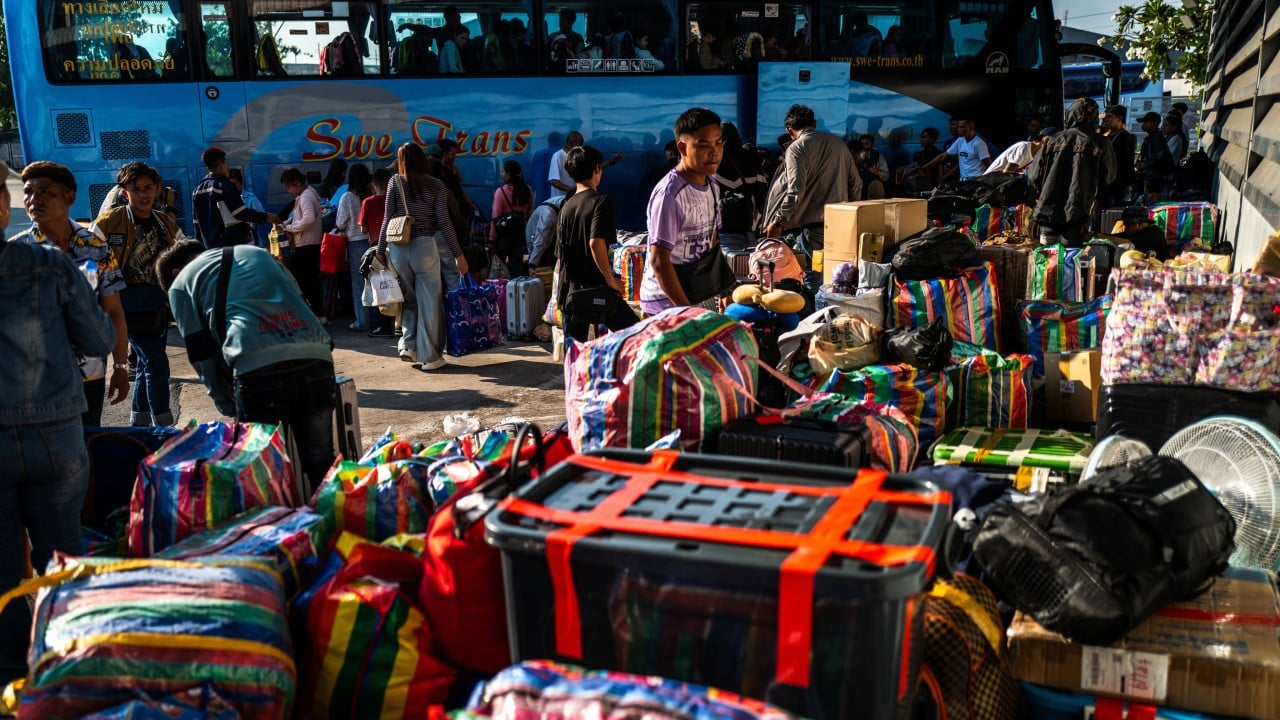
The traditional correlation between household disposable income and holiday travel volume in Thailand is currently undergoing a structural decoupling. While Songkran—the Thai New Year—historically serves as a peak consumption event, the 2026 season reveals a friction point where cultural mandates for mobility intersect with sharp energy price volatility. This creates a specific economic phenomenon: Resilient Demand with Compressed Velocity. Travelers are not cancelling their intent to move; they are recalibrating the frequency, distance, and duration of that movement to offset a spike in the marginal cost of transport.
The Energy-Mobility Cost Function
To understand why "fuel price shocks" do not result in a linear drop in travel, one must examine the Thai transport cost function. For the average domestic traveler, the total cost of a holiday trip ($C_{total}$) is defined by:
$$C_{total} = (P_f \times Q_f) + O_{fixed} + L_{opp}$$
Where:
- $P_f$ is the price of fuel (gasoline/diesel).
- $Q_f$ is the quantity of fuel consumed (distance/efficiency).
- $O_{fixed}$ represents fixed costs like food, gifts, and lodging.
- $L_{opp}$ is the opportunity cost of time spent in transit.
When $P_f$ increases abruptly, the immediate response in a low-discretionary travel event like New Year is not to reduce $C_{total}$ to zero, but to minimize $Q_f$. This explains the reported "delays" in travel. Travelers are waiting for price stabilization or pooling resources to optimize the efficiency of their fuel expenditure. The demand for Songkran travel is largely inelastic due to its role as a social and religious obligation, meaning the price of fuel must reach an extreme threshold before total volume collapses.
Three Pillars of Calibrated Mobility
The current holiday period is defined by three specific behavioral shifts that categorize how the population absorbs energy shocks without abandoning the tradition.
1. The Geographic Contraction of Leisure
Regional travel data suggests a shift from "Long-Haul Inter-Provincial" to "Intra-Regional" movement. Instead of traveling from Bangkok to distant southern provinces, there is a surge in travel to border provinces (Chonburi, Rayong, Kanchanaburi). This reduces $Q_f$ while maintaining the cultural requirement for "outing" (Pai Tiao). The economic implication is a localized concentration of capital; secondary provinces further from central hubs see a net loss in projected tourism revenue, while "satellite" provinces experience an unexpected surplus.
2. Modal Shift vs. Vehicle Efficiency
The rise in fuel prices triggers a shift in the hierarchy of transport modes. We observe a migration from private vehicle use to mass transit (rail and bus) where the per-capita energy cost is lower. However, a significant bottleneck exists: the capacity of the State Railway of Thailand and private bus operators is finite. When mass transit hits 100% capacity, the remaining surplus travelers are forced back into private vehicles, where they must then apply "load sharing"—increasing the number of passengers per vehicle to distribute the fuel cost burden.
3. Temporal Delay as a Hedging Strategy
The "delay" in travel mentioned in surface-level reports is actually a crude form of market hedging. Households anticipate potential government interventions, such as fuel subsidies or temporary price caps on diesel, which often occur during peak holidays to quell public dissatisfaction. By pushing their departure date back by 48 to 72 hours, travelers are effectively waiting for a more favorable $P_f$ or at least a reduction in traffic congestion, which directly impacts fuel efficiency through reduced idling time.
The Logistics Bottleneck and Supply Chain Lag
The timing of these fuel shocks is particularly disruptive because they coincide with the annual surge in logistics demand. During New Year, the supply chain for consumer goods must operate at 150% of its baseline capacity to stock retail outlets in rural areas.
High diesel prices create a dual-pressure system. First, transport companies pass on "fuel surcharges" to retailers. Second, retailers, fearing a drop in foot traffic due to higher travel costs, are hesitant to raise prices immediately, leading to a temporary margin squeeze. This creates a fragile equilibrium where the availability of goods in rural provinces—the destination for millions of travelers—may actually decrease just as demand peaks. If the cost of moving goods exceeds the projected profit margin of the holiday sale, we see a "stock-out" phenomenon in remote areas, further diminishing the economic utility of the holiday for returning workers.
Inflationary Pass-Through and the Spending Multiplier
The "fuel price shock" acts as a regressive tax on the traveling population. Every extra Baht spent at the pump is a Baht removed from the local economies of the home provinces. Historically, the "Songkran Multiplier" suggests that every 1,000 Baht spent by a returning worker generates approximately 1,400 Baht in local economic activity through food, service, and merit-making.
As energy costs eat into this discretionary pool, the multiplier effect weakens. The travel happens, but the depth of spending at the destination thins. We are seeing a transition from high-consumption travel to "presence-based" travel, where the primary goal is the social obligation of being home, with all non-essential ancillary spending excised from the budget.
Strategic Infrastructure Deficiencies
The inability of the Thai domestic market to absorb fuel price shocks during peak periods highlights a recurring infrastructure deficit. The reliance on road transport for 80% of holiday movement creates a single point of failure when oil markets fluctuate.
- Gridlock Inefficiency: Heavily congested routes (Highway 1, Highway 2, Highway 4) increase fuel consumption by up to 30% compared to free-flowing traffic. This "congestion tax" is an avoidable cost that compounds the pain of high fuel prices.
- Lack of Real-Time Pricing Data: The absence of sophisticated, real-time fuel pricing transparency across different provinces prevents travelers from optimizing their refueling stops, leading to sub-optimal expenditure.
- The Diesel Dependency: Thailand's heavy reliance on subsidized diesel for both public and private transport means that any global shift in Brent Crude is felt immediately at the consumer level, despite the government’s Oil Fund buffer.
Risk Assessment for the Hospitality Sector
For stakeholders in the travel and hospitality industry, the "price shock" is not a signal of total demand loss, but a signal for a change in service delivery.
The primary risk is Inventory Misalignment. Hotels and restaurants in traditional long-distance hubs (e.g., Chiang Mai or Phuket) that rely on Bangkok-based road travelers may see a spike in last-minute cancellations. Conversely, operators within a 200km radius of the capital should prepare for an over-capacity event. The "delayed travel" results in a "compressed peak"—instead of a five-day steady stream of revenue, businesses may face a hyper-intense three-day window that stresses staff and supply lines, followed by a sharp drop-off.
Future Mobility Projections
The current cycle suggests that Thai holiday travel is nearing a tipping point where traditional combustion-based road trips will become economically unviable for a segment of the middle class during price spikes. This will accelerate two long-term trends:
The first is the Digitization of the Holiday. If the cost of physical presence (transport) exceeds a certain percentage of monthly income, we will see a rise in virtual participation for secondary family members, with only the "head of household" making the physical journey.
The second is the Electrification Mandate. The volatility of the retail fuel market serves as the strongest possible marketing for the Electric Vehicle (EV) sector in Thailand. While currently limited by charging infrastructure on long-haul routes, the 2026 data indicates a high "willingness to switch" among frequent holiday travelers who seek to decouple their ritual movements from the fluctuations of the global oil market.
The strategic play for the current season is not to chase the volume of travelers, but to optimize for the Value-per-Kilometer. Businesses must recognize that the consumer is arriving with a "fuel deficit" in their wallet. Offering bundled services that reduce the need for local movement—effectively "destination lock-in"—will be the only way to capture the remaining discretionary spend. The holiday is not being cancelled; it is being audited by the household accountant. All service providers must adjust their pricing models to reflect this new, lean reality of Thai mobility.