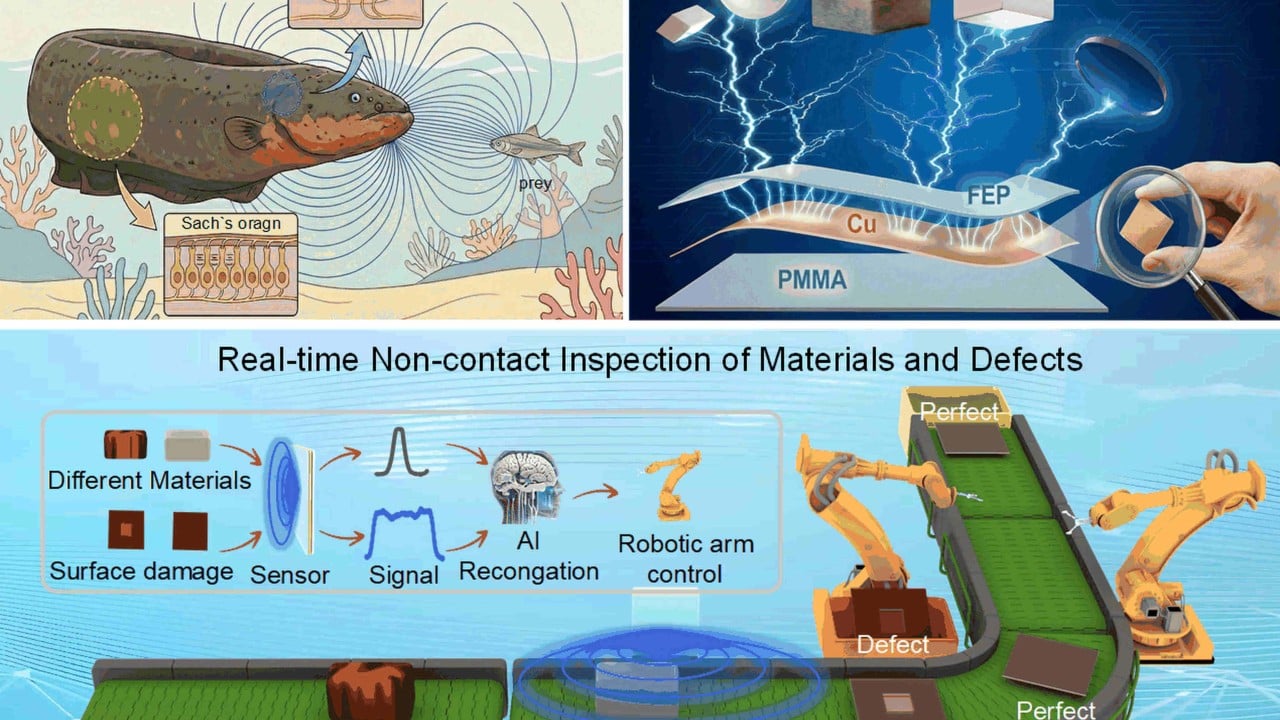
Robots have a major flaw. They are clumsy. Even the most advanced robotic arm built by top engineering labs will accidentally crush a delicate strawberry or slip on a wet glass because its force feedback relies on physical contact. Touch sensors need pressure to register resistance. By the time a sensor feels the push, the damage is already done.
That changes now. Researchers inspired by electric eels are building proximity-based touch sensors that let machines feel objects before their fingers even make contact. You might also find this related article interesting: Why Australia Building an Indo Pacific Cable Shield is a Multi Billion Dollar Distraction.
If you build hardware or follow automation trends, you already know that tactile sensing is the final frontier for robotics. Vision systems can spot an object from across a room, but closing the final centimeter safely remains an engineering nightmare. Let's look at how bio-inspired electric eel sensors solve this exact problem, why traditional approaches fall short, and what this means for the immediate future of automated systems.
The Problem With Traditional Robotic Touch
Standard industrial robots operate in structured cages. They don't need to feel because their environment is rigidly mapped out to the millimeter. When you move those same robots into unstructured spaces like a hospital ward, a disaster zone, or a kitchen, everything breaks down. As highlighted in latest reports by ZDNet, the implications are worth noting.
Force-torque sensors placed at the wrist measure loads experienced by the end-effector. Skin-like sensor arrays on fingertips detect pressure once physical deflection occurs.
- They require direct contact to trigger a reading.
- High-frequency vibrations can cause false positives.
- Rigid electronics often break under repeated physical impact.
- Wiring complexity scales exponentially with surface area.
Waiting for physical contact creates a lag. In high-speed manufacturing or delicate surgical assistance, milliseconds matter. If a robotic hand can detect an electric field distortion caused by an incoming object centimeters away, it can slow down or adjust its trajectory proactively.
Taking Cues From Nature
Electric eels don't just use high voltage to shock prey. They navigate murky Amazonian waters using weak electric fields, a sensory mechanism known as electrolocation. They emit an electric field from specialized organs and read distortions in that field caused by nearby objects, whether those objects are conductive or insulating.
Engineers replicated this biological marvel using hydrogels and ionic conductors. An artificial electric eel sensor works by generating a localized electrical field around a robotic digit. When an object enters that field, it alters the ionic current. The sensor reads this impedance change instantly.
You don't need physical pressure. You just need a disruption in the ionic gradient.
Conductive hydrogels mimic biological tissue remarkably well. They are stretchy, watery, and capable of transmitting electrical signals through ionic movement rather than electron flow, exactly like our own nervous systems. This makes the sensor inherently flexible. You can wrap it around a robotic gripper without restricting its range of motion.
How the Physics Actually Work
Let's get practical about the mechanics. An ionic hydrogel layer sits between flexible electrodes. An alternating current passes through the system, establishing a stable baseline electric field around the sensor.
When a conductive object like a metallic tool approaches, it concentrates the electric field lines. When an insulating object like a plastic cup or human skin approaches, it pushes those field lines outward.
The underlying circuitry measures these shifts in capacitance and resistance. Because different materials cause distinct signatures of field distortion, advanced signal processing algorithms can estimate not just the distance of the object, but its material composition before a single fingertip makes contact.
[Hydrogel Matrix] ---> [Alternating Current] ---> [Electric Field Generated]
                                                            |
                                              [Object Enters Proximity]
                                                            |
                                        [Field Distortion Read via Impedance]
This dual capability is rare. Traditional proximity sensors use infrared or ultrasound, which struggle with reflective surfaces, dark colors, or transparent materials. Electric fields pass right through water and ignore optical quirks. A robot fitted with ionic skin can navigate opaque liquids, dark shadows, or dusty environments without losing its spatial awareness.
Practical Applications in the Real World
Real-world deployment separates interesting lab demos from actual industry shifts. Where does this technology move the needle first?
1. Collaborative Robotics in Manufacturing
Cobots work alongside human operators on factory floors. Safety stops usually trigger only after a human bumps into the arm. Electric eel sensors create a proactive safety bubble. The robot senses your hand five centimeters away and halts its momentum smoothly, eliminating bruising impacts entirely.
2. Medical and Surgical Assistance
Minimally invasive surgery requires extreme precision. Inside the human body, tissues are soft, slippery, and easily perforated. Proximity-sensing surgical tools can warn a surgeon or an automated assistant when the instrument is getting too close to a sensitive blood vessel, preventing accidental tears.
3. Agriculture and Food Handling
Harvesting soft produce like berries, tomatoes, or ripe peaches destroys tons of food annually because pneumatic grippers misjudge pressure. Non-contact capacitive sensing lets a robotic harvester stop its descent the exact moment it detects the surface profile of the fruit, gripping it with zero bruising force.
Overcoming Current Engineering Hurdles
No technology launches without baggage. Hydrogel-based sensors face brutal environmental realities.
Water evaporates. If your hydrogel dries out in a hot warehouse, its ionic conductivity drops to zero, and the sensor dies. Researchers are actively tackling this by using ionic liquids or humectants that lock moisture into the gel matrix.
Durability remains another bottleneck. Soft materials tear. While hydrogels can stretch, coating them in durable, self-healing elastomers is necessary before they survive heavy industrial deployment.
Calibration is tricky too. Proximity electric fields shift based on ambient humidity and nearby grounding sources. A robot operating in a dry desert lab will read fields differently than one running in a humid greenhouse. Dynamic software calibration layers must constantly adjust baseline readings to filter out environmental noise.
Building With Proximity Tactile Sensors
If you are prototyping soft robotic systems today, you don't need to invent hydrogels from scratch. Commercial suppliers offer conductive elastomers and ionic liquids that yield similar capacitive feedback loops.
Start small. Instead of outfitting an entire multi-axis robotic arm, mount a single capacitive proximity pad on a pneumatic gripper finger. Program your microcontroller to monitor baseline impedance shifts at a 100Hz sampling rate. Set conditional triggers: when impedance changes by five percent, drop motor speed by half. When it hits ten percent, stop the actuator.
You will immediately notice the difference in collision avoidance compared to traditional threshold-based pressure switches. The movement becomes fluid. It looks organic.
What Comes Next for Intelligent Machines
Machines are moving past the era of blind force. Giving robots the ability to feel their environment before touching it bridges the final gap between rigid automation and biological dexterity.
We are stepping away from clumsy, brute-force engineering and toward sensory integration that mimics millions of years of evolution. The technology is scaling out of university labs and into commercial supply chains right now. Keep an eye on how soft robotics integrate ionic skins over the next few years. The machines handling your food, assisting in your surgeries, and working next to you on the line are about to get a whole lot more aware.