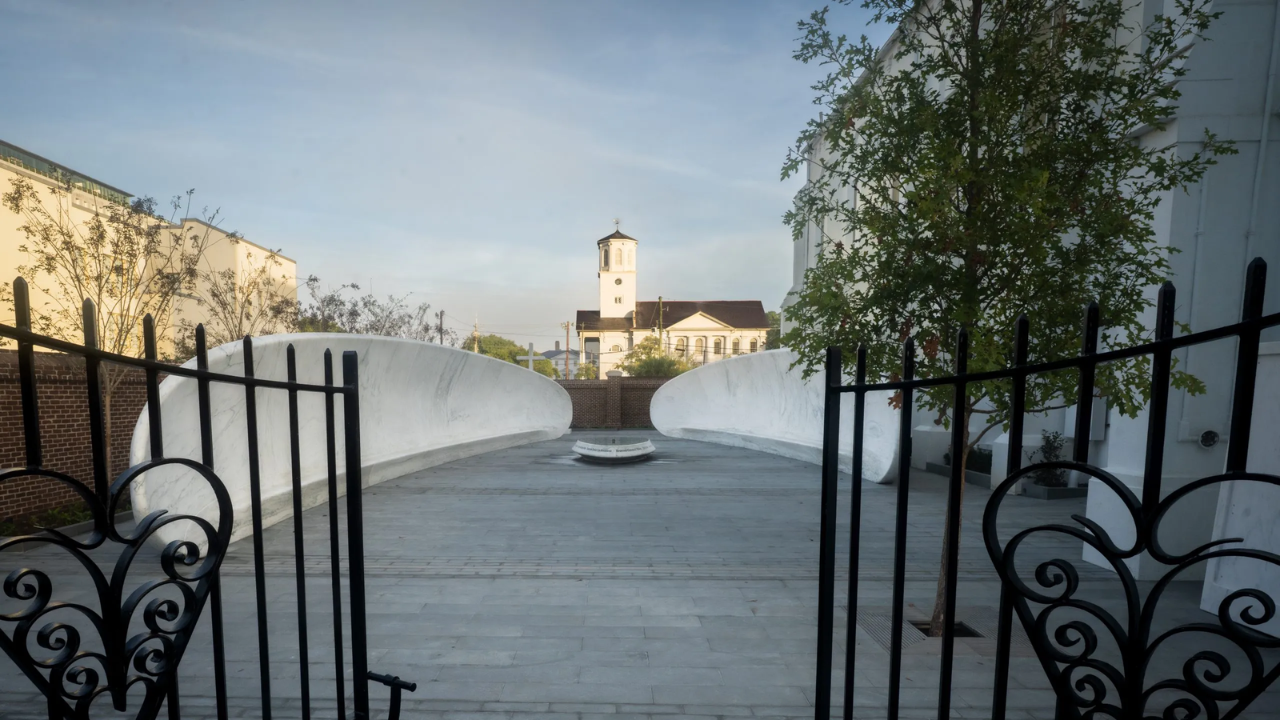
Humidity in Charleston does not just sit on your skin; it enters your lungs like warm water, heavy with salt from the Cooper River and the exhaust of idling tour buses. On a Wednesday evening in June, the heat lingers long after the sun drops behind the pastel facades of Calhoun Street.
Eleven years ago, that exact heat hung over a basement fellowship hall at 110 Calhoun Street.
Inside Mother Emanuel African Methodist Episcopal Church, twelve people sat in a circle of folding chairs, Bibles open on their laps, reading through the fourth chapter of Mark. A young white man sat among them for nearly an hour. They had welcomed him. They had given him a Bible and a printed study sheet. When they closed their eyes for the closing prayer, he stood up and began shooting.
Nine people died on that linoleum floor. Three survived.
For eleven years, the physical scar of that night existed mostly in memory, in legal transcripts, and in the quiet dignity of a congregation that refused to let hatred permanently shutter its sanctuary. Today, eleven years later, Charleston has finally opened a $25 million memorial beside the historic church—a permanent, architectural answer to an unanswerable violence.
To understand what this space actually does, you have to stop looking at the price tag and start looking at the geometry of grief.
The Architecture of an Interrupted Prayer
Most civic memorials are built to close a chapter. They are heavy, granite exclamation points placed at the end of a historical sentence so a city can feel proud of its own endurance and move on to the next fiscal quarter.
This one refuses that comfort.
Consider a hypothetical visitor—let’s call her Maya, a twenty-two-year-old college student visiting Charleston for the first time, walking up Calhoun Street with an iced coffee in hand, expecting a manicured park or a bronze plaque she can read in forty-five seconds. She rounds the corner beside the Gothic Revival sanctuary, and the city noise drops away.
Instead of a triumphant statue, Maya encounters two sweeping, curved walls of tabby—a traditional Lowcountry concrete made from crushed oyster shells, lime, sand, and water. The walls wrap around the site like open arms, forming a sanctuary without a roof. In the center sits a fountain, its shallow basin fed by water that spills over the edges in a continuous, rhythmic sheet.
Five seats surround the courtyard, symbolizing the five survivors—the three who lived through the gunfire in the basement, and the two who were spared because the shooter ran out of ammunition or turned away. Carved into the stone are the names of the nine who did not walk out: Cynthia Marie Graham Hurd, Susie Jackson, Ethel Lee Lance, Depayne Middleton-Doctor, Clementa C. Pinckney, Tywanza Sanders, Daniel Simmons, Sharonda Coleman-Singleton, and Myra Thompson.
Maya puts her coffee down on the low ledge. She notices the texture of the tabby walls—rough, pitted with white fragments of shell that once protected living creatures in the marsh. She looks at the water, which seems to rise from nowhere and disappear into thin air.
She realizes she is not looking at a monument to death. She is standing inside the pause between a prayer and an amen.
Why Eleven Years Took So Long
When news breaks that a $25 million memorial has opened more than a decade after a tragedy, the immediate cynical question rises to the surface: Why did it take eleven years?
If you have ever tried to bury someone you love while television trucks park across the street from your house, you already know part of the answer. Grief does not operate on a municipal construction schedule.
In the immediate aftermath of June 17, 2015, the world descended on Charleston with cameras, microphones, and a desperate appetite for a neat moral ending. Within days, during a bond hearing, several family members of the victims looked into a video feed at the killer and spoke words of forgiveness. That moment flashed across every screen in the country. For many outsiders, it felt like instant absolution—a soothing balm that allowed the nation to admire Black grace without interrogating white supremacy.
Behind the sanctuary doors, the reality was infinitely more complicated.
Forgiveness, in the Christian tradition of the historic AME church, is not amnesia. It is a refusal to let another person’s hatred rot your own soul, not a waiver of accountability. While pundits debated the meaning of grace, the congregation of Mother Emanuel was still scrubbing blood from its basement, attending nine funerals in eight days, and trying to figure out how to pay its electric bill while managing millions of dollars in unsolicited donations from strangers around the world.
Building a permanent memorial required navigating a minefield of competing needs. The church was not a museum; it was an active, working parish founded in 1816 by free and enslaved Black Charlestonians—a congregation whose original building was burned to the ground in 1822 after co-founder Denmark Vesey was accused of plotting a slave rebellion. Mother Emanuel had survived two centuries of arson, earthquakes, Jim Crow, and state-sanctioned terror. Its leaders were fiercely protective of its sacred autonomy.
Meanwhile, the city of Charleston, the state of South Carolina, corporate donors, and the victims’ families all had distinct visions for what the site should become. How do you honor nine individual human beings—a librarian, a state senator, a recent college graduate, a track coach, a retired sexton—without turning their deaths into a macabre tourist attraction? How do you raise $25 million without letting wealthy benefactors dictate the emotional truth of the space?
Architect Michael Arad, who previously designed the National September 11 Memorial in New York, spent years listening before drawing a single permanent line. He met with the families. He sat in the pews. He learned that the memorial could not overshadow the church itself, nor could it isolate the tragedy from the surrounding neighborhood.
The delays were not bureaucratic failure. They were the sound of a wounded community refusing to be rushed into someone else's timeline.
The Weight of Twenty-Five Million Dollars
Numbers in journalism often numb the very nerve endings they are meant to stimulate. Twenty-five million dollars sounds abstract—like a line item in a defense budget or the contract of a backup quarterback.
On the ground in Charleston, every dollar of that sum represents a deliberate choice against erasure.
Think of a memorial as an anchor dropped into fast-moving water. Without weight, the current of tourism, gentrification, and political convenience will sweep memory away within a single generation. Charleston is a city built on selective memory; for centuries, its economy has thrived on romanticizing antebellum mansions while tucking the auction blocks and slave quarters out of sight.
To build a permanent, weather-resistant, emotionally resonant sanctuary on prime downtown real estate—funded through a coalition of private philanthropy, state grants, corporate contributions, and thousands of small individual donations—is an act of historical friction. It forces the city’s visual geography to tell the truth.
The funds went toward more than stone and plumbing. They paid for the careful preservation of the historic church’s structural integrity during excavation. They funded the Survivors’ Garden—a separate, quieter space dedicated to the trauma carried by those who lived through the gunfire and the family members left behind. They established an endowment to ensure the site is maintained in perpetuity, so that fifty years from now, when the original donors have moved on, the water in the fountain will still run clear and the oyster shells in the walls will remain intact.
Still, spending $25 million on stone while systemic inequities persist in the very neighborhoods where the victims lived creates an undeniable tension. Many residents in North Charleston and the East Side—predominantly Black communities long squeezed by rising property taxes and stagnant wages—watched the construction cranes with mixed emotions. A memorial can honor the dead, they pointed out, while the living still struggle to afford rent two miles away.
Both truths sit side by side in the humid air. The memorial does not solve racism, nor does it pretend to. What it does is remove the excuse of forgetting.
What Happened in That Basement Still Happens Every Day
To treat the Charleston church shooting as an isolated historical artifact—a dark episode safely sealed behind a $25 million ribbon-cutting ceremony—would be a profound misreading of the present.
The shooter did not invent his hatred in a vacuum. He radicalized himself online, marinating in digital ecosystems that launder white nationalist paranoia into pseudo-intellectual talking points. He drove from the Midlands of South Carolina to Charleston specifically because Mother Emanuel was the oldest AME church in the South—a symbol of Black self-determination, faith, and political organizing.
When you walk through the new courtyard today, look closely at the bronze cross embedded near the sanctuary entrance, and consider the invisible architecture that brought the killer there in the first place. The same algorithms that fed him manifestos in 2015 operate at ten times the speed and sophistication in 2026. The same easy access to high-capacity handguns remains largely untouched by federal law.
This is why the design of the memorial avoids the traditional hero-and-villain tropes of American monuments. There is no mention of the perpetrator’s name anywhere on the grounds. His existence is denied the oxygen of stone.
Instead, the space emphasizes fellowship—the radical, vulnerable act of opening a door to a stranger.
In an era defined by locked gates, Ring cameras, and algorithmic silos, the radicalism of what happened in that basement on June 17, 2015, is easy to miss. Those twelve people did not merely tolerate an outsider; they pulled up a chair for him. They trusted that shared humanity was stronger than suspicion.
The memorial asks a quiet, unsettling question of everyone who steps onto its pavers: How do you keep your heart open in a world that keeps proving how dangerous openness can be?
Standing by the Water
Late in the afternoon, the sun angles through the live oaks along Calhoun Street, throwing dappled shadows across the tabby walls. The heat begins to break. A breeze comes off the harbor, carrying the faint, briny scent of low tide.
At the edge of the fountain, an older man in a pressed linen suit stands with his hands clasped behind his back. He does not take a photograph. He does not check his phone. He simply watches the water spill over the dark stone lip, listening to the steady, rushing sound that drowns out the sirens and the tour carriages rolling past a hundred feet away.
Around him, strangers move slowly. A mother kneels beside her young son, tracing the carved letters of Tywanza Sanders’s name with her index finger, whispering that he was twenty-six years old and died trying to shield his aunt. Two teenagers in high school track hoodies sit quietly on one of the five stone benches, staring down at their sneakers.
There are no speeches happening here today. No politicians are standing at a podium promising unity. The television cameras have packed up their tripods and driven back to the highway.
All that remains is the water moving over the stone, the crushed shells embedded in the walls, and the empty chairs waiting in a circle for anyone brave enough to sit down.


