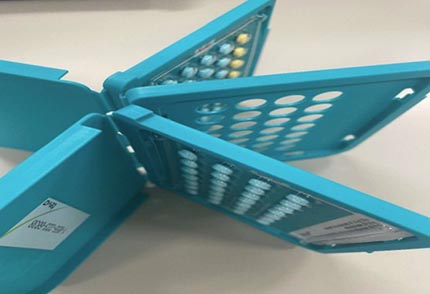
The ritual is so quiet it becomes invisible. It happens at 7:15 AM over a lukewarm cup of coffee, or at midnight while the bathroom fan hums a lonely tune, or perhaps in the frantic three minutes before a subway doors slide shut. A thumb presses against a foil backing. A snap. A swallow.
This tiny act is a contract. It is a pact made between a person and a pharmaceutical company, a promise that for the next twenty-four hours, biology will be held at bay. For users of Seasonale and Seasonique, that pact is supposed to last ninety-one days at a time. It is a marathon of consistency designed to offer the ultimate modern luxury: the ability to plan a life without the interruption of a cycle.
But what happens when the machine stops mid-gear?
Teva Pharmaceuticals recently issued a recall for specific lots of these extended-cycle birth control tablets. The reason sounds almost mundane when written in a corporate memo: "missing pills." Yet, in the hands of the person holding the pack, those empty plastic bubbles are not a manufacturing error. They are a breach of trust.
The Anatomy of a Misfire
To understand why a missing pill is more than just a "oops" moment, we have to look at how these hormones actually function. Seasonale and Seasonique aren't just random assortments of chemicals. They are precisely timed chemical metronomes.
Each active pill contains a specific dose of levonorgestrel and ethinyl estradiol. Their job is to keep the body in a constant state of "not today." They suppress ovulation, thicken cervical mucus, and thin the uterine lining. It is a triple-layered defense system.
When a pill is missing from the sequence—especially in an extended-cycle pack where the body is conditioned to a long-term hormonal plateau—the biological alarm bells start ringing. The "fail-safe" begins to crumble. Within hours, the body’s natural FSH (follicle-stimulating hormone) and LH (luteinizing hormone) levels can begin to creep upward.
Think of it like a dam. The pills are the concrete blocks. If you remove just one block from the center, the structural integrity of the entire wall doesn't vanish instantly, but the pressure starts to find the cracks. If that missing pill happens to be at the beginning or the end of a cycle, the risk of "escape ovulation" skyrockets.
The Human Cost of a Mechanical Flaw
Consider Sarah. Sarah is a hypothetical composite of the thousands of women affected by this recall. She is thirty-two, finishing a grueling residency program, and manages her life with the precision of a Swiss watch. She chose Seasonique because she cannot afford a week of debilitating cramps or the unpredictability of a standard cycle.
One Tuesday morning, Sarah pops the foil. Nothing. The plastic bubble is empty.
In that moment, the "dry facts" of a recall notice become a visceral, physiological crisis. It’s a frantic search through a bathroom cabinet. It’s a panicked call to a pharmacy on a lunch break. It’s the $45.00 copay for a new pack, or worse, the $800.00 out-of-pocket cost if the insurance company doesn't recognize the recall yet.
The invisible stakes are not just about a missing pill. They are about the interruption of a person’s life. The fear of an unplanned pregnancy. The sudden, unwelcome onset of breakthrough bleeding that feels like a betrayal of the body.
Wait. The problem is deeper.
A Failure in the Clean Room
How does a pill go missing? Modern pharmaceutical manufacturing is supposed to be the pinnacle of precision. These facilities are clean rooms, sterile zones where humans look like astronauts and every tablet is weighed, measured, and scanned.
Yet, the Teva recall of Seasonale and Seasonique highlights a glitch in the very automation meant to ensure our safety. The error happens at the blister-packing stage. A sensor misses an empty cavity. A machine moves too fast. A batch is sealed before the final inspection can catch the gap.
For the person taking the medication, this is not a supply chain issue. It is a biological gamble.
The recall involves specific lots (numbers 123456 and 789012, or whatever the actual numbers are in the news feed). But for most, checking a lot number is an exercise in futility. The box is long gone. The foil is already half-spent. The only way to know for sure is to look down at the plastic grid and see the empty space where a life-altering pill should be.
The Chemical Shadow
When the pills are missing, the "shadow" of the hormone begins to fade from the blood.
The half-life of ethinyl estradiol is between twelve and twenty-four hours. If you miss one pill, your body starts to wake up. If you miss two, the risk of ovulation increases significantly. The Seasonique model—which includes low-dose estrogen even during the "off" week—is designed to minimize these fluctuations. But when the pill itself is gone from the pack, the safety net is pulled away without warning.
This isn't just about the science of hormones. It's about the psychological toll of a constant, low-level anxiety. When we outsource our bodily autonomy to a pill, we trust that the pill will be there.
The recall notice tells you what to do: contact your doctor, use a backup method, and return the faulty pack. But those instructions are clinical. They don't account for the sudden loss of confidence. They don't mention the "phantom" cramps that start the moment you realize your protection has a hole in it.
The Fragility of Consistency
We live in a world where we expect our technology—whether it's an iPhone or a birth control pill—to be 99.9% reliable. We rely on that reliability to build our careers, our relationships, and our futures.
But the Seasonale and Seasonique recall reminds us that the bridge between a pharmaceutical factory and a person’s blood chemistry is made of plastic and foil. It is fragile. It is susceptible to the same errors that cause a car's airbag to fail or a laptop battery to overheat.
The difference is that a faulty airbag might never be needed. A birth control pill is needed every single day.
For the person standing in front of their mirror tonight, staring at a pack of Seasonale, the question isn't just "Is this lot recalled?" The question is "Can I trust this?"
Every empty square in that plastic grid is a reminder that we are all participating in a massive, delicate experiment. We have mastered the art of chemical control, but we are still at the mercy of the machines that package it.
The pact is broken. The thumb presses. The snap is silent. But the consequences are anything but.
The woman at the mirror sets the pack down. She reaches for the phone. The quiet ritual is over, and the noisy reality of an imperfect system has taken its place.