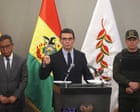
The morning air in Santa Cruz de la Sierra usually carries the scent of humid earth and diesel, but on Friday, it carried the weight of a multi-year manhunt finally reaching its conclusion. Sebastián Marset, the 34-year-old Uruguayan who rebranded himself as the King of the South, was pulled from the shadows of the Las Palmas neighborhood. His arrest does more than just remove a high-level trafficker from the board; it exposes the porous borders and institutional vulnerabilities that allowed a man accused of murdering a top prosecutor to hide in plain sight for years.
Marset was not just a fugitive. He was a provocateur. While authorities across South America scrambled to locate him, he was busy living a surreal double life, even appearing as a professional soccer player for a second-division Bolivian team. His capture by Bolivia’s Special Force for the Fight Against Drug Trafficking (FELCN) signals a dramatic shift in regional cooperation, particularly as Bolivia reopens its doors to the US Drug Enforcement Administration (DEA) after nearly two decades of frost.
The Honeymoon Hit and the Path to Santa Cruz
The accusations against Marset are as cinematic as they are brutal. In May 2022, Paraguayan prosecutor Marcelo Pecci was gunned down on a beach in Cartagena, Colombia. He was on his honeymoon. The hit was professional, swift, and designed to send a message. Pecci had been the architect of "A Toda Costa," the largest anti-money laundering operation in Paraguay's history—an operation that directly threatened Marset’s First Uruguayan Cartel (PCU).
Following the assassination, Marset became a ghost. He utilized a sophisticated network of false identities, slipping between Brazil, Paraguay, and Bolivia with the ease of a seasonal traveler. In 2021, he had already eluded capture in Dubai through a bureaucratic miracle—getting a genuine Uruguayan passport issued while in detention. That incident alone forced the resignations of top Uruguayan officials and proved that Marset’s influence was not limited to the streets; it reached into the mahogany offices of government ministries.
How the King Hid in Plain Sight
Most fugitives of this caliber bury themselves in jungle bunkers or remote border towns. Marset chose the opposite. He moved to Santa Cruz, Bolivia’s economic engine, and assumed the identity of Luis Paulo Amorim Santos. He didn't just hide; he participated in the local culture. By purchasing a soccer club and registering himself as a player, he exploited the very public nature of his surroundings to mask his criminal identity.
This audacity suggests a deep-seated belief in his own untouchability. In 2023, when Bolivian police finally raided his mansion, Marset was gone. He later released videos mocking the authorities, claiming he had been tipped off by the police themselves. This level of institutional infiltration explains why the 2026 capture is being treated as such a significant victory by the government of President Rodrigo Paz. It represents a purging of the rot within the security forces as much as a criminal arrest.
The Logistics of the First Uruguayan Cartel
To understand Marset is to understand the changing nature of the Southern Cone's drug trade. The PCU is not a traditional pyramid-style cartel. Instead, it operates as a sophisticated logistics firm for the global cocaine trade. Marset’s genius lay in the "Southern Route." He moved cocaine from the Andean producing regions through the river systems of Paraguay and Argentina, eventually reaching the deep-water ports of Montevideo and Buenos Aires.
From there, the product was shipped to Europe, often hidden in legal exports of soybeans or wood. This route avoided the heavily surveilled Caribbean corridors, making Marset an essential partner for European syndicates like the Italian 'Ndrangheta. Estimates suggest his network was responsible for moving over 16 tons of cocaine into European markets, generating tens of millions in untraceable cash.
The DEA Factor and the Extradition
The speed of Marset's transfer to US custody speaks volumes about the current political climate in La Paz. Within hours of his arrest, Marset was at Viru Viru International Airport, handed over to American agents, and flown out on a US government plane. He faces money laundering charges in the Eastern District of Virginia, but the broader goal for US investigators is to peel back the layers of his organization to see who else was on the payroll.
Bolivia’s decision to facilitate such a rapid extradition is a clear departure from the "Dignity and Sovereignty" policy of the previous era. Under President Paz, the country is actively seeking to shed its reputation as a sanctuary for narco-fugitives. This arrest is the price of admission for Bolivia's reintegration into the international security community.
The Fallout for Organized Crime
The collapse of Marset’s empire leaves a massive power vacuum in the Southern Cone. While his arrest is a tactical win, history suggests that the routes he established will not remain vacant for long. The infrastructure for the Southern Route—the bribed port officials, the shell companies, the clandestine airstrips—remains largely intact.
Smaller factions within the PCU and rival groups from Brazil, such as the Primeiro Comando da Capital (PCC), are likely already maneuvering to seize Marset’s territory. The real test for regional governments is whether they can dismantle the system Marset built, rather than just removing the man whose name was on the letterhead.
Marset’s era was defined by a brazen fusion of crime, sport, and high-level corruption. He was a man who believed he could play a soccer match on national television while being the most wanted man on the continent. That era ended on a Friday morning in Las Palmas, not with a shootout, but with the quiet click of handcuffs and a one-way ticket to a federal cell.