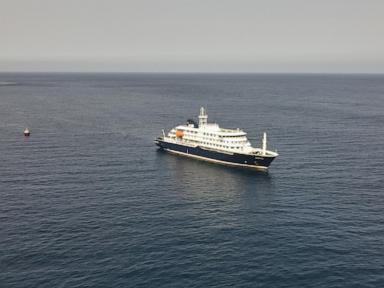
The containment of Hantavirus Pulmonary Syndrome (HPS) within the confined, recycled-air environment of a cruise vessel represents a critical failure in biosafety engineering and vector control protocols. While traditional reporting focuses on the chronological progression of patient symptoms, a rigorous strategic analysis reveals that the outbreak's trajectory is determined by three fixed variables: the density of the viral reservoir (rodent populations), the aerodynamic dispersion of particulate matter, and the structural latency of maritime HVAC systems. The inability to neutralize these variables transforms a localized contamination event into a systemic health crisis.
Viral Pathogenesis and the Aerosolization Vector
Hantaviruses, specifically those within the Orthohantavirus genus, do not require a direct bite for transmission. The primary mechanism of infection is the inhalation of aerosolized excreta from infected rodents, typically Peromyscus maniculatus (deer mouse) or Sigmodon hispidus (hispid cotton rat). In a terrestrial setting, viral load dilutes in open air. In a cruise ship environment, the architecture serves as a force multiplier for viral concentration.
http://googleusercontent.com/image_content/209
The viral lifecycle on a vessel follows a predictable kinetic path:
- Colonization: Rodent vectors penetrate the hull through port-side loading docks or utility umbilicals during dry-docking or extended stays in endemic regions.
- Nesting: Vectors establish hubs in interstitial spaces—voids between bulkheads and ceiling panels—where human traffic is zero but environmental control systems are accessible.
- Desiccation: Rodent urine and feces dry within these high-airflow voids.
- Aerosolization: Turbulence from the ventilation system lifts the desiccated particles, creating a suspension of viral-laden dust that bypasses standard filtration.
The incubation period, ranging from one to eight weeks, creates a "silent window" where the primary source of infection remains active and undetected while the first wave of hosts traverses the ship's social ecosystems.
The Structural Bottleneck of Maritime Ventilation
The core vulnerability in maritime health safety is the reliance on recirculated air to maintain thermal efficiency. Most cruise ships utilize a Variable Air Volume (VAV) system. While efficient for temperature regulation, VAV systems often lack the HEPA-grade filtration necessary to capture particles in the 0.5 to 5-micron range—the specific size of aerosolized hantavirus particles.
The Filtration Gap
Standard maritime filters are rated on the MERV (Minimum Efficiency Reporting Value) scale. Most vessels operate at MERV 8 to 11, which is effective for dust and pollen but fails to stop viral aerosols. To achieve true containment, a system requires MERV 17 or higher. The pressure drop associated with such dense filtration would require a complete overhaul of the ship’s blower motors, creating a cost-prohibitive barrier to immediate remediation.
The Thermal Inversion Risk
In humid maritime environments, condensation within ductwork creates a "bio-film" that can trap viral particles. If the system’s humidity controls fail, these particles can be re-released during dry cycles. This creates a secondary exposure risk for maintenance crews who may encounter concentrated viral loads during routine filter changes, often without Level 3 Bio-Safety (BSL-3) protection.
Quantifying the Outbreak Velocity
The progression of a shipborne hantavirus event can be mapped using a modified SIR (Susceptible, Infected, Recovered) model, but with a critical "Environmental Reservoir" (E) component. The equation for transmission ceases to be person-to-person (as hantavirus rarely spreads between humans) and instead becomes a function of human-to-void-space exposure.
The Exposure Rate ($E_r$) is calculated by:
$$E_r = \frac{V_c \cdot T_e}{V_{total}}$$
Where:
- $V_c$ is the concentration of viral particles per cubic meter of air.
- $T_e$ is the time of exposure in localized zones.
- $V_{total}$ is the total volume of the ventilated sector.
The data suggests that the highest risk zones are not the open decks, but the lower-tier interior cabins and staff quarters. These areas often have lower air exchange rates (ACH) and are closer to the utility chaseways where rodent activity is concentrated.
Clinical Manifestation and Diagnostic Lag
The biological threat of HPS is bifurcated into two distinct phases. The initial prodromal phase presents with non-specific symptoms: fever, myalgia, and gastrointestinal distress. Because these mirror common Norovirus or influenza symptoms—staples of maritime medicine—the diagnostic lag is severe.
The second phase is the cardiopulmonary stage, characterized by a sudden onset of pulmonary edema and hypotension. At this juncture, the mortality rate climbs to approximately 38%. The transition from "flu-like symptoms" to "acute respiratory failure" can occur in as little as 24 hours. On a vessel located multiple days from a high-acuity trauma center, this lag is frequently fatal.
The Economic Impact of Remediation
An outbreak of this nature imposes a three-tiered cost structure on the operator:
- Direct Operational Loss: Immediate cessation of the cruise, refunding of fares, and the cost of emergency medical evacuations.
- Structural Remediation: The "Search and Destroy" phase. This involves high-intensity ultraviolet germicidal irradiation (UVGI) of all ductwork and the chemical stripping of interstitial voids.
- Reputational Erosion: The long-term impact on booking yields. Unlike Norovirus, which is perceived as a transient risk, Hantavirus carries a stigma of structural filth and systemic neglect.
The financial friction of a single HPS event can exceed the annual net profit of the specific vessel involved, particularly when factoring in the legal liability of failing to maintain a "seaworthy" health environment.
Vector Management and Integrated Pest Measures
The failure of the ship’s Integrated Pest Management (IPM) is the root cause of the outbreak. Standard traps and baits are insufficient for maritime voids. Effective control requires a "Hardening" strategy:
- Point of Entry Sealing: All cable penetrations and pipe runs must be sealed with stainless steel mesh or copper wool, materials that rodents cannot gnaw through.
- Ultrasonic Deterrents: Implementation of variable-frequency ultrasonic emitters in non-human zones to disrupt rodent nesting patterns.
- DNA Sequencing of Droppings: High-end operators now utilize rapid DNA testing on recovered rodent droppings to identify the specific species and determine if they carry the hantavirus genome before an outbreak occurs.
Strategic Mitigation Framework
The industry must shift from reactive cleaning to proactive structural biosecurity. The current model of "Sanitize and Sail" is insufficient for zoonotic threats that live within the ship's bones.
A primary requirement is the installation of automated air quality monitoring sensors capable of detecting increased particulate matter in real-time. These sensors should be integrated into the bridge's environmental control dashboard, allowing for the immediate isolation of specific ventilation zones if a spike is detected.
The second requirement is a mandatory BSL-2 training certification for all maritime engineers. If the staff responsible for the ship's "lungs" do not understand the mechanics of aerosolized viral transmission, the filtration system will continue to act as a distribution network rather than a barrier.
The final strategic move involves a transition to "displacement ventilation" designs in future hull builds. By introducing fresh air at the floor level and exhausting it at the ceiling without recirculation, the residence time of viral particles in the breathing zone is reduced by over 60%. Until the industry addresses the fundamental physics of air movement within the hull, the risk of zoonotic spillover remains a permanent line item on the maritime risk registry.