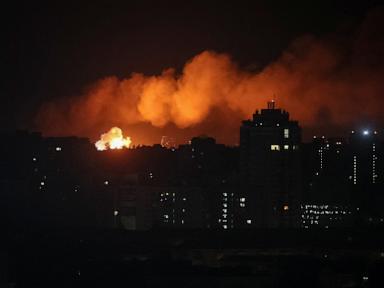
High-density missile campaigns directed at metropolitan centers operate on a predictable set of engineering, logistical, and strategic variables. When a major urban core like Kyiv experiences a concentrated volley of aerial munitions, the immediate reports focus heavily on raw casualty counts and general target categories. That approach obscures the underlying mechanics of modern strategic targeting. To evaluate these events effectively, analysts must deconstruct the operational taxonomy, examine the logistical friction points of air defense networks, and map the cascading systemic failures that occur when high-capacity strike packages intersect with dense civilian environments.
The Operational Taxonomy of Urban Targeting Vectors
Strategic strikes against capital cities are rarely arbitrary displays of force. They function as targeted disruptions designed to stress specific nodes of national functionality. Three primary vectors define these campaigns.
The first vector involves saturation mechanics. Modern air defense systems operate on finite tracking channels, missile inventories, and interceptor launch capacities. When an attacking force deploys a mixed package of ballistic missiles, cruise missiles, and loitering munitions, the objective is channel overload. By forcing defensive batteries to expend high-value interceptors on decoy profiles or lower-tier threats, the attacker creates operational windows for primary payload delivery.
The second vector targets energy and logistical distribution grids. Urban centers rely on centralized transformation stations, water pumping infrastructure, and transit nodes. Striking the periphery of these systems rather than the center creates cascading failures. A single substation hit can ripple outward, disabling hospital backup grids, halting municipal water pressure, and degrading emergency response coordination across multiple districts.
The third vector relies on psychological friction. The concentration of strikes near densely populated residential zones generates a secondary logistical burden. Emergency services, medical facilities, and municipal labor pools must pivot immediately from routine operations to triage and rescue. This diversion of human capital degrades the overall resilience of the municipal apparatus, creating friction that compounds over subsequent operational cycles.
The Friction Points of Defensive Interception
Evaluating the efficacy of a strategic strike requires analyzing the defensive response function. Air defense is not a binary shield; it is a probabilistic math problem governed by three core constraints.
Interceptor Inventory Ratios
Defenders face an asymmetrical economic problem. High-end surface-to-air missiles carry exorbitant unit costs compared to mass-produced offensive cruise or ballistic variants. When an attack volume exceeds domestic production or replenishment rates, defenders must ration interceptors. This rationing introduces spatial vulnerability gaps where certain sectors receive prioritized coverage while secondary zones experience reduced protection thresholds.
Sensor Horizon and Reaction Time
Geographic proximity to launch platforms dictates the warning window. Hypersonic and ballistic projectiles compress decision-making loops to minutes or seconds. This compression limits the automated calculus of fire-control systems, increasing the probability of false-positive engagements, missed trajectory corrections, or delayed civil defense sirens. The milliseconds lost between radar detection and public alert activation directly scale the casualty rate in unreinforced public spaces.
Terminal Ballistic Dispersion
When an incoming missile is successfully engaged by an interceptor at low altitude, the physics of kinetic destruction do not eliminate the mass; they redistribute it. Intercepting a warhead over a populated urban area frequently results in high-velocity shrapnel dispersion and uncontrolled wreckage impact across a wider footprint than the targeted coordinate. The structural integrity of multi-story residential buildings offers minimal resistance to falling debris fields composed of unburned rocket fuel, heavy guidance electronics, and titanium motor casings.
The Economic and Logistical Cost Function
The macro-level impact of these strikes extends far beyond the immediate geographic footprint of the impact zones. Every high-intensity engagement triggers a complex economic and industrial calculation for both the aggressor and the defender.
For the attacker, the cost function is defined by the depletion rate of precision-guided munition stockpiles versus the strategic degradation inflicted on the opponent's domestic stability. If the industrial base supporting the offensive campaign produces fewer missiles per month than are expended in a single saturation night, the strategy suffers from diminishing marginal returns. The attacker must continuously re-evaluate whether the structural damage achieved justifies the permanent reduction of their strategic reserve.
For the defender, the cost function centers on infrastructure elasticity. The speed at which damaged transformers, severed district heating mains, and shattered structural facades can be repaired dictates the long-term viability of the urban center as a functional administrative and economic hub. When repair times outpace strike frequencies, the city adapts through decentralized micro-generation and emergency hardening. When strike frequencies outpace repair capacity, structural abandonment accelerates, transforming urban neighborhoods into uninhabitable zones.
Strategic Trajectory and Systemic Adaptation
Urban defense against complex missile campaigns ultimately resolves into an arms race of technological iteration and logistical endurance. Attackers continuously refine flight paths using terrain-masking, electronic countermeasures, and altered payload configurations to exploit identified blind spots in radar coverage. Simultaneously, defenders decentralize command structures, deploy mobile point-defense groups to cover blind spots, and pre-position repair materials near critical infrastructure nodes to minimize downtime.
The immediate casualty figures reported in the wake of a heavy strike represent only the most visible metric of a much larger attrition equation. The true measure of the campaign lies in the degradation coefficient of the city's critical systems and the institutional capacity to maintain operational continuity under sustained aerial pressure. Future stability depends entirely on the scalability of distributed defense networks and the speed of infrastructure redundancy deployment before the next strike package clears the horizon.