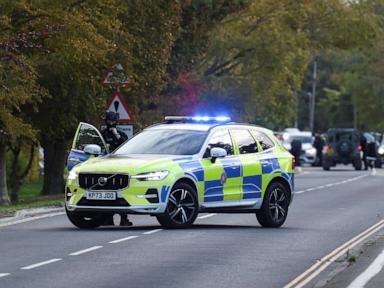
Every time flashlights sweep across a perimeter fence and the wire services push out an urgent bulletin about explosives acts near a strategic installation, the same reflex kicks in. The media scrambles to paint a picture of an imminent, sophisticated threat crashing against the gates of Western defense infrastructure.
It is lazy, terrified theater.
When UK police sweep up individuals near a sensitive military asset under counter-terrorism legislation, the automatic assumption from headline-chasers is that we are staring down the barrel of an advanced, coordinated sabotage campaign. Let's look past the flashing blue lights and the breathless reporting. What looks like a high-stakes intelligence coup or a counter-terrorism masterclass is usually a messy collision of low-level trespass, institutional paranoia, and the desperate need for security agencies to justify expanding budgets.
I have spent enough time around defense installations to know how perimeter security actually functions. The reality is far more mundane and far more chaotic than the press releases admit.
The Myth of the Sophisticated Threat
The standard narrative treats every trespasser or suspicious package near a strategic base as a seasoned operator probing defenses. This assumes a level of competence and strategic intent that rarely exists in the real world.
Most breaches, alarms, and arrests near sensitive sites are driven by three unglamorous factors:
- Pranksters and urban explorers chasing social media clout with zero political agenda.
- Lost civilians relying on broken GPS software and terrible situational awareness.
- Petty criminals looking for scrap metal or a quiet place to hide out, completely oblivious to what sits behind the razor wire.
When security personnel or local constabularies pick up these individuals under emergency or counter-terrorism statutes, they do not immediately possess proof of a grand conspiracy. They invoke heavy-handed legislation because operating out of an abundance of caution covers institutional liabilities. If you charge someone under standard trespassing laws, you look foolish for making a mountain out of a molehill. If you invoke the Explosives Act or anti-terrorism provisions, you instantly validate the entire security apparatus.
We are paying an astronomical tax—financially and psychologically—for a system designed to treat every anomaly as a worst-case scenario.
The Bureaucratic Incentive for Panic
Why do these incidents get blown into major international talking points? Simple economics and institutional survival.
Defense budgets and counter-terrorism mandates require constant validation. A quiet perimeter is an existential threat to an agency whose funding relies on the perception of a clear and present danger. When an arrest happens near a US air base on British soil, two distinct bureaucracies—local British policing and American base defense command—collide.
For the local police, sensationalizing an incident demonstrates proactive utility. For the base command, playing up the severity of an external threat justifies tighter restrictions, expanded physical security contracts, and zero political pushback when local communities complain about base expansion.
Nobody gets promoted in the defense sector by standing up at a press briefing and saying, "We arrested a teenager who hopped a fence to retrieve a drone." Instead, the event is wrapped in vague, ominous terminology: major incident, explosives act, sensitive asset.
The media eats it raw because fear sells clicks, and the public swallows it because we have been trained to associate military gray paint with immediate existential peril.
Dismantling the Perimeter Paranoia
If we want an honest conversation about modern security vulnerabilities, we have to stop treating perimeter arrests as tactical victories against terror. Real threats to strategic assets do not look like individuals fumbling around a chain-link fence with suspicious items.
Real threats are silent, distributed, and digital. They happen through supply chain compromises, insider coercion, electromagnetic reconnaissance, and remote data interception. A person standing near a fence with an improvised device or suspicious material is either a profound amateur or a deliberate distraction meant to draw resources away from where the real vulnerabilities lie.
By hyping up street-level police work as counter-terrorism triumphs, we exhaust public attention and squander resources on the wrong end of the risk spectrum. We build massive walls to keep out idiots while leaving the digital and logistical back doors wide open.
Stop confusing theater for security. The flashing lights are just there to blind you to what is happening behind your back.