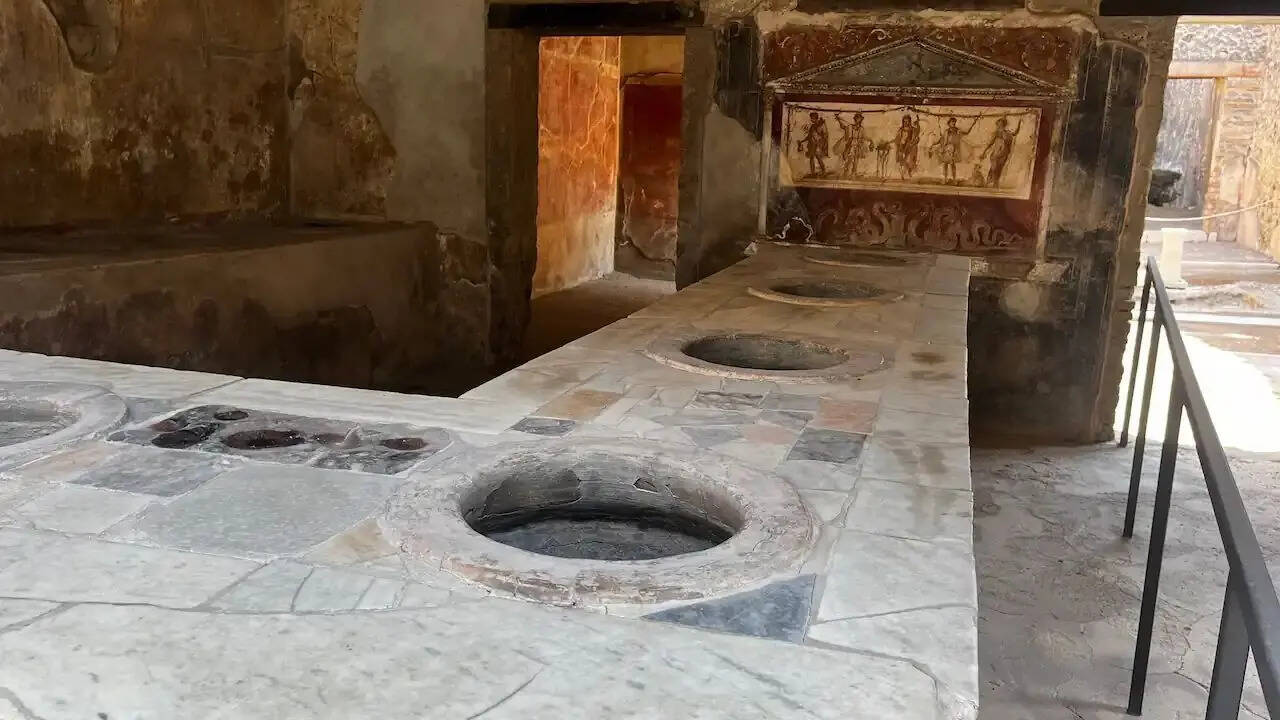
Walk into any ancient Roman tavern in Pompeii and you see them: massive ceramic jars embedded directly into solid stone counters. For decades, the standard tour guide script claimed these counter jars, traditionally lumped together under the blanket term dolia, were the ancient equivalent of steam tables, holding hot stews, wine, and grain for hungry plebeians.
It’s a clean, comforting image of ancient fast food. It’s also mostly guesswork.
Because these vessels are permanently cemented into the masonry of more than 150 tabernae (the neighborhood bars of the Roman world), archaeologists couldn't look inside their bodies or extract them without destroying the bars themselves. They were trapped in their stone casings. That meant we couldn't actually verify how they were made, let alone what they held.
A new study published in the Journal of Archaeological Method and Theory by researchers Xinyan Zhao and Yoshiki Hori changed the game without breaking a single piece of ancient mortar. Using an ultra-compact, portable structured-light scanner called the "Go! SCAN SPARK," the team managed to maneuver cameras into the tight, awkward openings of 40 different jars across 14 Pompeian taverns. The high-resolution 3D models generated from the inside out are shattering the lazy historical narrative that these jars were mass-produced, identical units meant for hot lunches.
The Myth of the Standard Roman Jar
Go to a restaurant supply store today and every stainless steel insert is uniform. We assumed the Romans, with their love of standardization and concrete, did the same thing. They didn't.
The 3D scans revealed an intense diversity in shape and engineering. Some vessels are perfectly cylindrical. Others bulge into bulbous, rounded shapes deep beneath the counter surface. The variance is so stark that using the generic word dolia to describe all of them is an archaeological cop-out.
By mapping the central axis—the invisible vertical line running through the center of the clay—the digital models caught the physical thumbprints of the artisans who threw these pots two millennia ago. The data shows that these jars deviate less than 2.3 degrees from absolute vertical precision. For a hand-thrown piece of clay standing nearly three feet tall, that’s an elite level of craftsmanship.
But it’s the construction method that tells the real story. The scans showed subtle, repeating internal ridges where the clay thickness shifts. This means Roman potters didn't just spin a giant lump of mud on a fast wheel. They built these massive jars in distinct, modular sections.
An artisan would mold the base, wait for it to dry enough to support its own weight, then blend a new ring of clay on top using a slow-turning wheel to smooth the seams. It was a rhythmic, highly planned manufacturing process that balanced industrial speed with custom, small-batch handcrafting.
The Countertop Conundrum
If the jars are all built differently, they probably weren't doing the same job. This brings us back to the burning question: what was actually inside them?
The old theory that they held hot soups has a massive logical flaw. If you put hot food into a massive clay jar buried inside stone, how do you clean it? You can't tip it over to wash out the grease. You can't scrape the bottom easily without climbing onto the counter. Leaving organic residue to rot in a damp, dark subterranean jar is a recipe for food poisoning, even by ancient standards.
The physical structure of the jars supports a different reality. Many of these vessels lack an interior glaze or pitch lining, which is essential for holding liquids like wine or olive oil long-term without the porous clay soaking it up.
It’s far more likely these jars served as dry storage units for non-perishable staples. Think dried beans, lentils, nuts, or grains. The insulation of the thick stone counter would keep the temperature stable, protecting dry goods from the blistering Mediterranean summer heat and keeping pests at bay.
A Fragmented Supply Chain
The 3D scanning project uncovered another bizarre detail. In some tabernae, several jars feature identical structural signatures and symmetry, meaning the bar owner bought a matching set from a specific workshop. But right next to those matching units, you'll find a jar with a completely alien internal design.
This strongly implies a booming secondhand market for commercial restaurant equipment in the ancient world. If a jar cracked, the owner didn't always order a custom replacement from the original potter. They likely went down to the local market, bought a used jar from a demolished building, and paid a mason to fit it into their existing counter.
It shows a gritty, pragmatic economic system that feels intensely human. Roman business owners were cutting corners, reusing materials, and dealing with broken infrastructure exactly like a modern restaurant owner dealing with a broken commercial fridge.
To get a true sense of how these tavern spaces operated, look at the physical layout of a typical Pompeian street corner.
- The Front Counter: Built directly facing the sidewalk to attract foot traffic, fitted with the newly scanned storage jars.
- The Hearth: Located at the back of the counter or in an adjacent room, where food was actually cooked over open fires before being served.
- The Backroom: A cramped seating area where patrons drank cheap wine, gambled with dice, and ate food kept in the dry counter jars.
Where Archaeology Goes From Here
If you want to understand the ancient world, stop looking at statues of emperors and start looking at the tools of the working class. The work done by Zhao and Hori proves that the most common objects still hold the biggest secrets.
The next step for researchers isn't just scanning more jars in Pompeii. It’s deploying this exact non-invasive structured-light tech to other buried Roman towns like Herculaneum or Ostia Antica. By comparing the internal 3D blueprints of jars across different cities, we can map out the regional trade routes of ancient potters and see exactly how far a single workshop’s style traveled.
For anyone interested in history, the lesson is clear: skip the generalized museum placards. The real story of daily life in antiquity is usually hidden beneath the surface, waiting for a tight enough camera angle to finally show its true shape.