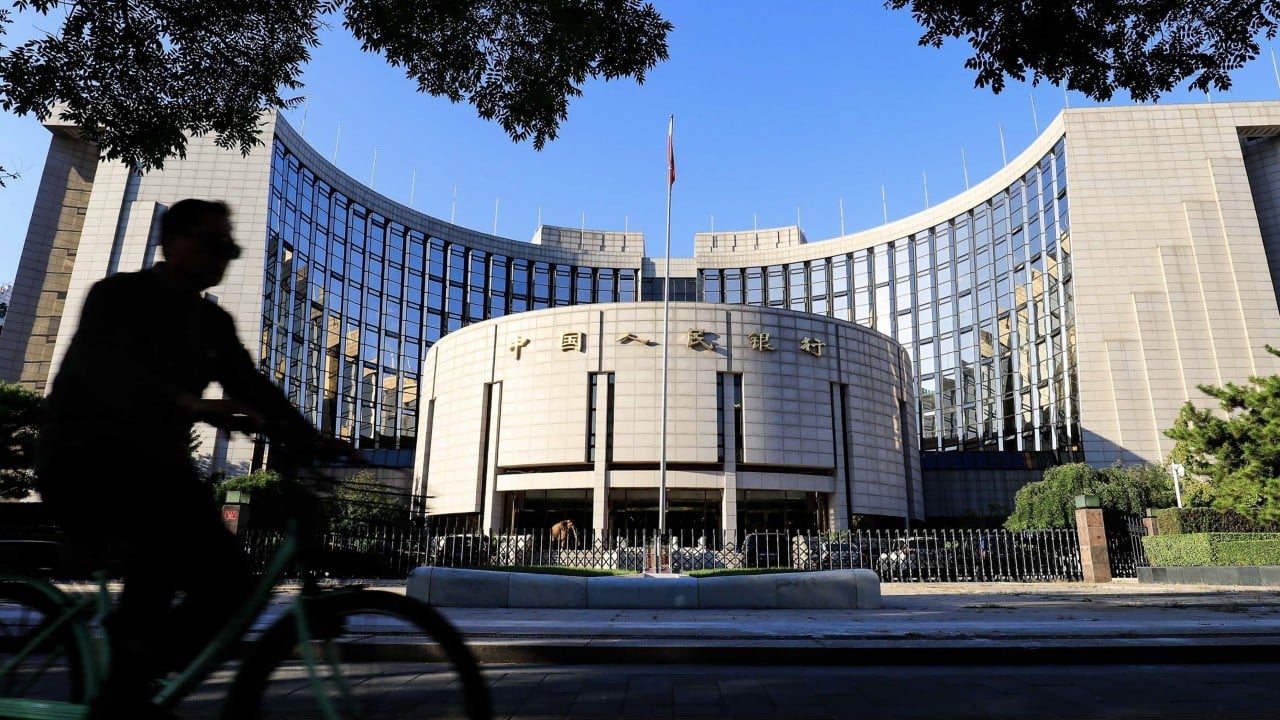
The omission of explicit "stimulus" phrasing from recent People's Bank of China (PBOC) communications does not signal monetary tightening; it marks a structural transition from liquidity generation to transmission efficiency. When a central bank stops announcing new easing cycles and instead emphasizes policy implementation, it has hit the boundary of monetary supply-side utility. For analysts, investors, and multinational operators, the analytical challenge is no longer forecasting the magnitude of the next reserve requirement ratio (RRR) cut or policy rate reduction. The objective is measuring the velocity of capital moving from commercial bank balance sheets into productive real-economy liabilities.
To understand why Beijing dropped the rhetoric of incremental stimulus, one must separate monetary supply from credit demand. Over multiple cycles, the PBOC injected substantial base money into the banking system. Yet, lower benchmark lending rates and expanded liquidity facilities failed to generate proportional increases in fixed-asset investment or household consumption. The bottleneck is not the cost of capital; it is the marginal propensity to borrow among private enterprises and households facing balance-sheet repair. Continuing to broadcast "stimulus" creates diminishing marginal returns in market expectations while risking currency depreciation pressures and commercial bank net interest margin (NIM) compression. By shifting the linguistic focus to "policy delivery," Beijing is attempting to clear the plumbing of existing credit channels rather than flooding an already congested pipe. Recently making headlines lately: Mechanics of Sovereign Deposit Insurance and Partial Depositor Refunds in Paraguay.
The Transmission Breakdown Between Base Money and Real Credit
Standard monetary theory assumes that lowering the price of reserves incentivizes commercial banks to expand loan books, which in turn stimulates aggregate demand. In China's current macroeconomic environment, three distinct structural frictions interrupt this mechanism.
First, commercial bank net interest margin compression constrains lending appetite. State-owned and joint-stock banks operate under dual mandates: they must support state-directed credit quotas while maintaining capital adequacy ratios. Repeated reductions in the Loan Prime Rate (LPR) have compressed asset yields faster than banks can lower deposit rates, particularly as households shift funds from demand deposits into higher-yielding time deposits. When a bank's NIM falls below the threshold required to cover non-performing loan (NPL) provisioning, extending new credit to higher-risk private borrowers becomes value-destructive. Dropping stimulus language relieves immediate downward pressure on bank asset yields, giving financial institutions breathing room to digest existing credit facilities. Additional insights regarding the matter are covered by CNBC.
Second, liquidity traps in the corporate and household sectors neutralize rate cuts. Borrowing requires a positive spread between the expected return on invested capital and the cost of debt. When industrial overcapacity suppresses producer prices and real estate asset values remain in an adjustment phase, the expected return on private capital expenditure drops. Lowering borrowing costs by 10 to 25 basis points does not alter the net present value calculation of a factory expansion or a residential mortgage when asset deflation expectations persist. Households and private firms use cheap liquidity to pay down existing high-interest debt rather than fund new consumption or investment—a classic balance-sheet recession dynamic.
Third, local government debt restructuring absorbs disproportionate financial bandwidth. Local Government Financing Vehicles (LGFVs) historically acted as the primary transmission belt for Chinese stimulus, converting bank loans into infrastructure spending. With Beijing imposing strict controls on hidden local debt and prioritizing debt-swap programs over new off-balance-sheet borrowing, the traditional fiscal-monetary multiplier has stalled. Liquidity intended for growth is diverted into rolling over legacy obligations at lower interest rates and longer maturities.
Deconstructing the Policy Delivery Framework
When the PBOC and senior economic planners pivot to "policy delivery" (often framed domestically as ensuring existing measures take root and yield results), they are deploying a specific operational framework designed to bypass traditional banking bottlenecks. This framework rests on three functional pillars.
1. Structural Monetary Policy Tools Over Aggregate Easing
Aggregate tools—such as broad RRR cuts or policy rate reductions—distribute liquidity indiscriminately across the financial system, where it frequently remains trapped in interbank markets or flows into government bonds. Policy delivery relies on targeted relending facilities.
Under a structural relending mechanism, the PBOC provides low-cost funding to commercial banks strictly conditional on those banks having already extended loans to designated sectors: advanced manufacturing, green transition projects, technological innovation, and affordable housing inventory digestion. This reverses the traditional sequence. Instead of providing liquidity first and hoping banks lend it out, the central bank reimburses banks after verified credit deployment. Dropping broad stimulus language forces commercial loan officers to hunt for qualifying real-economy projects to access cheap central bank funding, directly improving transmission velocity.
2. Fiscal-Monetary Synchronization
Monetary policy cannot generate aggregate demand in isolation when private risk appetite is dormant; fiscal policy must act as the primary borrower of last resort. The shift toward delivery reflects a realignment where the central bank's primary function is accommodating sovereign and quasi-sovereign bond issuance rather than engineering standalone credit booms.
When the Ministry of Finance issues ultra-long special treasury bonds or accelerates local government special-purpose bond (SPB) issuance, the PBOC manages interbank liquidity—via open market operations (OMO) and outright reverse repos—to prevent sovereign debt supply from spiking yields and crowding out private credit. The absence of "stimulus" headlines masks a critical operational reality: monetary policy has become subordinate to fiscal execution. Success is no longer measured by new PBOC announcements, but by the speed at which fiscal authorities disburse bond proceeds to contractors, suppliers, and local projects.
3. Administrative Enforcement of Credit Whitelists
In a market where risk-averse loan officers hesitate to lend to distressed sectors—most notably property developers—price signals fail. Policy delivery substitutes administrative coordination for market pricing through mechanisms such as the urban real estate financing coordination mechanism (the "whitelist" system).
Local governments compile lists of viable housing projects and submit them to commercial banks. Once a project is whitelisted, banks are administratively mandated to meet its reasonable financing needs, supported by regulatory forbearance on non-performing loan accountability for individual loan officers. This is an execution mechanism, not a monetary expansion. It requires zero new stimulus announcements from the PBOC, yet it determines whether stalled construction sites receive the working capital needed to complete deliveries and restore household confidence.
Operational Mechanics: How to Read the Data Signals
Because Beijing has deliberately muted its rhetorical signaling, relying on official press releases for policy direction will produce false negatives. Analysts must track the physical movement of capital through four specific empirical indicators to verify whether policy delivery is actually occurring.
- The M1-M2 Money Supply Spread: M2 measures broad money, including time deposits, while M1 captures cash in circulation and corporate demand deposits. A wide negative spread (where M2 grows significantly faster than M1) indicates liquidity hoarding—firms and households are parking cash in savings accounts rather than keeping it in liquid checking accounts for imminent transactions. True policy delivery is confirmed only when M1 growth accelerates and narrows the gap with M2, proving that credit is entering active commercial circulation.
- Government Bond Issuance vs. Fiscal Expenditure Velocity: Tracking the announcements of bond quotas is insufficient. Analysts must compare net government bond financing in Total Social Financing (TSF) against monthly Ministry of Finance fiscal expenditure data. A lag between bond issuance and fiscal spending indicates local bureaucratic paralysis—officials holding cash due to fear of audit or lack of compliant projects. Policy delivery succeeds only when fiscal expenditure growth outpaces bond issuance growth.
- Medium- and Long-Term Corporate Loan Share: Short-term loans and bill financing often reflect artificial "idle circulation" (arbitrage where firms borrow cheap short-term funds and deposit them in higher-yielding wealth management products). Genuine industrial policy delivery appears as a sustained rise in medium- and long-term corporate loans as a percentage of total new yuan loans, signaling capital expenditure rather than working-capital arbitrage.
- Commercial Bank Excess Reserve Ratios: If the PBOC injects liquidity or maintains accommodative conditions while commercial bank excess reserve ratios climb, the delivery mechanism is failing. Falling excess reserves paired with stable interbank repo rates (such as DR007) indicate that banks are actively deploying funds into the real economy.
The Structural Constraints of the Delivery-Only Approach
Treating policy delivery as a complete substitute for fresh stimulus carries severe operational limitations. Recognizing where this strategy fails is essential for accurate risk modeling.
- The Consumer Demand Deficit: Structural relending and fiscal bond issuance heavily favor supply-side interventions—upgrading factory equipment, building infrastructure, and clearing housing inventory. None of these directly repair household balance sheets or raise disposable income growth. Without direct fiscal transfers to consumers or structural reforms to the social safety net that reduce precautionary savings, supply-side policy delivery risks exacerbating industrial overcapacity, further depressing producer prices (PPI) and corporate profit margins.
- Local Bureaucratic Risk Aversion: Policy delivery depends entirely on execution by municipal officials and local bank branch managers. Ongoing anti-corruption campaigns and strict lifetime accountability rules for bad loans create an asymmetric incentive structure: local officials face severe penalties for failed projects or unauthorized debt, but receive minimal reward for aggressive economic experimentation. Administrative directives from Beijing frequently lose momentum as they filter down to county-level executors who prioritize compliance over growth.
- External Currency Constraints: The PBOC's decision to avoid aggressive rate-cut rhetoric is heavily influenced by interest rate differentials with the United States and other major economies. Aggressive verbal easing triggers capital outflows and downward pressure on the renminbi (RMB). By pivoting to quiet policy delivery, the PBOC preserves exchange rate stability, but it forfeits the psychological shock-and-awe effect required to rapidly reverse entrenched deflationary expectations.
Strategic Positioning for Capital Allocators and Operators
The removal of stimulus language from PBOC statements requires an immediate recalibration of exposure to the Chinese economy. Strategies built on anticipating broad-based macro beta—such as buying broad equity indices, generic consumer discretionary stocks, or commodity baskets on the expectation of a massive liquidity flood—are structurally misaligned with Beijing's operational reality.
Capital allocators and corporate strategists must execute three specific adjustments:
First, pivot from macro-beta exposure to policy-node alignment. Map capital allocation directly onto the specific sectors receiving PBOC structural relending and special treasury bond disbursements. Industrial automation, grid modernization, domestic semiconductor supply chains, and state-backed urban renewal projects possess guaranteed funding pipelines regardless of headline monetary policy. Avoid sectors reliant on organic, unsubsidized private credit expansion.
Second, prioritize cash-flow conversion over top-line revenue growth in China operations. In an environment defined by supply-side policy delivery and weak consumer demand, price competition will remain deflationary. Multinational operators and domestic suppliers must tighten accounts receivable terms, minimize inventory build-up, and align sales teams with state-owned enterprises (SOEs) and government-backed entities that have direct access to fiscal bond disbursements.
Third, use the M1-M2 spread and DR007 volatility as primary hedging triggers. Ignore official commentary regarding "ample liquidity" or "prudent policy." Maintain defensive currency and duration hedges until M1 growth demonstrates a sustained three-month upward inflection, which remains the sole reliable proof that Beijing's execution pivot has successfully converted central bank balance-sheet capacity into genuine private-sector velocity.