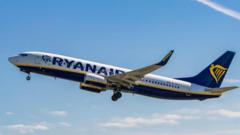
The internet loves a good aviation panic. Give the public a headline about a cracked windshield or a loose window on a budget carrier like Ryanair, and the collective hive mind immediately conjures images of Goldfinger—a helpless passenger being vacuumed through a tiny hole into the freezing stratosphere.
It makes for great drama. It makes for fantastic clickbait. For a different view, check out: this related article.
It is also mechanically, physically, and aerodynamically impossible under the conditions the media loves to sensationalize.
When passengers claimed a man was "nearly sucked out" of a window mid-air during a recent flight, they weren't lying about their fear. They were just lying about the physics. The lazy consensus among travel bloggers and hysterical news outlets is that commercial aircraft are fragile balloons waiting to pop, held together by duct tape and prayers, where a single structural flaw results in instant, explosive decompression. Similar reporting on this trend has been provided by AFAR.
As someone who has spent two decades analyzing structural engineering failure modes and dealing with aviation safety data, I am exhausted by this narrative. The "sucked out of a window" trope is a psychological projection of vulnerability, not a reflection of engineering reality. Let's dismantle the panic and look at how cabin pressure actually works.
The Myth of the Atmospheric Vacuum Cleaner
The core misunderstanding stems from a flawed premise: the idea that the atmosphere outside a cruising jet acts like a high-powered industrial vacuum cleaner actively pulling things out.
It doesn't. Vacuums don't suck; pressure pushes.
When an aircraft climbs to 35,000 feet, the ambient air pressure drops significantly. To keep passengers conscious and breathing, the cabin is artificially pressurized to mimic an altitude of roughly 6,000 to 8,000 feet. This creates a pressure differential. The air inside the tube is pushing outward against the fuselage with tremendous force—roughly 8 pounds per square inch ($8\text{ psi}$).
If a window fails, the air inside the cabin rushes out to equalize with the lower pressure outside. This is a blowout, not a suction event.
The Geometry of the Hole vs. The Human Anatomy
For a human being to be ejected through an opening, the structural failure must be massive. Commercial airplane windows are remarkably small, typically measuring about 11 by 15 inches.
Imagine a scenario where the outer and inner panes of a cabin window completely disintegrate simultaneously. The opening left behind is smaller than the shoulder width of an average adult. The initial rush of escaping air—the decompression wave—lasts only a matter of seconds before the pressure inside and outside equalizes.
Can a passenger's arm or loose objects be pulled toward that opening? Absolutely. Can a full-grown human body be cleanly "sucked out" of a standard, intact window frame like a piece of spaghetti? No. The physics of mass flow rate and structural geometry prevent it.
To actually lose a passenger through a fuselage breach, you need a catastrophic structural failure that compromises the surrounding aluminum frame, such as the explosive decompression experienced by Aloha Airlines Flight 243 in 1988, or the tragic fan blade failure on Southwest Flight 1380 in 2018, where an engine explosion acted as a literal missile, tearing away a massive section of the window and the surrounding fuselage structure.
A standard window crack on a Ryanair Boeing 737 does not possess the kinetic energy to duplicate those freak structural anomalies.
The Triple-Redundant Engineering Everyone Ignores
Aviation regulators like the FAA and EASA do not allow aerospace manufacturers to build single-point-of-failure systems. Aircraft windows are masterpieces of over-engineering, designed to survive forces far beyond anything they encounter in normal service.
An aircraft window is not a single piece of glass. It is a multi-layered sandwich assembly:
- The Scratch Pane (Inner): This is the thin plastic layer you can touch from your seat. Its only job is to protect the actual structural panes from your fingers, coffee spills, and carry-on bags. It carries zero structural load.
- The Middle Pane: This is a heavy-duty acrylic layer equipped with a tiny "bleed hole" (that little hole you see at the bottom of the window). This hole allows pressure to equalize between the cabin and the tiny air gap inside the window assembly, ensuring that the outermost pane bears the full force of the cabin pressure. If the outer pane fails, this middle pane is fully rated to hold the entire cabin pressure on its own.
- The Outer Pane (Structural): This is the thick, main structural barrier that manages the pressure differential and seals the aircraft.
For a passenger to be put in genuine danger from a window failure, both the outer and middle structural panes must fail simultaneously while the aircraft is at peak altitude. The probability of this happening purely from a material defect or a standard crack is infinitesimally small.
Why the Budget Airline Narrative is Flawed
The media loves to target budget carriers like Ryanair or Spirit for these stories because it feeds into a classist bias: “You paid €19 for a ticket, so of course the plane is falling apart.”
This is dangerous nonsense. Maintenance standards are dictated by international law, not by the price of your ticket. A Boeing 737 operated by a ultra-low-cost carrier undergoes the exact same rigorous scheduled maintenance checks (A-checks, B-checks, and heavy C/D-checks) as a Boeing 737 operated by a legacy flag carrier.
The pilots sitting up front have the same licenses, the same simulator training hours, and the same physiological drive to not crash into a mountain. When a window develops a cosmetic crack or a seal becomes loose, causing a loud whistling noise, it triggers an immediate precautionary descent by the crew.
That descent is not a sign of impending doom; it is standard operating procedure. Dropping the aircraft to 10,000 feet eliminates the pressure differential completely. Once the pressure inside matches the pressure outside, the structural hazard drops to zero. The terrifying "rush of air" stops completely.
Stop Asking if the Plane is Safe (Ask This Instead)
The public focuses heavily on the wrong risks because human beings are terrible at assessing probability. People panic over a rattling window pane or a sudden bout of clear-air turbulence, yet they routinely ignore the actual mechanical and human vulnerabilities that cause real accidents.
If you want to worry about aviation safety, stop staring at the window. Start looking at airport surface deviations and runway incursions. The real threat to modern aviation isn't a bolt popping out of a fuselage mid-flight; it is a communication breakdown between air traffic control and a distracted flight crew on a foggy tarmac, leading to two jets occupying the same piece of concrete at the same time.
Furthermore, the real danger of a mid-air decompression isn't being pulled into the sky—it is hypoxia. When air pressure drops, the partial pressure of oxygen drops with it. You don't freeze to death or get pulled out; you simply lose consciousness within 30 seconds if you fail to put on your oxygen mask. The yellow masks dropping from the ceiling are your actual life insurance policy, yet half the cabin treats the safety briefing like an unwanted commercial interruption.
The Real Cost of Irrational Fear
Amplify these sensationalized stories enough, and you create a culture of operational paralysis. When passengers panic over a harmless whistling sound from a door seal or a minor crack in a non-structural window pane, they force crews into making unnecessary emergency diversions.
These diversions dump thousands of pounds of fuel into the atmosphere, disrupt hundreds of flights, strain air traffic control networks, and increase the statistical risk of ground incidents at diversion airports.
The next time you see a headline about a passenger "nearly sucked out" of a commercial airliner, recognize it for what it is: a campfire ghost story told by people who don't understand the difference between a minor pressure leak and a structural hull failure.
Your plane is a fortress of redundant engineering. If a window cracks, the aircraft will descend, you will breathe through a plastic mask for a few minutes, and you will land safely on a runway, bored and inconvenienced, just as the laws of physics intended.
Wear your seatbelt, listen to the safety briefing, and stop looking at the windows. They are tougher than you are.