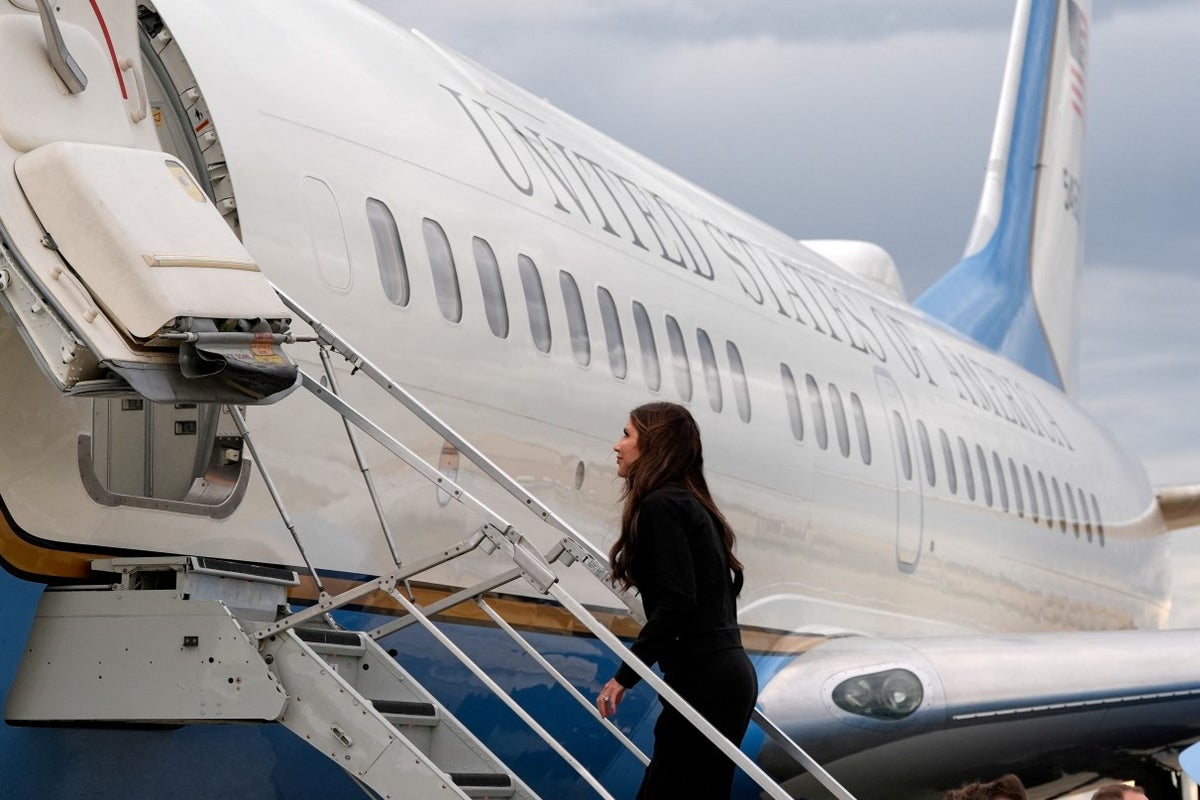
The federal government has officially absorbed the $70 million Gulfstream G550 jet once at the center of South Dakota’s executive travel controversy. By moving this asset into the federal fleet, the White House has effectively neutralized a long-standing political liability for Governor Kristi Noem while simultaneously expanding the transport capabilities of the executive branch. This is not merely a change in registration. It is a calculated reshuffling of high-value aviation assets that serves both the outgoing state administration and the incoming federal requirements for senior staff and first-family logistics.
The jet, a long-range powerhouse capable of nonstop international flight, was originally purchased by the state of South Dakota under intense public scrutiny. Critics argued that a state with a population under one million had no business operating a luxury aircraft of that caliber. Now, the federal government has stepped in to take the heat, repurposing the plane for a rotation that includes high-level diplomatic missions and the specific transport needs of Melania Trump and senior advisors.
From Pierre to Pennsylvania Avenue
The transition of the G550 from a state-level headache to a federal workhorse was executed through a series of administrative handoffs designed to minimize public friction. For years, the aircraft sat as a symbol of perceived overreach in Pierre. The Gulfstream G550 is not a budget-friendly prop plane used for hopping between regional airports; it is a sophisticated machine designed for global reach. Its maintenance cycles alone cost millions, a burden that the South Dakota taxpayer is now officially rid of.
Federal authorities justify the acquisition by citing a constant need for "gray bottom" aircraft—planes that belong to the government but do not carry the high-profile "Air Force One" or "Executive One" callsigns unless the President or First Lady is physically on board. These planes are essential for moving the machinery of government without the logistical circus of a full presidential motorcade and Boeing 747. By taking over the Noem jet, the White House has bypassed the lengthy procurement process required to buy a new airframe from Gulfstream’s Savannah factory.
The Melania Factor and Senior Staff Logistics
Melania Trump’s return to the role of First Lady brings unique transportation requirements. Unlike many of her predecessors, she has historically maintained a schedule that often necessitates independent travel separate from the President’s primary itinerary. The G550 provides the perfect middle ground. It offers the security and communication suites required for the spouse of a commander-in-chief without the astronomical operating costs of the larger VC-25A.
Senior staff also benefit from this acquisition. In previous administrations, top-tier advisors often had to rely on aging C-37A fleets—the military version of the older Gulfstream V. The "Noem Jet" is a significant upgrade in terms of avionics, fuel efficiency, and interior configuration. It allows for secure, encrypted communications in a mobile command center environment, enabling the Chief of Staff or the National Security Advisor to remain in constant contact with global leaders while at 41,000 feet.
Engineering the Transfer
The mechanics of how a state-owned asset becomes a federal one involve complex inter-agency agreements. In many cases, these transfers are framed as "sales" for a nominal fee or as part of a larger swap of federal grant obligations. South Dakota officials have remained relatively quiet on the specific valuation of the transfer, but the result is clear: the state’s debt or maintenance obligations tied to the tail number have been wiped clean.
The aircraft is currently undergoing a refitting process. This includes the installation of Mil-Spec (military specification) defensive systems, such as infrared countermeasures designed to deflect heat-seeking missiles. These are standard for any aircraft regularly carrying "VP-level" or "FLOTUS-level" passengers. The interior, which was already configured for executive comfort, is being modified to include more robust workstations and a more secure data backbone.
The Cost of Staying Airborne
Running a Gulfstream G550 is an exercise in bleeding capital. A single hour of flight time can easily exceed $10,000 when factoring in fuel, crew salaries, insurance, and hangar fees. For a state like South Dakota, these numbers were a constant drag on the budget and a recurring talking point for the opposition. For the federal government, however, these costs are absorbed into the massive Department of Defense or Treasury budgets, where a few million dollars for aviation fuel is essentially a rounding error.
This move highlights a growing trend in executive governance: the centralization of high-value assets. By pulling the jet into the federal fold, the administration ensures that the aircraft is maintained to the highest possible standards while removing it from the localized political crossfire of state-level audits.
A Strategic Buffer
There is also a political buffer created by this move. If the jet stayed in South Dakota, it would remain a "Noem problem." In Washington, it becomes a "national security asset." This rebranding is effective. It shifts the conversation from luxury and excess to utility and protection. The G550 is one of the most reliable airframes in history, boasting a dispatch reliability rate that most commercial airlines would envy. It can fly from D.C. to Tokyo with only a single stop, or to London and Paris nonstop, making it an ideal tool for the fast-paced diplomacy of a modern White House.
Infrastructure and Oversight
The integration of the G550 into the federal pool also involves the 89th Airlift Wing, based out of Joint Base Andrews. This is the unit responsible for "SAM" (Special Air Mission) flights. While the aircraft may be used frequently by the First Lady or senior staff, it is maintained by a specialized group of technicians who ensure that the plane is always mission-ready.
The oversight of these flights is theoretically managed by the White House Travel Office. However, the line between official government business and "political" travel is notoriously thin. When the First Lady uses the jet to attend a ribbon-cutting or a state dinner, the taxpayers foot the bill. When the jet is used for campaign-related stops, the respective campaign is supposed to reimburse the government at a rate equivalent to a commercial first-class fare. In reality, the "commercial equivalent" rarely covers the actual operating cost of a $70 million private jet, creating a hidden subsidy for whoever is in power.
The Long Range Play
This acquisition should be viewed as a permanent expansion of the executive branch's mobile footprint. The G550 has a fatigue life that will allow it to serve the federal government for the next two decades if properly maintained. It is a long-term solution to a short-term political problem.
The White House has effectively "laundered" the reputation of a controversial aircraft. What was once a symbol of state-level vanity is now a vital component of the most powerful transportation fleet in the world. The shift allows the Noem administration to move past the controversy while providing the Trump administration with a ready-to-use, high-performance asset that would otherwise have taken years to procure.
Taxpayers in South Dakota can breathe a sigh of relief that the maintenance bills are no longer hitting their desks, even if they are now paying for the same fuel through their federal returns. The jet is no longer an outlier. It is part of the system now, tucked away in the hangars of Joint Base Andrews, ready to whisk the political elite across the globe at a moment's notice.
The transfer is complete. The tail number may change, but the mission remains the same: moving the most powerful people in the country in a manner befitting their station, regardless of the price tag.