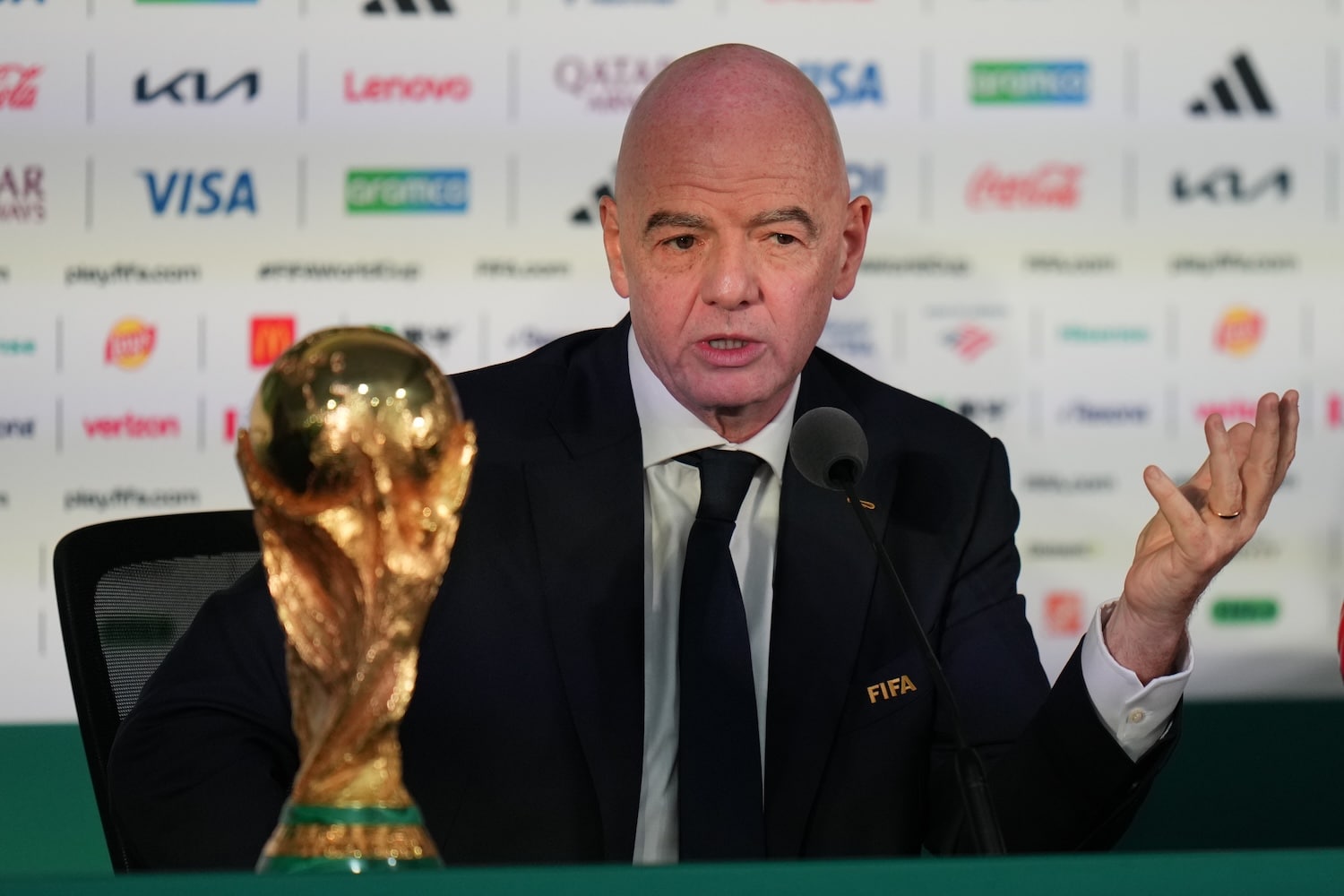
FIFA President Gianni Infantino wanted the football world to relax. Facing a swelling rebellion from players, leagues, and domestic stakeholders over an overcrowded fixture calendar, the head of world football’s governing body used a sports conference to downplay the crisis surrounding his newly expanded, 32-team Club World Cup. His message was simple: calm down, the math adds up. But the math only works if you ignore the breaking point of the human beings on the pitch. FIFA is pushing ahead with a massive summer tournament that nobody asked for, driven by institutional jealousy and a desperate need to capture the lucrative club soccer market dominated by UEFA.
The strategy is failing because it treats player welfare as an afterthought and commercial success as a guarantee. By expanding the tournament, FIFA has entered a direct collision course with domestic leagues, player unions, and television broadcasters who are already experiencing football fatigue.
The Institutional Envy Driving the Expansion
To understand why FIFA is risking a civil war within the sport, you have to look at the money. For decades, FIFA has watched the UEFA Champions League generate billions of dollars in annual revenue, establishing European clubs as the true epicenters of global football power. FIFA controls the international game, but its primary cash cow, the men’s World Cup, only occurs once every four years.
Infantino’s administration designed the expanded Club World Cup to bridge this revenue gap. The goal was to create a club-level equivalent of the national team tournament, held every four years during the European summer, featuring elite teams like Real Madrid, Manchester City, and Bayern Munich.
Traditional Calendar: Domestic Leagues -> Domestic Cups -> Continental (UEFA) -> Short Summer Break
Expanded Calendar:    Domestic Leagues -> Domestic Cups -> Continental (UEFA) -> 32-Team Club World Cup -> Zero Break
The institutional jealousy is transparent. FIFA wants a year-round seat at the billionaire club football table. By inserting a month-long, 32-team tournament into June and July, FIFA directly encroaches on the traditional offseason. This is the only window where players can recover from a grueling ten-month domestic and continental campaign.
The Fallacy of the Five Percent
FIFA frequently defends its expanding calendar by stating that the Club World Cup only impacts a tiny fraction of the world's players. The argument suggests that because the vast majority of clubs do not participate, the outcry is exaggerated.
This logic is fundamentally flawed. While the tournament only features 32 teams, those teams employ the most prominent, heavily marketed, and frequently capped players on earth. These elite athletes are not just playing domestic league matches; they are competing in domestic cups, continental championships, and regular international breaks for their national teams.
A top-tier midfielder for a Premier League club can easily log 60 to 70 appearances a year before this new tournament even starts. Adding another seven high-intensity matches in the summer heat of North America is not a minor adjustment. It is a breaking point. Player unions, spearheaded by FIFPRO, have documented a sharp rise in soft-tissue injuries, mental burnout, and premature career declines caused precisely by this lack of recovery time. When the stars are broken, the quality of the product degrades. FIFA is effectively cannibalizing its own assets for short-term television rights fees.
The Broadcaster Backlash and Financial Realities
FIFA expected media conglomerates to engage in a frantic bidding war for the broadcast rights to this tournament. That bidding war never materialized.
Initial financial projections whispered to participating clubs promised payouts upwards of $50 million just for showing up. Those promises were built on sand. Broadcasters are facing their own economic headwinds, and the sports media market is saturated. Television networks and streaming platforms recognized that fans possess a finite amount of attention and disposable income. A summer tournament featuring exhausted players, played in front of potentially half-empty NFL stadiums, did not command the premium price tag FIFA anticipated.
This lack of commercial enthusiasm forced FIFA into awkward negotiations. When media companies refused to meet the multi-billion-dollar valuation placed on the tournament, the governing body had to scramble to secure alternative funding and distribution models. The corporate arrogance that defined the tournament's launch met the harsh reality of market indifference.
The Legal Rebellion of the Domestic Leagues
The resistance is no longer confined to angry press conferences and player player union statements. It has moved into the courtroom. Domestic leagues, including England's Premier League and Spain's La Liga, alongside FIFPRO, have filed formal complaints with European antitrust regulators.
The core of the legal argument centers on a conflict of interest. FIFA acts as both the regulatory governing body of global football and a commercial event organizer. The leagues argue that FIFA uses its regulatory powers to unilaterally dictate the international match calendar to maximize its own commercial gain, directly harming the economic viability of domestic competitions.
- Calendar Cannibalization: Summer tournaments delay pre-season tours, which are vital revenue generators for individual clubs.
- Player Depreciation: Increased injury rates directly diminish the value of a club's most expensive assets.
- Squad Dilution: Leagues may be forced to allow larger squad sizes, driving up wage bills and threatening financial sustainability rules.
Domestic leagues are fiercely protective of their domestic markets. If a domestic cup competition loses its luster or a league match features reserve squads because the stars are being rested for FIFA events, the domestic product loses value. The leagues are realizing that giving FIFA an inch means losing a mile of the footballing calendar.
The Myth of Global Inclusivity
FIFA frequently cloaks its commercial expansions in the language of global development. The narrative claims that a 32-team tournament gives clubs from Africa, Asia, and North America a rare chance to compete on equal footing against the giants of Europe.
This is a romantic notion that ignores the sporting reality. The financial disparity between European football and the rest of the world is a canyon, not a gap. A club from the Egyptian Premier League or the AFC Champions League operates on a fraction of the budget of a mid-table English side, let alone a state-backed superpower. Bringing these teams together in a grueling tournament does not democratize football; it merely highlights the systemic inequality while using non-European clubs as props to justify a global footprint.
The tournament structure ensures that the wealthy European clubs will likely dominate the later stages, turning the semi-finals and finals into a redundant iteration of the UEFA Champions League, just played on a different continent under a different corporate logo.
A Broken System of Governance
The crisis surrounding the Club World Cup exposes a deeper malaise within football governance. The sport is run by a collection of fiefdoms—FIFA, continental confederations like UEFA, domestic leagues, and national associations—each operating with its own balance sheet and political agenda. There is no centralized authority looking out for the holistic health of the game or the people who play it.
When Infantino tells the industry to relax, he is speaking from a position of insulated political security. FIFA presidents are elected by national associations, many of which rely heavily on FIFA development funds to survive. These associations rarely produce the elite players who bear the burden of the calendar expansion. Therefore, the political incentive structure within FIFA always favors more tournaments, more matches, and more distributed revenue, regardless of the strain it places on a handful of top-tier clubs and leagues.
This disconnect cannot hold forever. The threat of a player strike, once dismissed as empty rhetoric, has become a legitimate talking point among senior internationals. If the top fifty players in the world collectively refuse to step onto the pitch during a summer tournament, FIFA's multi-billion-dollar asset vanishes instantly. The governing body is gambling that the players' competitive drive and contractual obligations will always compel them to play. It is a dangerous bet to make when the physical limits of the human body are being reached.
The Unviable Path Forward
The fundamental flaw of the expanded Club World Cup is that it treats football as a commodity with infinite elasticity. It assumes that fans will watch any combination of badges on a screen at any time of the year, and that players can be run into the ground like machines without breaking.
Fixing the calendar requires an admission that the current trajectory is unsustainable. It requires reducing the number of meaningless international friendlies, restructuring domestic cup competitions, and enforcing a mandatory, uninterrupted summer break for every player. FIFA will not initiate these changes willingly, because doing so requires relinquishing power and potential revenue. The change will have to be forced through the courts, through broadcaster withdrawal, or through the ultimate leverage of a player walkout. Until then, the sport will continue to redline, driven by an executive suite that tells everyone to chill while the engine is smoking.