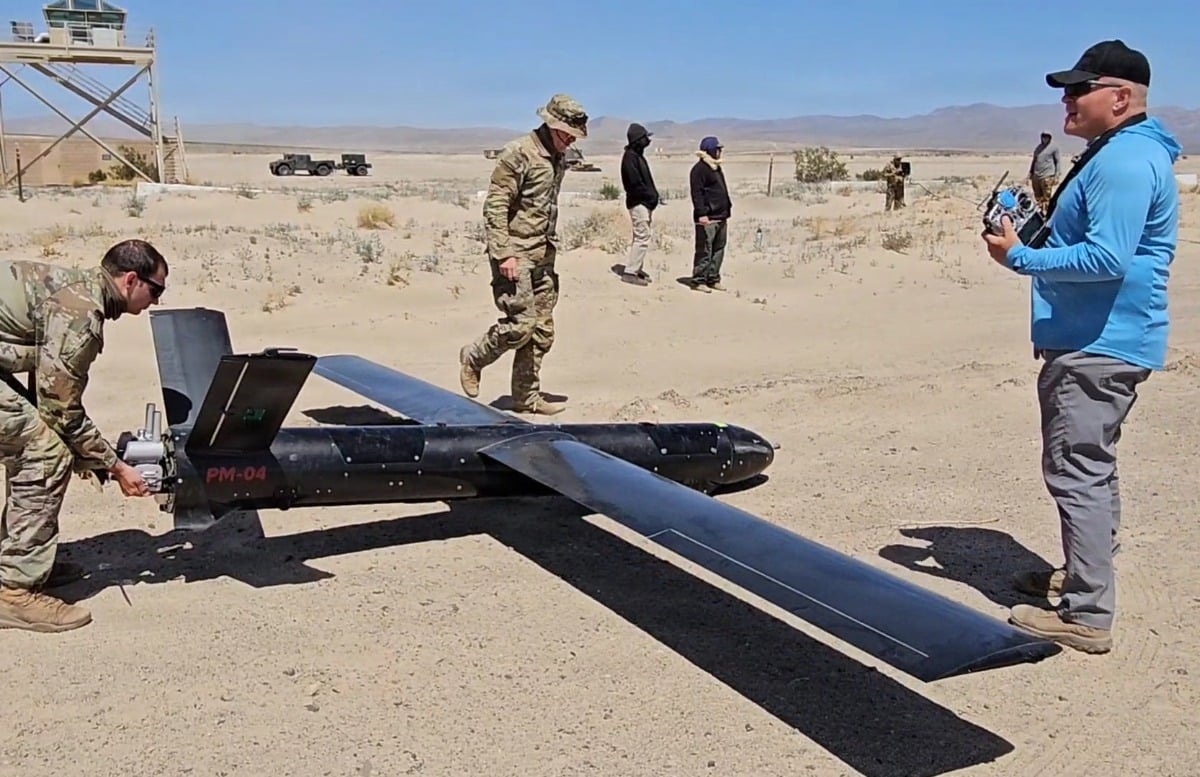
The defense procurement echo chamber is celebrating again. AEVEX Aerospace just locked down a $50 million contract for GPS-resistant strike drones. The headlines read like a tech utopian blueprint: autonomous navigation, jam-resistant electronic warfare suites, and mass-producible loitering munitions ready to saturate contested airspace.
It sounds flawless on paper. It is a disaster in waiting. In similar developments, read about: The Moment the Clock Stopped on the Silicon Throne.
The defense establishment is throwing millions at yesterday's problem, patting itself on the back for outsmarting jamming tech that peer adversaries moved past three years ago. I have watched defense tech firms burn through ten times this budget chasing "jam-proof" architectures, only to realize they built a beautifully engineered brick.
The entire premise of the GPS-resistant strike drone market rests on a fundamental misunderstanding of modern electronic warfare. We are building sophisticated, localized navigation workarounds while completely ignoring the brutal reality of multi-spectral denial. Ars Technica has analyzed this fascinating issue in great detail.
The Illusion of Alternative Navigation
The lazy consensus screams that if you lose GPS, you just need a better backup sensor. The industry has rallied around three specific pillars to solve the denial problem:
- Optical Flow and Visual Odometry: Using cameras to track ground features and calculate velocity.
- Terrain Contour Matching (TERCOM): Radar or LiDAR altimetry mapped against pre-loaded 3D digital elevation models.
- High-End Inertial Measurement Units (IMUs): Dead reckoning via micro-electromechanical systems (MEMS) that calculate position without external inputs.
Here is the brutal truth the marketing decks gloss over.
Visual navigation fails the moment your adversary deploys cheap multi-spectral obscurants, aerosol screens, or simple thermal cloaking blankets over high-value assets. If a camera cannot see contrast, the navigation algorithm drifts within seconds.
TERCOM requires massive onboard processing power and highly accurate, pre-mapped terrain data. Try running TERCOM over a rapidly shifting littoral environment, a flattened urban landscape, or the featureless topography of an open desert. The math breaks down.
Then there is the IMU trap. To get an inertial system that does not drift by hundreds of meters after twenty minutes of GPS denial, you need fiber-optic or ring-laser gyros. Those do not fit into a cheap, mass-producible strike drone. The low-cost MEMS units forced into these $50,000-to-$100,000 airframes have drift rates that turn a precision strike mission into an expensive game of blind lawn darts.
The Machine Vision Delusion
The contract wins rely heavily on the promise of terminal guidance via machine vision. The pitch states that even if the drone loses its data link and its GPS signal, onboard artificial intelligence will identify the target and execute the terminal dive.
Imagine a scenario where an autonomous strike drone is hunting a specific mobile radar unit. It approaches the target area under heavy electronic attack. It switches to its onboard neural network for object recognition.
The enemy has placed an inflatable decoy three meters away from the real vehicle. They have painted high-contrast geometric shapes on the roof of the actual radar unit and lit a smoky oil fire nearby.
The machine vision system, trained on clean synthetic data or pristine satellite imagery, suffers an immediate classification failure. It either tracks the decoy or defaults to a non-target.
We are treating autonomous target recognition as a solved computer science problem. It is an adversarial cat-and-mouse game where the defender holds all the cards. Cheap, low-tech countermeasures defeat expensive algorithms every single time.
The Scalability Paradox
You cannot build a cheap, mass-producible attrition asset that also contains the hardware suite required to survive a modern peer-to-peer electronic warfare environment. You have to choose one.
| Attribute | The Marketing Promise | The Engineering Reality |
|---|---|---|
| Unit Cost | Low enough to expend by the hundreds ($20k–$50k) | Escalates rapidly ($150k+) when adding survivable sensors |
| Sensor Suite | Commercial-off-the-shelf (COTS) optical and IMU | Requires hardened, shielded, and calibrated military-grade components |
| Processing Power | Edge-AI on low-power silicon | Heavy thermal and battery drain from running real-time localization |
| Production Speed | Rapid assembly line scaling | Bottlenecked by specialized calibration facilities for precision sensors |
When you try to bridge this gap, you get a compromise that achieves neither objective. You build a drone that is too expensive to lose in volume, yet too fragile to survive against an adversary like China or Russia.
People Also Ask (And Get Wrong)
Can't we just use anti-radiation seekers to home in on the jammers?
This is 1990s thinking. Modern electronic warfare platforms do not sit there emitting a continuous, high-power jamming signal for your drone to track. They use cognitive electronic warfare: blinking networks of synchronized jammers, directional antennas, and digital radio frequency memory (DRFM) clones that create ghost targets. A cheap strike drone trying to home in on a modern jammer is chasing a phantom.
Doesn't a $50M contract prove the military validates this tech?
No. It proves the procurement system validates the tech. The Department of Defense routinely awards contracts based on performance in sanitized testing environments. Flying a drone across a desert grid in New Mexico with a localized GPS jammer running on a known frequency is not combat validation. It is theater.
Why not just use satellite communications for remote piloting when GPS is gone?
Because SATCOM links are just as vulnerable to uplink and downlink jamming. If an adversary can blank out the civilian L1/L2 GPS bands across a 200-kilometer front, they can and will blind your Ku- and Ka-band satellite transceivers with localized high-power directional noise.
The Dangerous Downside of the Counter-Approach
To be completely transparent, fixing this requires a pivot that carries its own massive risks. If we abandon the idea of making individual low-cost drones smarter and more resilient, the alternative is radical simplicity: unguided, ballistic, or semi-autonomous mass salvos that rely purely on geographic saturation rather than precision guidance.
The downside to this approach is obvious. It increases the risk of collateral damage. It demands a massive logistics tail to move thousands of simpler weapons instead of hundreds of smart ones. It strips away the clean, surgical narrative that politicians love.
But war is not clean, and it is not surgical.
Stop Hardening the Drone. Change the Architecture.
We need to stop trying to build the ultimate self-contained, jam-proof flying robot. It is a dead end. Instead of packing $100,000 worth of alternative navigation sensors into an airframe meant to explode, the entire architecture must be decoupled.
The intelligence must live outside the strike asset.
We should be deploying high-altitude, low-observable stand-off platforms that remain outside the primary electronic warfare bubble. These platforms use passive signals intelligence, bistatic radar, and long-range optical tracking to map the battlespace in real time. They do not send guidance data to the drone via fragile radio links. Instead, they calculate precise, time-stamped ballistic trajectories and project local, short-duration optical or pseudo-GPS beacons directly onto the target zone from above.
The strike drone itself should be nothing more than a wing, a motor, an explosive charge, and a dirt-cheap receiver tuned to a highly specific, rapidly modulating frequency.
If the drone remains a dumb pipe, there is nothing for the enemy to jam, confuse, or spoof.
We are watching a massive misallocation of capital take place under the guise of innovation. Winning a fifty-million-dollar contract for GPS-resistant drones is not a sign of technological leadership. It is a sign that the bureaucracy has successfully institutionalized a temporary band-aid.
The next war will not be won by drones that can stumble through a jammed environment. It will be won by the forces that realize the individual drone never needed to think in the first place. Stop building smart weapons for an environment that punishes complexity. Turn the drones back into ammunition.

