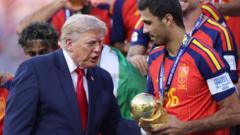
The convergence of political leadership, pop culture icons, and mega-sports during the 2026 FIFA World Cup final signals a structural shift in how global attention is monetized. The integration of a extended 11-minute, Super Bowl-style halftime spectacle featuring Shakira, Justin Bieber, BTS, and Madonna alongside high-profile political attendees like Donald Trump was not an isolated event; it was a deliberate strategy to maximize value per viewer in a fragmented media market.
By expanding the traditional 15-minute halftime window to accommodate a multi-artist musical performance, FIFA fundamentally altered the economic model of international football broadcasting. Understanding this pivot requires evaluating three operational vectors: broadcast real estate expansion, cross-demographic yield optimization, and political legitimacy mechanics.
The Three Vectors of Live Event Yield Optimization
Traditional sports monetization relies on two primary channels: media rights acquisition and matchday ticketing. However, organic growth in linear television rights has slowed globally. To unlock new revenue tiers, rightsholders must engineer structural inventory where none previously existed.
1. Broadcast Real Estate Expansion
International Football Association Board (IFAB) Law 7 dictates that players are entitled to an interval at halftime not exceeding 15 minutes. Breaking this protocol to introduce a condensed concert forced a trade-off between sporting tradition and commercial monetization.
- Inventory Creation: Extending the broadcast window creates premium advertising slots during peak global viewership, commanding rates comparable to the NFL's Super Bowl.
- Risk Factor: Lengthening player downtime introduces metabolic cool-down risks, affecting second-half athletic performance and sparking pushback from tactical purists.
2. Cross-Demographic Audience Capture
Football broadcasts inherently risk viewer attrition among non-hardcore fans during halftime. Structuring an ensemble performance—ranging from global Latin pop (Shakira) and Afrobeats (Burna Boy) to K-pop (BTS) and Western mainstream pop (Justin Bieber, Madonna)—functions as an attention retention engine.
[Pure Sport Audience] ---> (Halftime Interval) ---> [Potential Viewership Decay]
                                    |
                           +--------v--------+
                           | Pop Music Medley| ---> [Demographic Retention & On-Ramping]
                           +-----------------+
This model treats the halftime window as a cross-promotional funnel, converts passive social media observers into active broadcast consumers, and generates immediate viral impressions across digital channels.
3. Political Legitimacy and Soft Power Aggregation
Major sporting finals act as neutral ground for high-profile political figures seeking public attention. The presence of world leaders leverages the event's massive reach, generating non-sporting press coverage and amplifying total impression volume.
Monetization Trade-offs and Strategic Bottlenecks
While the financial arguments for entertainment integration are compelling, institutional execution exposes significant operational friction points.
- Pacing Bottlenecks: Cramming multiple global headliners into an 11-minute window forces aggressive song truncation. Rapid stylistic transitions—such as shifting from acoustic ballads to high-tempo Afrobeats—risk alienating both casual listeners and stadium attendees seeking cohesive entertainment.
- Cultural Polarization: Imposing North American commercial broadcast formats onto traditional international sport creates cultural friction. European and South American fanbases often view the commercialization of match breaks as an unwelcome import that undermines the flow of competition.
- Distribution Costs: Live orchestral arrangements combined with complex stadium staging require rapid installation and removal within minutes, dramatically increasing pitch maintenance and operational costs.
To capture maximum enterprise value from future tournament finals, sports properties must formalize the operational boundary between sport and entertainment. This requires establishing strict staging time limits to protect player welfare, co-licensing official tournament music assets directly with streaming algorithms weeks prior to the event, and segmenting commercial halftime inventory specifically for non-traditional regional sponsors.