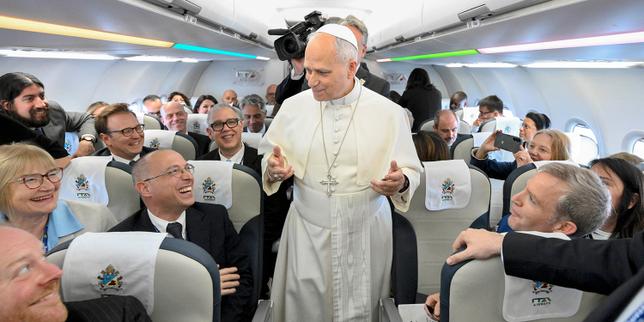
Air travel for heads of state is complicated enough. Now imagine organizing a massive pastoral journey while managing international airspace permissions, massive press pools, and a pontiff who refuses to act like a typical VIP. When a papal plane takes off for France, aviation geeks and international reporters get a rare glimpse into the logistics machine that keeps the Vatican moving at 35,000 feet.
Most people picture a solemn, quiet cabin where everyone speaks in whispers. That is completely wrong. Anyone who has ever squeezed into the back of a chartered ITA Airways or Alitalia jet during an apostolic voyage knows it is closer to a chaotic traveling newsroom crossed with a family reunion. The reality of papal aviation is fascinating, exhausting, and entirely unique.
The Misconception About Papal Charters
You've probably seen the iconic photos of the Pope waving from the top of the aircraft stairs. People assume the Vatican owns a fleet of luxury private jets. They don't.
The Holy See operates on a smart charter model. For international trips, the Vatican Secretariat of State partners with national carriers, most frequently ITA Airways for departures from Rome. Flight AZ4000 isn't just a flight code; it is a signal to air traffic controllers across Europe that priority handling is active.
Securing these flights requires months of quiet diplomatic work. Ground crews must clear security clearances for every single journalist on board. Flight paths have to bypass active conflict zones while keeping fuel loads optimized for tight turnaround times. It's a logistical puzzle that leaves zero room for error.
Inside the Cabin Dynamics
Once the wheels leave the tarmac, the atmosphere shifts instantly. Papal flights are split into distinct zones. Up front, you have the papal suite, a compact private cabin where Pope Leo XIV handles paperwork, prepares speeches, and occasionally rests.
Move past the curtain, and the vibe changes. The press section is packed tight. Over seventy journalists from around the globe squeeze into standard economy or business seats, trading Wi-Fi passwords, frantically filing stories, and comparing notes.
Security personnel maintain a quiet, watchful presence throughout the cabin. They aren't imposing, but they notice everything. Flight attendants work double shifts serving meals while navigating narrow aisles blocked by camera gear and satellite phones.
The Flying Press Conference
The most anticipated moment of any papal flight happens near the end of the journey. Pope Leo XIV usually walks back from his private cabin into the press section to hold an impromptu, wide-ranging Q and A session.
There are no pre-screened questions. Reporters pitch queries directly in French, Italian, Spanish, and English. The Pope answers without a teleprompter, often offering candid thoughts on current global conflicts, climate policy, or internal church governance.
These airborne press conferences have generated some of the most memorable diplomatic headlines of the decade. The acoustics are terrible, engine noise hums in the background, and everyone is straining to hear every word. Yet, it remains one of the most transparent media traditions in international politics.
Landing and Protocol
Arriving in France brings its own set of precision choreography. As the aircraft touches down at Charles de Gaulle or a regional tarmac, local French security forces coordinate seamlessly with the Swiss Guard and Vatican gendarmes.
The plane parks at a remote stand rather than a jet bridge. Mobile stairs roll up to the forward door. When Pope Leo XIV steps out, the welcoming committee of French government officials and local clergy waits below.
Managing these high-profile arrivals requires split-second timing. Motorcades must roll the second the door opens to keep tight schedules across multiple cities. Behind the scenes, pilots and logistics coordinators are already checking weather reports for the return leg to Rome.
Next time you spot a news clip of a papal departure, remember the complex web of diplomacy, security, and journalism happening right behind the cockpit door. It takes a massive, synchronized global effort just to keep one plane moving across the sky.