Forty.
It is a number small enough to fit inside a single regional bus, yet heavy enough to collapse the ceiling of an entire town's memory.
In the relentless, grinding machinery of modern news cycles, a headline flashes across a screen in Paris, New York, or Tokyo: the death toll from a Russian strike on Komyshuvakha, in Ukraine’s Zaporizhzhia region, has climbed to forty, according to President Volodymyr Zelensky. You read the digits. You register the geography—somewhere in the southeastern steppe, a few dozen kilometers from the shifting, smoking scars of the front line. Then your thumb flicks upward, and the screen refreshes to a weather forecast, a stock ticker, a recipe for sourdough bread.
That flick of the thumb is the invisible victory of attrition warfare. When violence becomes a daily ticker tape, human beings dissolve into arithmetic.
To understand what happened when the sky tore open over Komyshuvakha, you have to stop looking at the map as a chessboard of territorial gains and start walking its cracked asphalt at seven in the morning. Before the full-scale invasion rewrote every postal code in southern Ukraine, Komyshuvakha was an unremarkable, sun-drenched settlement of roughly five thousand souls, stitched together by orchards, railway tracks, and the quiet predictability of agricultural life. It sits in the Zaporizhzhia oblast, a region defined by the wide, muscular sweep of the Dnipro River and the vast black-earth plains that have fed empires for centuries.
I have spent enough time along the gray zones of eastern and southern Ukraine to know the exact texture of a morning like the one that preceded this strike. The air smells of dry dust, diesel exhaust, and damp cellar concrete. There is a specific kind of exhaustion that settles into the marrow of people who live fifteen or twenty miles from artillery range—a hyper-vigilance that never truly turns off, even when the kettle is boiling. You learn to listen to the wind differently. You learn the acoustic signature of outgoing fire versus incoming dread.
And yet, life refuses to pause indefinitely. People still queue for bread. Elderly neighbors still sweep broken glass from their front steps with birch brooms. Municipal workers still patch downed power lines so that a grandmother on the third floor can charge her phone and hear her daughter’s voice from Warsaw or Lviv.
The Anatomy of an Ordinary Morning
Consider a hypothetical resident—let us call her Olena, a retired schoolteacher whose apartment windows have been taped in crisp white X-patterns since the spring of 2022. This is a composite portrait drawn from dozens of survivors across the Zaporizhzhia front, meant to ground the cold statistics of official dispatches in lived reality.
Olena wakes up not to an alarm, but to the low, metallic rattle of her windowpanes. In Komyshuvakha, that vibration is background noise. She puts on a wool cardigan, steps over the emergency backpack packed by her front door—containing her passport, blood pressure medication, a flashlight, and a bottle of water—and walks down to the local shop to buy milk and sunflower seeds.
Outside, the town is awake. A postman pushes his bicycle past a row of whitewashed cottages. Two men in grease-stained jackets lean over the open hood of a Lada, arguing about a carburetor. A young mother adjusts the knit cap on her toddler’s head near the bus stop. None of them are wearing uniforms. None of them are sitting inside a command bunker or operating a radar array. They are simply existing in the narrow strip of land between the occupied south and the regional capital of Zaporizhzhia, roughly twenty-five kilometers to the northwest.
To understand why places like Komyshuvakha are struck with such devastating frequency, you have to grasp the brutal physics of modern long-range munitions. Think of the front line not as a neat fence, but as a storm system whose lightning strikes miles ahead of the rain clouds. Guided aerial bombs—heavy Soviet-era iron bombs fitted with pop-out wings and satellite navigation kits, known across Ukraine by the chilling acronym KAB—can be released by aircraft flying dozens of kilometers behind Russian lines, well out of reach of short-range air defenses. They glide silently through the upper atmosphere, carrying half a ton or more of high explosive, and slam into the earth with almost zero warning. Unlike cruise missiles, which trigger air-raid sirens minutes before arrival as radar tracks them across hundreds of miles, a glide bomb launched near the Zaporizhzhia line gives a town like Komyshuvakha seconds.
Seconds. Not enough time to finish tying a shoelace. Not enough time to run down three flights of concrete stairs to a basement shelter.
The Arithmetic of the Rubble
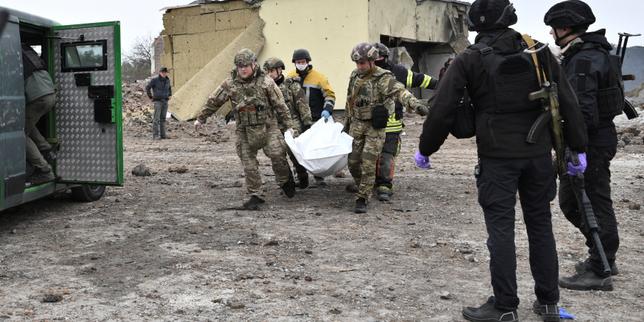
When the strike hit Komyshuvakha, the initial reports were fragmentary, as they always are in the immediate aftermath of mass-casualty blasts. First come the dust clouds—thick, gray plumes of pulverized brick and plaster that choke the lungs and blind the rescue crews arriving on scene. Then come the early, understated numbers: five dead, twelve injured, search operations ongoing.
In the architecture of disaster reporting, the death toll rarely arrives all at once. It rises in grim increments over hours and days as heavy cranes lift slabs of reinforced concrete, as sniffer dogs whine at gaps in collapsed stairwells, and as critically wounded patients succumb to internal injuries in overwhelmed regional trauma wards. When President Volodymyr Zelensky confirmed that the toll had reached forty, that figure represented the slow, agonizing excavation of a community’s daily routine.
Let us look closely at what forty deaths actually means in a settlement of five thousand people.
If a proportional catastrophe struck a city the size of Paris, it would mean nearly eighteen thousand dead in a single morning. If it hit New York City, more than sixty-five thousand people would be wiped off the census before lunch. In a small town like Komyshuvakha, forty dead means almost every surviving resident knows the name, the voice, and the laugh of at least three or four people buried beneath the rubble. It means an entire generation of neighbors—the baker, the nurse, the mechanic, the child waiting for the bus—vanishes simultaneously, leaving behind empty chairs at kitchen tables and unwatered geraniums on windowsills.
Why does the international public struggle to hold onto these numbers? Psychologists call it psychic numbing—a cognitive defense mechanism first documented by researchers studying how human empathy responds to mass tragedy. Our brains are wired to feel profound grief for one identifiable person, a mother holding a photograph or a child pulled from debris, yet our emotional circuitry short-circuits as the numbers climb into the dozens, hundreds, and thousands. Once a tragedy crosses from a human story into a statistical update, our minds file it under the abstract category of "ongoing conflict."
Military strategists understand this cognitive blind spot intimately. Repeated strikes on frontline towns and civilian infrastructure are rarely accidental byproducts of imperfect targeting; they are instruments of psychological attrition. The objective is twofold: first, to render the borderlands uninhabitable, forcing waves of internal displacement that strain the host country’s economy, hospitals, and municipal budgets; and second, to normalize the horror for outside observers until political urgency dissolves into diplomatic fatigue.
What the Sirens Do Not Tell You
Living through this reality strips away every romanticized notion of resilience. From afar, outsiders often praise Ukrainian civilians for their toughness, as if endurance were a superpower rather than a grueling, daily tax paid by the nervous system.
I remember sitting in a dimly lit kitchen in Zaporizhzhia city during an autumn blackout, listening to a volunteer coordinator explain how she decides which villages to drive into with humanitarian aid. She had a paper map spread across the oilcloth table, marked with red felt-tip circles around settlements like Komyshuvakha, Orikhiv, and Huliaipole. Her hands shook slightly every time a heavy truck rumbled past the building outside, mimicking the low-frequency thrum of an explosion.
"People ask me why the elderly don't just leave," she told me, staring at the red circles. "Where do you go when your entire life is forty square meters of brick and a vegetable garden you planted forty years ago? If you leave with two suitcases on a pension of a hundred dollars a month, you become a ghost in someone else's city. If you stay, you gamble your life every time you walk out the gate to feed your chickens."
That is the trap that defines life across the Zaporizhzhia region. Since the occupation of the southern half of the oblast in 2022—including the massive Zaporizhzhia Nuclear Power Plant at Enerhodar and the coastal cities along the Sea of Azov—the northern edge of the region has functioned as an exposed nerve. Komyshuvakha sits directly along the rail and road arteries connecting Zaporizhzhia city to the southeastern front. That geography makes it permanently vulnerable.
When Zelensky announced the updated toll of forty dead, he paired the figure with a familiar, urgent refrain: the desperate need for additional air defense systems and long-range capabilities to strike the airfields and launch platforms before those bombs ever leave the rails under Russian wings. To a reader skimming a news feed, that plea can sound like standard wartime rhetoric, a political talking point repeated across hundreds of briefings since 2022.
Look at it instead through the lens of physics and time.
Air defense is not merely a shield; it is the purchase of minutes. An advanced surface-to-air interceptor battery stationed near a regional hub does not just protect power substations or bridges—it buys a mother at a bus stop the thirty seconds she needs to throw her body over her child inside a concrete stairwell. Without that umbrella, every school, post office, and grocery store within fifty kilometers of the contact line becomes an open-air target.
The Invisible Aftershocks
The tragedy of Komyshuvakha does not end when the last body is recovered from the rubble and the official death toll stops climbing. Every mass-casualty strike triggers a silent cascade of secondary damage that never makes the breaking-news banners.
Think of the rescue workers from the State Emergency Service—men and women in scorched yellow helmets who spend twelve-hour shifts prying twisted rebar apart with hydraulic cutters, knowing that every vibration could trigger a secondary collapse, and knowing that a second strike—a double-tap attack aimed specifically at first responders—could arrive at any moment. Think of the surgeons in Zaporizhzhia operating under generator light on blast injuries that tear apart tissue with supersonic shockwaves.
And think of the children who survive.
A child who hears the whistle of an incoming munition and watches the walls of their neighborhood turn to dust does not simply bounce back when the debris is cleared. Trauma rewires developing brains, turning thunder, slamming doors, and the hum of a refrigerator into triggers of acute panic. Schools across the Zaporizhzhia region have been forced underground—literally built inside reinforced concrete bunkers beneath the earth so children can learn multiplication tables without looking up at the ceiling every time an engine passes overhead.
When we reduce Komyshuvakha to a single line of text—forty dead in a Russian strike—we inadvertently erase the texture of what is being defended and what is being lost. History shows us that wars of attrition are rarely decided solely by the movement of flags on a map; they are decided by whether the outside world retains the moral imagination to recognize individual human worth inside a sea of statistics.
The next time a dispatch from Zaporizhzhia scrolls past your screen, pause before your thumb moves on. Picture a whitewashed cottage beside a railway track, a bicycle leaning against a garden gate, and a bowl of sunflower seeds left half-empty on a kitchen table.
Forty is not a statistic.
It is forty entire universes, extinguished in the time it takes to draw a single breath.