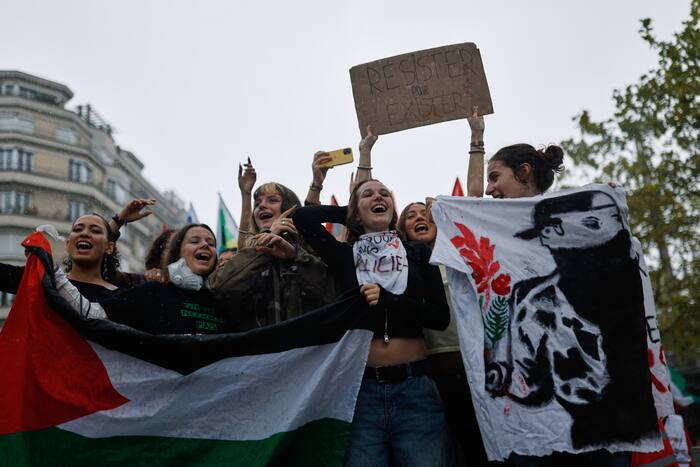
Standard protest coverage treats the mobilization across France as a simple headcount of angry citizens reacting to higher prices and crowded classrooms. That framing misses the structural engine driving the unrest: two distinct pressure systems—household cash-flow erosion and public-school resource rationing—converged into a single street coalition.
A rigorous breakdown of the demonstrations requires separating the raw street count from the underlying causal chain. When workers, unions, yellow vest veterans, and lycée students occupy the same streets, observers often confuse tactical overlap with shared ideological goals. In reality, the conflict operates through two coupled mechanisms that govern how fast grievances scale, how governments respond, and why concessions on one front rarely pacify the other. Meanwhile, you can find other stories here: Why Calling Donald Trump's Ukraine Pivot a Betrayal Misses the Real Trap.
Deconstructing the Competitor's Framing
A headline focused on protesters rallying over rising living costs alongside student grievances captures the surface coalition, yet it relies on three analytical shortcuts that distort how the crisis functions.
First, it treats street attendance as a single homogenous metric. Counting participants as one block obscures sharp divergences in turnout estimates, geographic spread, and protest tactics. For the November 17 mobilization, French authorities put nationwide turnout at 146,000 people with 28,000 in Paris, whereas the CGT union placed the total above 500,000. Treating those numbers as interchangeable—or ignoring the gap between official security tallies and union counts—hides whether a movement is broadening or concentrating in specific cities and sectors. To explore the bigger picture, check out the recent analysis by The New York Times.
Second, it flattens cause and effect into a side-by-side list. Reporting that workers worry about living costs while students protest school conditions implies parallel complaints rather than a feedback loop. Rising fuel and grocery costs squeeze household budgets, while understaffed schools force families and students to absorb quality losses without corresponding relief in household spending. When student blockades disrupt daily routines and union strikes hit transport or public services, the cost of friction rises for everyone at once.
Third, it omits the political and institutional feedback loops that turn localized grievances into national instability. Street clashes, arrests, and policy reversals do not sit outside the conflict; they alter public blame attribution and reshape electoral incentives ahead of France's next presidential cycle. Polling after the October 17 escalation showed Marine Le Pen above 30 percent and Jean-Luc Mélenchon rising to 17 percent, with 81 percent of surveyed respondents blaming the government for the violence on that day. Without mapping those second-order effects, standard reporting explains who marched while missing why the crisis resists routine de-escalation.
The Two-Track Grievance Engine
To understand how the protests scaled from late-summer and September school walkouts into recurring national demonstrations, model the unrest as a two-track system. Each track has its own trigger, cost structure, and vulnerability to state intervention.
Track One: The Household Cost-of-Living Function
For wage earners and families, the core variable is disposable real purchasing power—what remains after non-discretionary outlays such as fuel, food, housing, and basic utilities are paid. When prices for essentials like diesel or everyday goods rise faster than nominal wages or public-sector pay adjustments, households face an immediate squeeze.
In economic terms, essentials have low price elasticity in the short run. A commuter cannot easily eliminate fuel needs overnight, and a household cannot simply stop buying groceries or paying rent. When non-discretionary costs claim a larger share of monthly income, marginal budget slack disappears. Any secondary shock—a utility bill, a transport disruption, or stagnant pay—triggers acute frustration because households have no buffer left to absorb it.
This is why cost-of-living grievances readily connect traditional trade unions like the CGT with decentralized or yellow vest networks. Organized labor brings institutional coordination and strike capacity across public services and industries, while looser social-media mobilization lowers the barrier for individuals to join marches or blockades.
Track Two: The Public-School Resource Bottleneck
The student track operates on a different mechanism: service capacity per pupil. When public lycées face unfilled teaching positions, shortages of support staff such as education assistants, nurses, or social workers, overcrowded classrooms, or uneven infrastructure, the perceived quality of instruction drops immediately.
Students also point to structural friction inside the education system itself, including long days, scheduling gaps, and high-stakes admissions bottlenecks tied to Parcoursup and concentration tracks. Unlike adult workers who bargain primarily over wages and benefits, high school students experience institutional neglect directly in their daily schedules and future academic pathways.
Crucially, student mobilizations spread through network contagion rather than formal union dues. Once pupils at one lycée stage a walkout or blockade over missing teachers or poor facilities, peers in nearby districts observe the tactic online and replicate it. During late September, disruptions spread across dozens of Paris-region lycées within days as social-media copycat effects amplified local grievances.
Why the Two Tracks Reinforce Each Other
Separate grievances become a durable coalition when they share a common diagnosis: state capacity is strained on multiple fronts simultaneously. Families feel the squeeze of living costs at home while their teenagers confront understaffed schools at the neighborhood level.
Known facts establish the convergence of student walkouts, union-backed rallies, yellow vest revival calls, and nationwide demonstrations across September, October, and November. By contrast, claiming that every protester shares a unified economic program is an educated hypothesis at best. Placards and chants during the unrest have ranged from school resources, wages, and fuel prices to broader political opposition, climate and artificial intelligence warnings, and international causes. A coalition can be broad in attendance while remaining plural—and sometimes fragile—in its priorities.
Escalation Mechanics, Policing, and Political Realignment
Mass protests rarely move in a straight line. They escalate when routine demonstrations collide with enforcement tactics, property damage, or high-visibility flashpoints.
Consider the mechanics of escalation during major mobilization days:
- Crowd density and peripheral radicalization: Large peaceful marches create cover for smaller, more confrontational groups to engage in vandalism, looting, or clashes with security forces.
- Enforcement friction and public reaction: Heavy security deployments, street closures, or controversial crowd-control tools can shift public debate from protest demands to state force. Authorities suspended a type of police stun grenade used against young demonstrators after a 15-year-old lost a hand, illustrating how a single severe injury alters operational rules.
- Judicial and detention load: Large-scale arrests and fast-track prosecutions test administrative capacity. Interior Ministry figures cited by news reports indicate over 7,100 detentions tied to inflation and wage protests since October 17 and roughly 8,000 detentions across student demonstrations since September, with thousands of cost-of-living cases leading to charges and hundreds of prison or suspended sentences.
- Electoral polarization: When mainstream centrist or governing coalitions appear reactive or divided over order and affordability, opposition poles at both ends of the political spectrum gain room to frame the crisis as proof of systemic failure.
Distinguishing between verified outcomes and strategic interpretations matters here. Official arrest counts, policy announcements, and poll snapshots are documented facts. Predicting whether street momentum will permanently lock in a specific presidential matchup next spring remains an educated hypothesis because voter preferences between autumn protests and spring ballots depend on inflation trajectories, wage negotiations, and whether street disorder subsides or recurs.
Evaluating the Government's Containment Playbook
Faced with simultaneous pressure from schools, unions, and households, the French executive has relied on a segmented containment strategy—offering targeted concessions to defuse the most organized or sympathetic grievances while holding the line against broader fiscal or systemic demands.
On the education front, the government announced measures including deploying 3,000 additional substitute teachers, dropping a plan to introduce tuition fees for certain technical programs and preparatory classes, launching a youth consultation platform, and outlining reforms to Parcoursup starting in 2027 with full replacement slated for 2028. President Emmanuel Macron also sought to separate student grievances from violent street actors by condemning rioters while distinguishing them from pupils.
Evaluating this playbook as an operational response reveals both real leverage and clear limits:
- Targeted relief lowers acute friction: Rescinding tuition proposals and adding substitute teachers address concrete pain points that students and parents can immediately verify. That helps explain why student representatives welcomed progress in talks with Prime Minister Sébastien Lecornu even while urging continued mobilization.
- Long-horizon promises carry credibility discounts: Reforms scheduled for 2027 or 2028 do not solve immediate classroom crowding or timetable frustration today. When students see no immediate change on the ground, protests persist.
- Educational concessions do not fix household cash flow: Better school rules or future admissions changes do not lower diesel prices at the pump or raise monthly take-home pay. Because the cost-of-living track is anchored in household budgets, policy wins in education cannot fully substitute for wage or price relief.
- Order enforcement without economic relief risks a blame trap: Relying heavily on bans, security cordons, and arrests can contain immediate street disruption, yet if a large share of the public blames the government for escalation, crackdown optics can backfire politically.
There is no silver bullet available to policymakers managing a multi-front discontent cycle. Broad fiscal subsidies or sweeping wage mandates risk straining public budgets and fueling inflation, whereas fiscal restraint alone prolongs the squeeze on low- and middle-income households. Every lever carries a trade-off.
Strategic Play for Decision-Makers and Analysts
Anyone tracking or navigating this crisis—whether a policymaker, union strategist, institutional investor, or business operator—should stop reading headline crowd estimates as a single signal and instead track three leading indicators:
- Wage-versus-essential-price spread: Watch negotiated public- and private-sector pay adjustments relative to fuel, food, and housing costs. Street mobilization stays elevated as long as real disposable income for frontline workers feels compressed.
- School-to-street conversion rate: Monitor whether lycée walkouts remain localized around staffing and timetable issues or merge into coordinated strike days with major labor confederations.
- Attribution of escalation: Track polling and public commentary on who bears blame when marches turn tense. When public blame concentrates on the government rather than fringe rioters, protest movements gain broader political leverage despite lower or fluctuating street numbers.
The decisive strategic move for authorities seeking to lower the temperature is to pair immediate, verifiable operational fixes in schools with narrow, transparent cost-of-living relief targeted at the highest-friction household expenses, rather than relying on long-dated institutional promises and security containment alone. Until household purchasing power stabilizes alongside visible day-to-day improvements in public services, France's streets will remain an active barometer of unresolved economic strain.