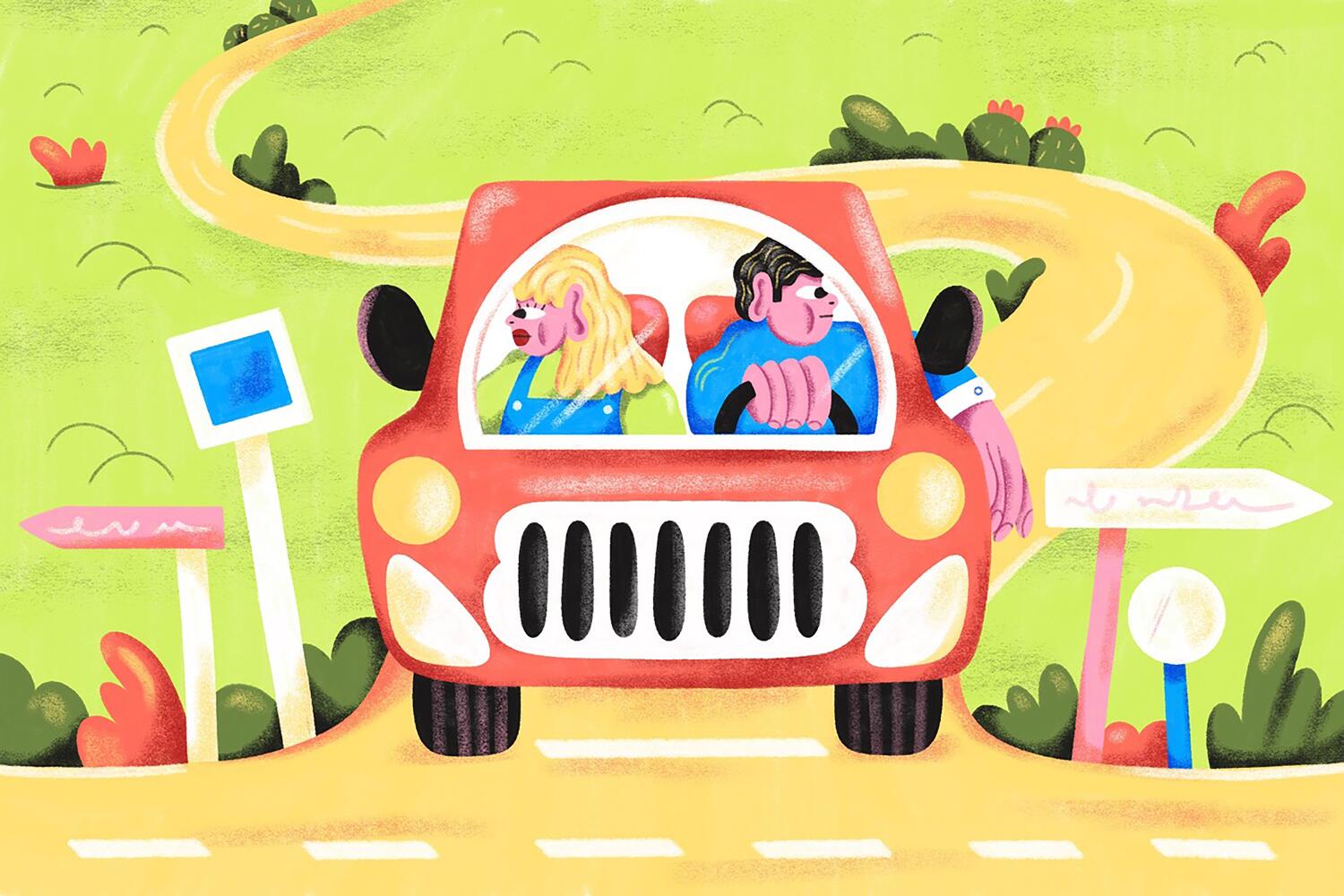
The text arrived exactly when the sun began its slow, bruised-purple descent behind the Santa Monica Mountains.
Just passed the Getty. Traffic is brutal, but I’m moving.
In Los Angeles, this is not a casual status update. It is a declaration of intent. It is an accounting of resources spent, a sacrifice of precious, non-refundable hours offered up on the altar of potential romance. To understand the weight of that text, you have to understand the specific, punishing geometry of the city.
Living in the coastal basin or the central grid of L.A. while dating someone in the San Fernando Valley is a cross-border long-distance relationship. It requires a passport of patience and a full tank of gas. The Sepulveda Pass is not just a geological cleft dividing the city from the Valley; it is a psychological fault line. When someone agrees to cross it during rush hour, they are not just coming over for a drink. They are investing capital.
The Red Tail Lights of Modern Romance
We live in an era of hyper-convenience. With a swipe of a thumb, dinner arrives at the door, laundry disappears and returns folded, and a endless conveyor belt of potential partners flashes across a five-inch screen. We have been conditioned to expect intimacy without friction. If a dating app match lives more than four miles away, the modern brain treats them as if they reside in another time zone.
But true connection resists this optimization.
Consider the math of a Thursday evening date. The distance from Sherman Oaks to West Hollywood is roughly twelve miles. On a map, it looks like a short ribbon of asphalt. In reality, between the hours of five and eight in the evening, those twelve miles transform into an agonizing, slow-motion parking lot. The brake lights stretch out ahead like a glowing, warning string of rubies.
For the person sitting in that gridlock, the radio becomes a mocking soundtrack to their own isolation. The air conditioning hums. The engine idles. The minutes tick away, and with every missed green light, the mental stakes rise.
When a man makes that specific trek, he is signaling something that a thousand witty text messages cannot replicate. He is saying that the possibility of your company outweighs the soul-crushing monotony of the 405 freeway. In a world where men frequently suggest "hanging out" only if it requires zero transit on their part, a willingness to brave the mountain pass is a rare currency. It feels vintage. It feels like effort.
The Psychological Border of the Sepulveda Pass
Every region has its own unwritten rules of engagement. In New York, crossing boroughs can feel like an ordeal, but you can always read a book on the subway or decompress with a walk. In Los Angeles, you are trapped in a metal box, left alone with your thoughts, your posture deteriorating, your stress hormones spiking.
The city forces an immediate calculation. Before the first drink is even poured, the ghost of the return trip hovers over the conversation.
Let us look at a hypothetical scenario to map this out. Imagine Sarah, who rents a small, sunlit apartment in Los Feliz, and David, who owns a home with a yard in Studio City. On paper, they are aligned. They share an interest in independent cinema, obscure taco trucks, and early morning hikes. But between them lies the hill.
On their first date, David drives over the hill to meet Sarah at a dimly lit wine bar on Sunset. He arrives thirty minutes late, his shirt slightly wrinkled from the seatbelt, exhaling a deep breath as he sits down. He apologizes, blaming the bottleneck at the interchange.
Sarah observes this. She feels a rush of validation. He is here. He endured the gauntlet for her. The date goes well, the conversation flows, but beneath the laughter, an invisible clock is ticking. David looks at his phone at 10:15 PM. He isn't checking his messages; he is checking Waze. He is calculating whether the pass has cleared out or if he will encounter construction crews closing down three lanes for overnight resurfacing.
The geography dictates the pacing of the romance. It introduces an artificial urgency. You cannot easily have a casual night when the commute requires a logistical briefing.
The Gridlock Tax on Affection
This geographic tax changes how we evaluate people. In a traditional setting, you judge a partner by their manners, their humor, or their career ambitions. In a sprawling metropolis, you judge them by their willingness to endure inconvenience.
Some might argue this is an superficial way to measure love. It isn't. It is an incredibly accurate diagnostic tool.
The willingness to commute for a person reveals their capacity for discomfort. Modern dating culture is plagued by a low tolerance for any form of friction. The moment an obstacle arises—a scheduling conflict, a minor misunderstanding, a bad day at work—people tend to retreat back into the comfort of their routines. The physical distance of the city acts as a brilliant filter. It weeds out the tourists of your affection.
If a man refuses to drive into the basin because "the traffic is just too crazy right now," he is giving you a preview of his emotional availability. He is telling you that his comfort zone has a strict geographic boundary. If he cannot handle the bumper-to-bumper crawl of the canyons, he will likely falter when the relationship encounters its first real emotional bottleneck.
Conversely, the person waiting at home experiences their own shift in perspective. When you know someone has spent an hour and fifteen minutes fighting their way to your neighborhood, you don't take their presence for granted. You don't scroll through your phone while they talk. You clean up the apartment. You make sure the wine is chilled. You show up to the date with an equal amount of intentionality, because to do otherwise would be an insult to the time they sacrificed on the tarmac.
What We Talk About When We Talk About Traffic
Ultimately, complaining about the drive is the universal love language of Southern California. It is how we express vulnerability without being overly sentimental.
When that new guy finally pulls up to the curb, switches off his ignition, and walks up the steps to your apartment, the first five minutes of conversation will almost certainly be about which route he took. He will talk about the shortcut through Laurel Canyon that failed, or the unexpected accident near the Mulholland exit.
Listen closely to those complaints. They are not actually about the cars or the construction zones.
They are a confession. They are his way of telling you exactly how much he wanted to see your face, packaged in the gritty, exhausting prose of the city he had to conquer to get there.
The front door opens. The heat of the valley still clings to his clothes, a stark contrast to the cool evening breeze coming off the coast. He smiles, a little tired around the eyes, but entirely present. The journey is over. The engine is cooling down in the driveway, and for the next few hours, the map of the city shrinks down until it only contains the space between the two of you.