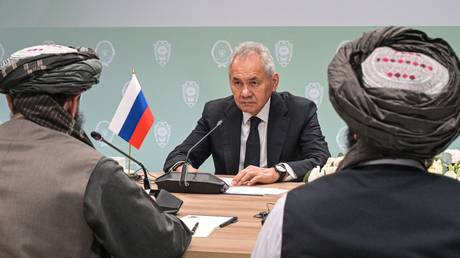
Moscow’s formal alignment with the Taliban administration reflects a calculated, transactional foreign policy designed to manage regional insecurity rather than an endorsement of the regime's ideology. By analyzing this relationship through the lens of realist statecraft and threat containment, the partnership resolves into three distinct strategic imperatives: regional counter-terrorism, border stabilization along the post-Soviet periphery, and the exploitation of Eurasian trade corridors.
The convergence between a major nuclear power and a de facto militant government operates on an asymmetrical dependency model. Russia requires a stable buffer zone against transnational jihadism, while the Taliban requires diplomatic legitimacy and economic insulation to consolidate its domestic authority. If you enjoyed this article, you should read: this related article.
The Containment Vector: Managing the Khorasan Bottleneck
The primary driver of Moscow's engagement with Kabul is the mitigation of asymmetric security threats, specifically the Islamic State Khorasan Province (ISKP). From a Russian defense perspective, the Taliban functions as a low-cost, proxy enforcement mechanism capable of executing high-intensity counter-insurgency operations within Afghan borders.
[Threat Origin: ISKP Recruitment/Radicalization]
       │
       ▼
[Transit Corridor: Weakly Governed Central Asian Borders]
       │
       ▼
[Target Vulnerability: Russian Core Security / Urban Centers]
This security architecture relies on a clear cause-and-effect chain: For another angle on this development, check out the recent coverage from Associated Press.
- Intelligence Asymmetry: Russian intelligence services possess superior satellite reconnaissance and electronic intercept capabilities but lack human intelligence networks inside eastern and northern Afghanistan. The Taliban possesses ground-level operational access but lacks advanced tracking technology.
- Operational Division of Labor: Moscow provides political cover and shared tactical telemetry. In return, Taliban security forces act as the kinetic kinetic edge, directly targeting ISKP cells, training camps, and logistics nodes.
- The Central Asian Buffer: Countries like Tajikistan, Uzbekistan, and Turkmenistan represent Russia’s soft southern flank. A destabilized Afghanistan directly threatens these states via refugee surges and weapons proliferation, which would inevitably bleed into the Russian Federation through visa-free travel regimes.
By formalizing ties with Kabul, Moscow establishes a forward security perimeter. The strategic objective is not the total eradication of extremism—an unrealistic milestone—but the containment of ISKP's operational reach to prevent localized threats from transforming into transnational external operations.
The Economic Corridors: Integrating the Eurasian Heartland
Beyond immediate hard security concerns, Russia’s engagement strategy incorporates a long-term economic calculus designed to bypass Western maritime trade dominance. Afghanistan occupies a critical node in the changing geography of Eurasian supply chains, specifically regarding the development of trans-Afghan transport networks.
The Trans-Afghan Railway Project
Moscow’s economic analysts view the proposed railway linking Uzbekistan’s networks through Mazar-i-Sharif and Kabul to Pakistan’s ports in Karachi and Gwadar as a vital diversification route.
- Logistical Redundancy: This corridor provides landlocked Central Asian states, and by extension Russia, direct access to the Indian Ocean, bypassing traditional European transit routes.
- Resource Extraction Access: Afghanistan’s untapped mineral deposits, particularly lithium, copper, and rare earth elements, require infrastructure for exploitation. Russian state-aligned enterprises aim to secure exploratory concessions in exchange for infrastructure development.
- Energy Export Diversification: Facing restricted access to Western energy markets, Russia views South Asia as a growth market for liquified natural gas (LNG) and refined petroleum products. A stabilized Afghanistan is a prerequisite for any pipeline or overland energy transit network connecting Central Asia to Pakistan and India.
Strategic Deficits and Structural Bottlenecks
A rigorous analysis must account for the profound structural vulnerabilities inherent in this arrangement. The Russia-Taliban alignment is not a formal treaty based on shared values; it is an unstable equilibrium prone to rapid degradation under specific conditions.
The Problem of Dual Sovereignty
The Taliban is not a monolithic entity. Internal friction between the Kandahari faction, centered around traditional ideological purity, and the Kabul-based Haqqani network, which focuses on bureaucratic governance and security operations, creates systemic unpredictability. Russian diplomats face the constant risk that commitments made by one faction will be subverted or ignored by another.
Financial Limitations
Russia’s ability to anchor the Afghan economy is structurally constrained by its own capital limitations and prioritized expenditures elsewhere. Moscow cannot match the financial scale of Beijing’s Belt and Road Initiative, nor can it provide the volume of humanitarian assistance required to permanently stabilize the Afghan economy. Consequently, Russia's influence remains heavily leveraged on security diplomacy rather than deep economic integration.
The Dilemma of Non-State Actor Recognition
By normalizing relations with an entity that achieved power via armed insurgency, Russia alters regional norms regarding state sovereignty. This creates a precedent that neighboring Central Asian regimes view with covert apprehension. Moscow must constantly balance its immediate tactical need for Taliban cooperation against the long-term risk of validating Islamist militancy near its sphere of influence.
Operational Execution for Regional Stakeholders
For external analysts, corporate risk officers, and regional policy planners, tracking the trajectory of this alliance requires monitoring specific operational indicators rather than diplomatic rhetoric.
- Monitor Joint Border Drills: Track the frequency and scale of Russian military exercises conducted within the framework of the Collective Security Treaty Organization (CSTO) along the Tajik-Afghan border. An increase in forward-deployed Russian assets signals a decline in Moscow's confidence in Taliban border containment.
- Audit Customs and Tariff Agreements: Look for formal agreements reducing tariffs on Russian petroleum products entering Afghanistan. Volume increases in these specific commodities serve as the primary mechanism for Moscow to subsidize the Taliban administration without direct cash transfers.
- Track Cross-Border Counter-Terrorism Telementry: The real health of the alliance is indicated by the volume of shared actionable intelligence that results in verifiable disruptions of northern Afghan insurgent cells.
The relationship will likely evolve into a highly transactional, semi-permanent security regime. Moscow will extend incremental diplomatic recognition and economic lifelines in direct proportion to the Taliban's success in suppressing anti-Russian militant groups and preventing regional border spillover.