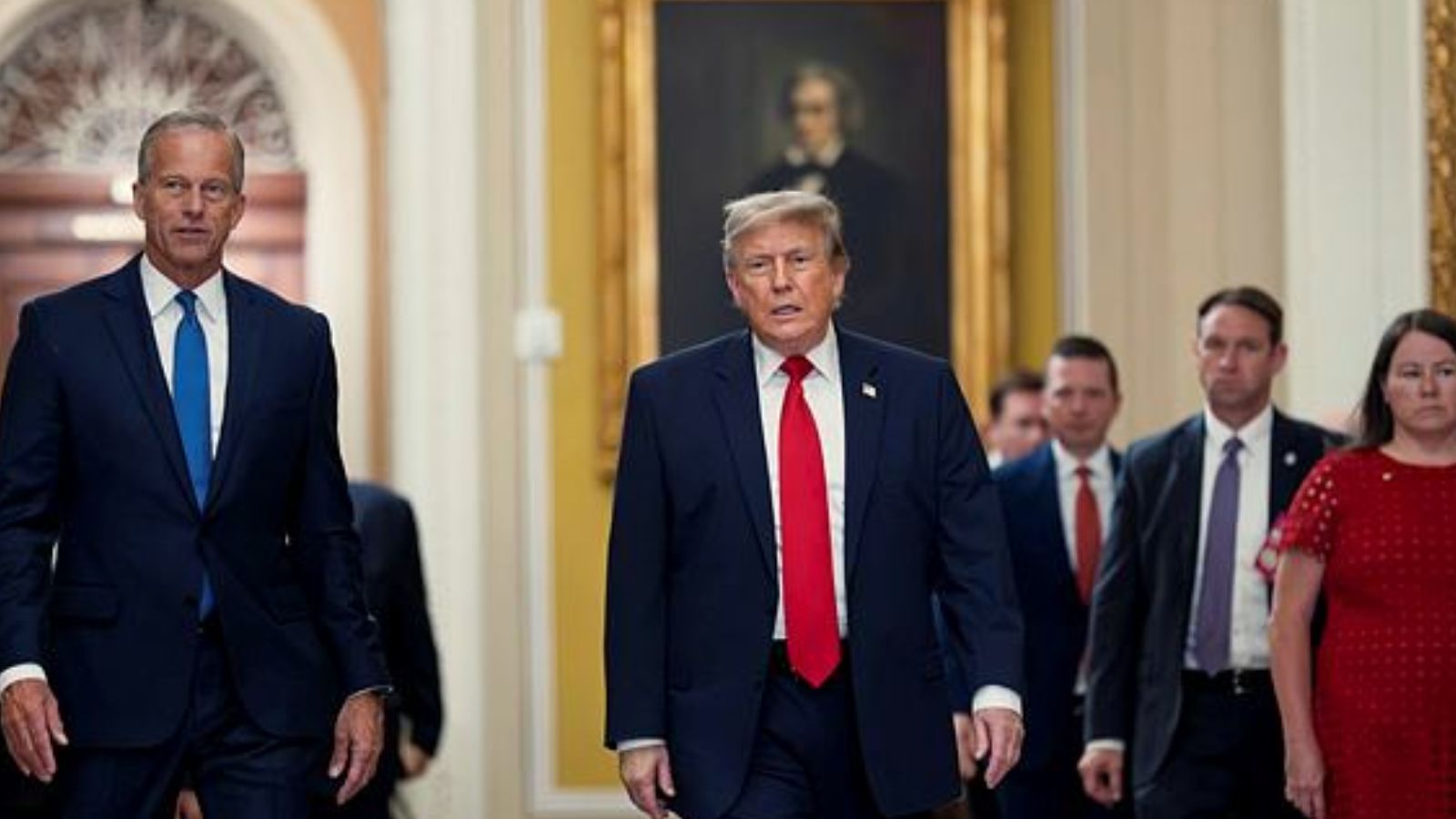
Legislative pushback against an executive foreign policy shift demonstrates that internal party alignment is a function of structural incentives, not automatic loyalty. The confrontation between President Donald Trump and Senate Republicans regarding the interim memorandum of understanding (MoU) with Iran illuminates the fundamental friction between executive negotiation strategies and legislative oversight frameworks. While conventional political commentary interprets this as a mere personal dispute or a breakdown in party discipline, an analytical assessment reveals a deeper systemic tension: the clash between centralized executive optionality and localized legislative risk mitigation.
Executives operate on a model that prioritizes strategic ambiguity and high-leverage negotiation, whereas legislators are bound by an accountability structure determined by transparent outcomes, regional partner security, and the long-term precedent of congressional war powers. Understanding this dynamic requires breaking down the modern executive-legislative relationship into its structural, economic, and strategic components.
The Dual-Track Incentive Model
To map why a Republican-controlled Senate would challenge an administration of its own party, the situation must be viewed through a dual-track incentive framework. The executive branch and the legislative branch optimize for entirely different utility functions.
+-----------------------------------------------------------------+
|                    THE INCENTIVE ASYMMETRY                      |
+-----------------------------------------------------------------+
|  EXECUTIVE FOCUS:                                               |
|  - Maximize dynamic bargaining leverage                         |
|  - Preserve unstructured operational flexibility                 |
|  - Implement rapid, iterative diplomatic adjustments             |
+-----------------------------------------------------------------+
|  LEGISLATIVE FOCUS:                                             |
|  - Minimize structural risks of long-term concessions          |
|  - Enforce explicit, verifiable commitments                     |
|  - Protect institutional oversight and fiscal authorities        |
+-----------------------------------------------------------------+
Executive Utility: Maximizing Bargaining Space
The administration’s primary asset in international diplomacy is flexibility. By executing an interim MoU—such as the 14-point agreement signed in France—the executive seeks to establish a baseline for long-term negotiations without boxing itself into rigid, legally binding parameters that require formal ratification.
From this operational perspective, domestic legislative interference is a direct tax on bargaining power. When Congress threatens to pass a war powers resolution or demands micro-oversight of an active diplomatic track, it signals a divided state apparatus to the foreign adversary. This division diminishes the credible threat of force and lowers the adversary's cost of non-compliance, as the foreign regime perceives that the executive's domestic mandate is constrained.
Legislative Utility: Eliminating Front-Loaded Risk
Conversely, lawmakers face an entirely different set of electoral and institutional calculations. For Senate defense hawks, an interim agreement that grants immediate economic relief or asset liquidity in exchange for future behavioral promises introduces an unacceptable asymmetry.
The second limitation driving legislative resistance is the asymmetry of commitment. If an agreement unfreezes assets or sets up frameworks for economic reconstruction funds up front, the adversary receives tangible, front-loaded utility. The verification of the adversary's compliance—such as halting ballistic missile development or providing verifiable pathways regarding nuclear infrastructure—is back-loaded and highly dependent on future enforcement. Consequently, legislators view interim MoUs not as stepping stones to a durable peace, but as structurally flawed mechanisms that surrender leverage before securing permanent concessions.
The Economics of Reconstruction and Sanctions Asymmetry
The core of the policy dispute centers on the economic architecture of the 14-point memorandum, specifically the proposed $300 billion regional reconstruction and development fund. The friction here can be mathematically expressed as a cost function of geopolitical leverage.
When an administration structures an agreement that involves third-party capitals or regional partners capitalizing a fund for an adversary's economic development, the goal is to shift the financial burden away from domestic taxpayers while still offering a compelling off-ramp to the target state. However, the legislative calculation treats capital as fungible.
Geopolitical Leverage = (Value of Withheld Sanctions + Threat of Force) / (Adversary's Alternative Capital Flows)
If the adversary gains access to external capital flows—whether through direct funding, unfreezing of escrowed accounts, or sanctions relaxation—the denominator increases. As the denominator grows, the net efficacy of the primary state's unilateral leverage declines.
Senate critics argue that providing a blueprint for a $300 billion fund, even if not bankrolled by U.S. treasury outlays, fundamentally alters the target state’s macroeconomic stability. It lowers the internal pressure on the regime, reduces the domestic political cost of their defense spending, and decreases their incentive to make structural concessions on non-nuclear strategic vectors, such as regional proxy networks or missile technology.
Institutional Bottlenecks and Legislative Remediation Channels
When internal party friction escalates to a closed-door confrontation, the legislative branch deploys specific structural tools to reclaim its position in the constitutional balance of power. This tension manifests through two primary channels: the withholding of legislative acquiescence and the threat of statutory constraints.
The Information Bottleneck
The primary point of failure in executive-legislative coordination is information asymmetry. During the initial phases of the MoU rollout, lawmakers like Senator Bill Cassidy explicitly noted that the administration had withheld sufficient technical details regarding the enforcement mechanisms of the agreement.
This lack of transparency triggers an immediate defensive posture within the legislature. Lacking precise data, lawmakers default to a worst-case scenario analysis to protect their political capital and institutional prerogatives. The bottleneck is only resolved when the executive branch increases the frequency and granularity of classified briefings, shifting the strategy from public messaging to targeted data sharing.
Statutory Controls: The War Powers Counterweight
The threat of a war powers resolution serves as the most potent structural lever available to a dissenting legislative faction. Even if a resolution is narrowly blocked—as seen in the 50-47 vote to table the measure—the proximity to passage changes the executive’s risk calculation.
+-----------------------------------------------------------------+
|                 WAR POWERS RESOLUTION LEVERAGE CYCLE            |
+-----------------------------------------------------------------+
|  1. Executive acts unilaterally via Interim MoU/Ceasefire       |
|                             ↓                                   |
|  2. Legislative branch signals dissatisfaction with terms       |
|                             ↓                                   |
|  3. War Powers Resolution introduced to restrict military force |
|                             ↓                                   |
|  4. Executive leverage is compromised in international theater  |
|                             ↓                                   |
|  5. Executive forced to offer concessions/briefings to Senate   |
+-----------------------------------------------------------------+
A high probability of legislative restriction on the use of military force alters the international bargaining table. If the adversary calculates that the executive cannot legally resume hostiles without triggering a constitutional crisis, the adversary's compliance costs drop significantly. The vote to block the resolution was not a validation of unstructured executive freedom; rather, it was a calculated calibration by key senators who exchanged their negative votes for immediate access, granular policy explanations, and explicit enforcement assurances from top administration officials.
Strategic Trajectory and Executive Enforcement Parameters
To project the resolution of this executive-legislative impasse, the analysis must move past political rhetoric and focus strictly on the operational boundaries established by both branches. The administration maintains that it possesses the unilateral authority to adjust sanctions frameworks via executive orders, referencing longstanding legal opinions from the Office of Legal Counsel. The legislature, however, retains absolute control over formal treaty making and explicit budgetary appropriations.
The strategic resolution of this friction will depend on three operational variables:
- The Verification Timeline: The administration must establish immediate, quantifiable milestones for Iranian behavioral compliance before any regional capital or unfrozen assets are deployed. This directly addresses the legislative concern regarding front-loaded concessions.
- The Scope Expansion Protocol: Future rounds of negotiation must formally integrate non-nuclear strategic vectors—specifically ballistic missile ranges and regional proxy funding limits—into the text of any permanent successor agreement to satisfy Senate defense hawks.
- Institutional De-escalation: The executive must transition from a strategy of public pressure and rhetorical confrontation to one of formalized, structured consultative loops with key committee chairs.
The definitive play for the administration is not to bypass the Senate, but to utilize the Senate's hawkish stance as a deliberate element of its international bargaining strategy. By positioning the legislature as a highly volatile, risk-averse counterweight that is prepared to snap back sanctions or restrict operational space, the executive can credibly signal to foreign adversaries that the cost of violating the interim MoU will be immediate, severe, and structurally unavoidable.
The mechanics of congressional war powers and executive deal-making are further examined in this legislative policy analysis, which details the late-night Senate floor dynamics and the specific tactical maneuvers used by both factions to navigate the voting thresholds during the confrontation.