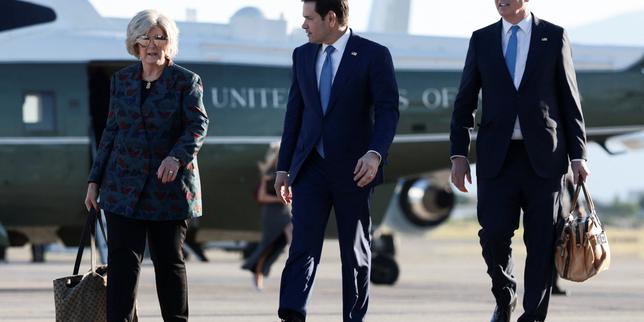
The diplomatic mission led by US Secretary of State Marco Rubio to the United Arab Emirates, Kuwait, and Bahrain exposes a deep structural divergence between Washington's transactional foreign policy and the long-term economic stability requirements of the Gulf Cooperation Council (GCC). While the Trump administration frames the recently signed memorandum of understanding (MoU) with Tehran as a stabilizing architecture, a rigorous assessment of regional risk vectors reveals that the 60-day negotiation runway introduces severe operational and capital frictions for the Gulf petromonarchies.
The core tension stems from a fundamental mismatch in security priorities. Washington seeks an exit strategy from a high-intensity conflict, whereas the host nations require long-term, predictable containment of Iranian asymmetric capabilities. The trip is not merely a routine diplomatic consultation; it is an aggressive exercise in reassurance designed to prevent GCC states from hedging their security portfolios toward alternative global powers.
The Tri-Border Security Deficit
The physical trajectory of the diplomatic tour—spanning Abu Dhabi, Kuwait City, and Manama—maps directly onto the regions most exposed to systemic maritime and infrastructure vulnerabilities. The strategic exposure can be disaggregated into three distinct operational vectors:
- The Maritime Bottleneck (Manama, Bahrain): As the host of US Naval Forces Central Command (NAVCENT) and the Fifth Fleet, Bahrain represents the military hub for securing the Strait of Hormuz. Because 20% of global petroleum liquids pass through this transit corridor daily, any protracted ambiguity during the 60-day negotiation window maintains a high-risk premium on maritime insurance, directly impacting shipping margins.
- The Commercial Vulnerability (Abu Dhabi, UAE): The UAE's economic model relies on its status as a secure global hub for logistics, tourism, and capital insertion. The conflict initiated on February 28 highlighted that proxy strikes can bypass traditional air defense layers, threatening the critical infrastructure required to maintain foreign direct investment.
- The Northern Gulf Exposure (Kuwait): Geographically contiguous to Iraq and in close maritime proximity to Iran, Kuwait occupies a precarious position where escalation rapidly translates into direct territorial threats.
The Cost Function of Regional Uncertainty
The primary structural flaw of the US-Iran MoU is the implementation of a 60-day negotiation buffer. In corporate and state financing, prolonged geopolitical ambiguity operates as a direct tax on capital. The economic friction manifests across three major operational variables:
- Capital Flight and Risk Premiums: GCC states have systematically diversified their economies toward tourism, technology infrastructure, and real estate. The introduction of an extended period of diplomatic uncertainty disrupts long-term capital allocation, forcing sovereign wealth funds to self-insure against sudden escalatory shocks.
- Asymmetric Deterrence Realities: The recent conflict demonstrated that defensive air capabilities (such as Patriot and THAAD missile batteries) operate at a massive cost-disadvantage when countering low-cost, mass-produced drone swarms and ballistic assets. A single interceptor missile costing 2 million to 4 million dollars is routinely deployed to neutralize a drone built for less than 50,000 dollars. This fiscal imbalance means that even under an active defense umbrella, the economic cost of maintaining readiness is unsustainable over an extended timeline.
- The Sovereignty Bottleneck: Gulf states found themselves absorbing the collateral costs of US-led strikes against Iran, suffering retaliatory infrastructure impacts for a conflict they did not initiate. This creates a severe credibility gap in bilateral security guarantees.
Mapping the Strategic Hedging Playbook
Faced with an unpredictable security partner, GCC leadership is shifting away from exclusive reliance on Western defense architectures. This transition follows a strict logic of diversification, visible in how regional actors structure their long-term defense procurement and diplomatic alignments.
The first manifestation is the rapid expansion of defense procurement contracts outside the traditional US-European ecosystem. By acquiring advanced sensor arrays, electronic warfare packages, and unmanned aerial vehicles from non-Western suppliers, Gulf states are building redundant infrastructure that operates independently of Washington's legislative approvals or policy pivots.
The second shift involves diplomatic positioning. Rather than viewing regional security as a zero-sum calculation brokered by an external superpower, the UAE and Saudi Arabia are treating relationship management with Tehran as a direct bilateral necessity. By establishing independent channels, they seek to decouple their domestic infrastructure from the broader ideological friction between Washington and the Iranian state.
The strategic play for the United States during this tour cannot rely on rhetorical alignment. To prevent deep structural hedging by the Gulf states, Washington must formalize concrete mechanisms that tie the 60-day negotiation outcomes to explicit maritime security metrics in the Strait of Hormuz. If Secretary Rubio fails to deliver binding, legally structured assurances regarding proxy containment, the upcoming GCC summit in Bahrain will mark the formal acceleration of a multipolar security paradigm in the Middle East.