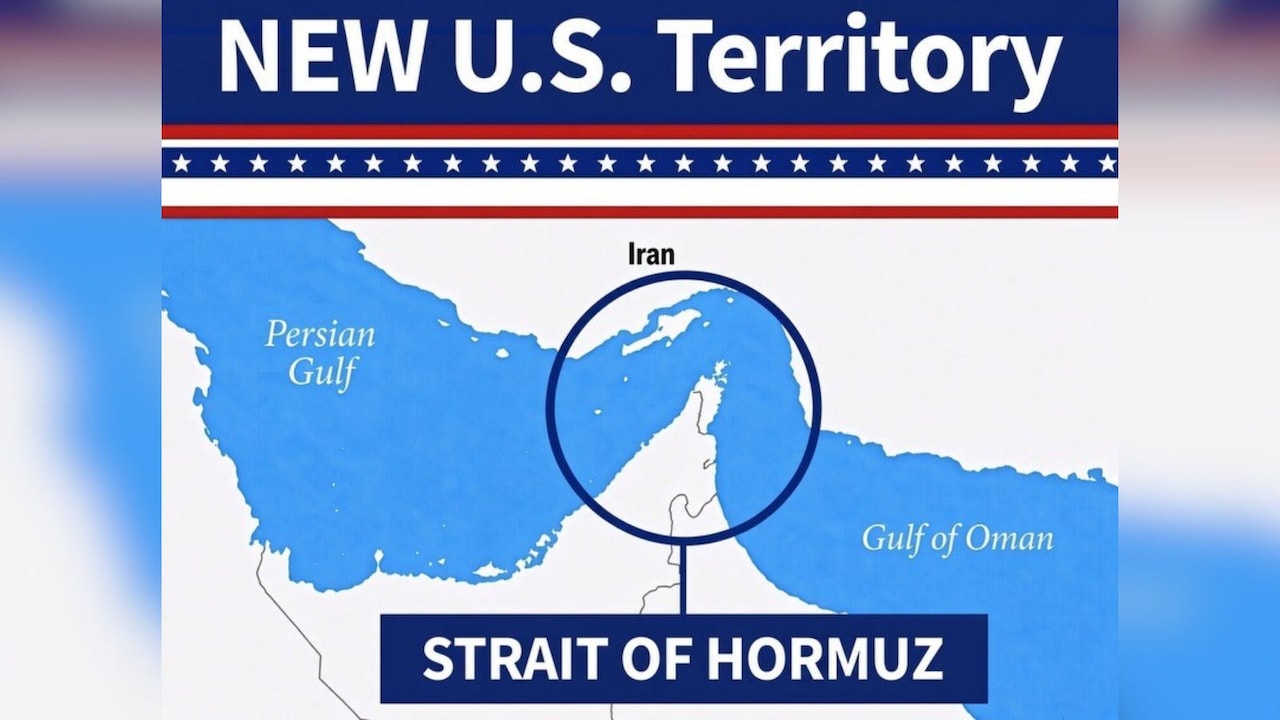
The modern global energy trade relies on narrow maritime corridors where physical geography dictates economic reality. When political actors attempt to override sovereign boundaries and international maritime law via digital cartography and naval blockades, a structural fracture occurs between declared control and operational execution. The recent dissemination of maps labeling the Strait of Hormuz as a sovereign territorial acquisition of the United States highlights a fundamental misunderstanding of maritime jurisdiction, international law, and energy market mechanics. Evaluating this geopolitical friction requires stripping away rhetorical declarations and examining the underlying variables of naval power projection, bilateral mediation, and commodity flow constraints.
The Mechanics of Maritime Chokepoint Control
Controlling a strategic waterway requires more than administrative declarations or digital maps. Under the United Nations Convention on the Law of the Sea, the Strait of Hormuz overlaps the territorial waters and exclusive economic zones of Oman and Iran, leaving no high seas corridor for transit. Sovereignty over these waters precludes unilateral annexation without systemic legal and military restructuring of the region.
The strategy currently deployed by Washington relies on an active naval blockade designed to intercept targeted commerce and compress macroeconomic indicators within Iran. However, operational control over a 21-mile-wide passage differs fundamentally from territorial ownership. While carrier strike groups and surface action units can interdict specific classes of vessels, they cannot unilaterally transform international transit corridors into domestic landmasses without triggering total war or permanent regional occupation.
The Cost Function of Transit Disruption
The closure of the Strait of Hormuz alters the global supply equation by removing roughly a fifth of globally traded petroleum and liquefied natural gas from smooth transit. The economic impact operates through distinct transmission channels:
- Physical throughput reduction forces crude carriers and LNG tankers to anchor or seek alternative routes, depressing daily barrel movements from historical pre-conflict averages of over twenty million barrels down to a fraction of that volume.
- Secondary economic pressure expands outward as financial authorities prepare broad sanctions to penalize any entity maintaining commercial lifelines with Tehran, forcing international shipping conglomerates to reprice risk across entire supply chains.
- Regional mediation structures experience acute strain when primary security guarantors issue threats against traditional diplomatic intermediaries like Oman, collapsing the backchannel communication required to negotiate safe maritime passage.
The structural limitation of an enforcement-only posture is its inability to compel voluntary compliance from regional actors. While administrative posts claim that the waterway is open and mines have been cleared, commercial insurers and shipping liners assess risk based on active threat vectors, including shore-based anti-ship missiles, drone infrastructure, and ongoing military exchanges. Consequently, formal ownership claims collide with commercial reality: insurance premiums remain prohibitive, and commercial traffic stays stalled.
Strategic Trajectory
The impasse over the Hormuz corridor demonstrates the limits of coercive diplomacy when applied to critical energy transit points. As the expiration of diplomatic frameworks gives way to intensified economic warfare, the primary variable is not how the territory is designated on digital platforms, but how energy importers manage sustained supply truncation. Resolution depends on whether diplomatic channels can be reconstructed independently of maximalist territorial claims, or if the chokepoint remains structurally paralyzed by competing assertions of sovereignty.