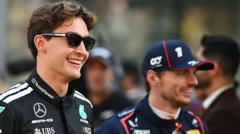
Max Verstappen doesn't care about your record books. While fans and pundits obsess over whether he’ll eclipse Lewis Hamilton’s seven world titles or Michael Schumacher's dominance, the man behind the wheel seems to have his eyes on the exit door. George Russell recently weighed in on this, noting he’d completely understand if Verstappen decided to hang up his helmet sooner rather than later. It's a take that cuts through the usual PR fluff we see in the paddock.
The F1 calendar is a grind. We’re looking at 24 races a year. That’s not just 24 Sundays. It’s 24 weeks of travel, simulator work, media obligations, and constant physical toll. For someone like Verstappen, who started this journey as a literal child, the burnout factor isn't just a theory. It's a looming reality. If you've been living at 200 miles per hour since you were four years old, the appeal of a quiet life starts to outweigh the trophy cabinet. Discover more on a related issue: this related article.
The relentless pressure of the modern F1 schedule
Russell pointed out that the sport is "draining." He’s not wrong. The current era of Formula 1 is more demanding than any that came before it. We aren't in the 1990s anymore where drivers could fly in, race, and vanish to a boat in Monaco. The commercial side of the sport has exploded. Verstappen has been vocal about his distaste for the "show" elements, like the over-the-top Las Vegas introductions or the endless sprint race format changes.
He’s a purist. He wants to race. When the racing starts feeling like a secondary part of a massive marketing machine, someone with Max’s mindset starts looking for the off-ramp. Russell gets this because he’s part of that same generation. They see the toll it takes on their personal lives. Verstappen has already achieved everything. He's a multiple-time world champion. He’s won the races that matter. What’s left? Further journalism by The Athletic highlights comparable perspectives on the subject.
Financial freedom and the hunger for other series
Verstappen isn't motivated by money anymore. He’s earned enough to support several lifetimes of luxury. When financial pressure disappears, only the passion remains. But Max's passion isn't limited to an F1 cockpit. He’s obsessed with GT racing and endurance events like the 24 Hours of Le Mans. He runs his own sim racing team. He spends his "off-time" driving more cars.
I've watched drivers stay in the sport far past their prime because they didn't know who they were without it. Verstappen doesn't have that problem. He has a clear vision of a life outside the F1 bubble. Russell’s comments highlight a shared sentiment among the younger grid members—success is great, but it shouldn't be a prison. If the car isn't competitive or if the rules stop being fun, Verstappen won't stick around just to collect a paycheck.
Red Bull internal drama and the loyalty factor
You can't talk about Verstappen leaving without looking at the mess inside Red Bull Racing. The power struggles and the departure of key figures like Adrian Newey have shifted the ground beneath Max’s feet. If the team that built his success starts to crumble or lose its edge, the incentive to stay vanishes. He’s a winner. He isn't interested in a "rebuilding phase" or fighting for P6 because of a technical decline.
Russell’s perspective is grounded in the reality of the paddock. He sees the body language. He hears the tone in the briefings. While the media paints Verstappen as an unstoppable robot, his peers see a guy who is increasingly tired of the noise surrounding the sport. There's a real chance he walks away at the end of his current contract in 2028, or even earlier if the 2026 engine regulations don't go Red Bull's way.
What a Verstappen exit means for the grid
If he leaves, it blows the driver market wide open. It’s the ultimate "silly season" catalyst. Russell himself would be a prime candidate for a top-tier seat if Mercedes isn't delivering, though he’s currently spearheading the Silver Arrows' resurgence. The vacuum left by a talent like Verstappen would change the dynamic of every single team.
Fans might think it’s crazy to walk away from a winning car. But look at Nico Rosberg. He won his title and walked away days later. He knew the cost of staying was higher than the reward of winning again. Verstappen operates on a similar frequency. He’s been "on" since he was a toddler under the intense tutelage of his father, Jos. A decade in F1 might feel like thirty years to him.
Life after the checkered flag
We should stop asking if he will leave and start asking when. The signs are all there. His comments about the calendar, his frustration with FIA officiating, and his desire to try other categories all point to an early retirement. Russell is just being honest about what most people in the pit lane already suspect.
If you want to track where Max is heading, watch his involvement in his "https://www.google.com/search?q=Verstappen.com Racing" projects. He’s building a foundation for a career as a team owner and a versatile racer across different disciplines. He’s not going to sit on a beach. He’s going to race on his own terms, without a Netflix camera crew following his every move.
Keep a close eye on the 2026 regulation testing. That's the real turning point. If the Red Bull Ford power unit isn't a rocket ship from day one, expect the retirement talk to go from a whisper to a roar. Max has nothing left to prove to us, and he knows it.
Pay attention to his post-race interviews over the next few months. Look for the moments where he complains about the schedule rather than the car. That’s the real indicator. If you’re a fan, enjoy the masterclass while it lasts, because the exit door is already propped open.