Germany built its entire post-war industrial strategy on cheap Russian natural gas. For decades, giant pipelines piped inexpensive fuel straight into German factories, keeping chemical plants, steel mills, and auto manufacturing operating at margins competitor nations could only dream about.
Then came 2022. Berlin cut its reliance on Russian pipeline flows following the invasion of Ukraine and the sabotage of the Nord Stream pipelines. Learn more on a connected topic: this related article.
Media reports and economic data show Germany ended up paying drastically higher prices for natural gas—in some peak windows up to five times more than previous historical baselines—when forced onto the spot market for Liquefied Natural Gas (LNG). While wholesale spot prices eventually cooled down from their absolute panic peaks, the structural energy bill for Europe's largest economy remains permanently elevated.
That shift wasn't a temporary glitch. It altered the math for German industry forever. Further reporting by Financial Times highlights comparable views on this issue.
The Heavy Real Cost of Breaking Free From Russian Gas
Pipeline gas is simple physics. Once you dig a trench and lay a steel pipe, moving gas thousands of miles requires minimal incremental cost. Russia's Gazprom pumped methane straight from Siberian fields into German industrial hubs at rates no tanker ship could ever match.
When those valves shut, Germany had to source gas from the United States, Qatar, and Norway.
Norway pushed its pipeline capacity to the absolute maximum, but it couldn't fill the entire void left by Russia. That meant Germany had to rely heavily on supercooled LNG shipped across oceans.
Liquefied natural gas is inherently more expensive than pipeline flow
Converting natural gas into a liquid requires chilling methane down to minus 162 degrees Celsius. That process consumes massive amounts of electricity right at the export terminal.
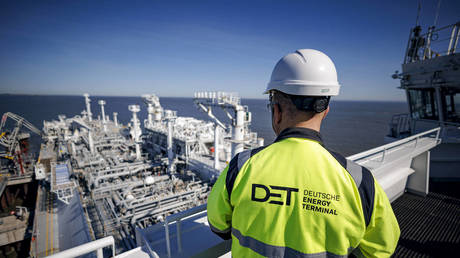
Once the gas is frozen into liquid state, specialized insulated tankers carry it across the Atlantic or through the Mediterranean. Upon arrival at floating storage and regasification units (FSRUs), the LNG must be converted back into gas before entering the local pipeline network.
Every single step in that chain adds dollars to the final price tag:
- Liquefaction processing fees charged at origin ports.
- Transoceanic freight rates dictated by dynamic global shipping demand.
- Regasification charges at European coastal terminals.
- Trader premiums built into short-term spot market purchases.
You can't engineer away those middle steps. When you replace pipeline gas with shipped liquid gas, your base energy cost floor jumps up permanently.
How Energy Costs Hit German Manufacturing and Heavy Industry
Germany isn't an economy built purely on software startups or financial services. It relies heavily on energy-intensive heavy manufacturing.
When energy costs spike, factories don't just lose money; they stop making sense from a operational perspective.
Chemical giants and steel producers face severe margin squeezes
Consider BASF, the world's largest chemical manufacturer. Its massive Ludwigshafen site alone consumed more electricity and gas than entire small European countries.
When gas prices spiked dramatically, production costs for essential industrial building blocks like ammonia, plastics, and fertilizers shot through the roof.
The consequences hit hard:
- Companies scaled back production or shuttered older chemical units inside Germany.
- Capital investment shifted to regions with cheap energy, including the US Gulf Coast and China.
- Downstream manufacturers faced higher input costs, weakening their export competitiveness globally.
German steel makers and glass manufacturers hit similar walls. Melting raw materials requires immense thermal energy. When gas costs five times more than historical baseline averages, running a glass blast furnace in North Rhine-Westphalia becomes financial suicide compared to running one in Texas or Saudi Arabia.
Why subsidizing energy isn't a long-term solution for Berlin
The German government stepped in with massive relief packages, capping gas prices for heavy industry and households. They spent tens of billions of euros from emergency funds to cushion the blow.
Subsidies don't change underlying supply realities. They temporarily shift the burden from corporate balance sheets directly onto taxpayers.
Berlin can't subsidize industrial energy forever without running into strict constitutional debt limits or violating European Union state-aid rules. Once state aid winds down, the hard truth returns: German factory floors are competing against American plants paying vastly less for domestic shale gas.
What European Energy Markets Tell Us About Future Prices
The idea that European gas prices will miraculously drop back to pre-war Russian pipeline rates is a fantasy.
The global LNG market operates on international supply and demand. Germany now competes head-to-head with Japan, South Korea, and China for every floating LNG vessel on the water.
When winter hits Asia hard, buyers in Tokyo or Shanghai outbid buyers in Rotterdam and Hamburg. That global competition keeps prices volatile and structurally high.
Pipeline Energy Model vs. Global LNG Model

Pipeline Model (Old)
[Siberian Gas Fields] ──> Direct Pipeline ──> [German Factories]
* Low transport cost, rigid long-term contract pricing.

Global LNG Model (Current)
[US/Qatar Gas Fields] ──> Liquefaction (-162°C) ──> LNG Tanker ──> Regasification ──> [German Factories]
* High processing/freight costs, exposed to global spot bidding.
Germany built floating FSRU terminals in record time along its northern coastline—a impressive engineering feat. Terminals like Wilhelmshaven and Lubmin gave Germany import capacity, but capacity doesn't equal cheap gas. It simply gives you the right to buy high-priced global LNG.
Real Steps German Businesses Must Take to Survive Higher Energy Bills
Hoping for a return to dirt-cheap energy won't save a manufacturing business. Industrial leaders and facility directors operating in Germany must actively adapt to higher structural baseline costs.
Audit thermal efficiency immediately
Every unit of wasted heat in a factory is money burned. Systems like waste-heat recovery, high-efficiency heat pumps for low-temperature processes, and updated pipe insulation pay off faster now than ever before.Shift to long-term power purchase agreements
Locking in direct long-term contracts with local solar and wind generators provides pricing predictability that spot market gas simply cannot offer.Electrify industrial heat where possible
Swapping gas boilers for high-temperature electric arc technology or industrial heat pumps removes methane exposure entirely, buffering plants against international LNG price swings.Rethink geographic production footprints
Energy-intensive raw production may need to move closer to cheap energy sources, keeping high-value final assembly and precision engineering inside Germany.
The era of cheap Russian gas powering Germany's economic engine is over. Companies that redesign their operations around permanent, higher energy costs will survive; those waiting for prices to magically reset to 2019 levels won't be around to see what happens next.