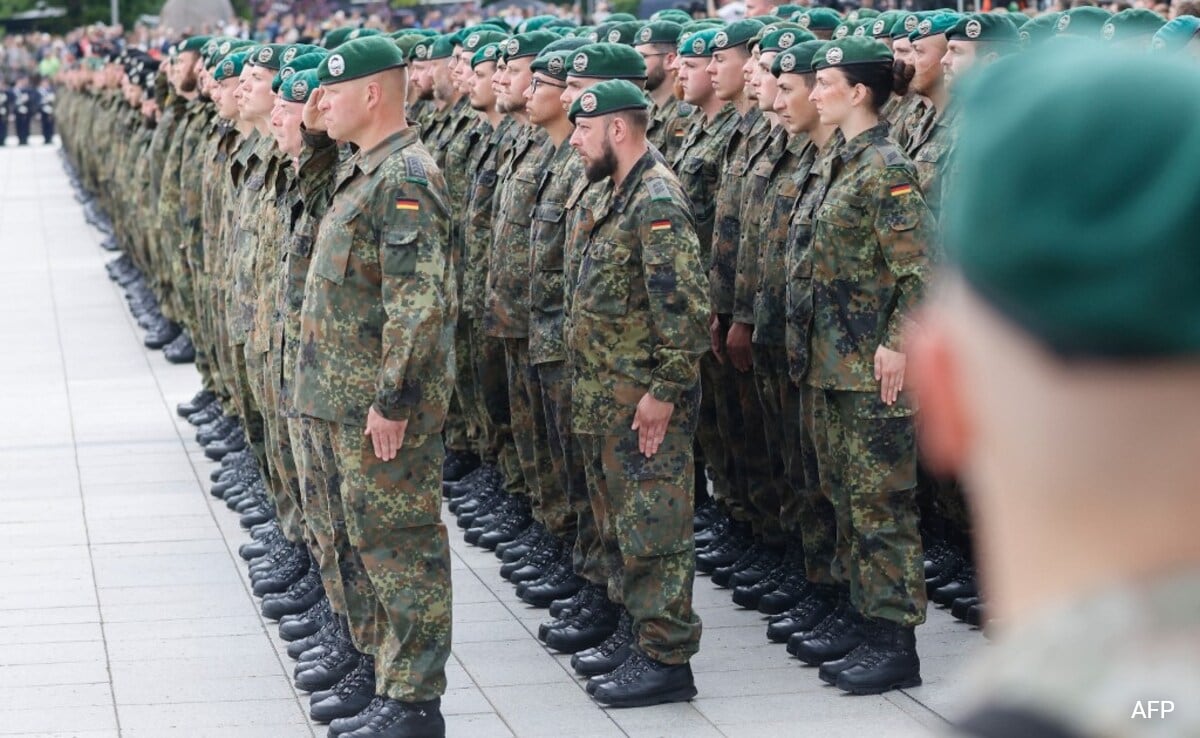
The global defense community is currently obsessed with the Zeitenwende. Analysts are tripping over themselves to herald Germany’s first comprehensive military strategy in eight decades as a "wake-up call" for the Indo-Pacific, and specifically for India. They point to the €100 billion special fund and the shift toward "Prehrfähigkeit" (war-readiness) as a seismic shift in European security.
They are wrong.
This isn't a wake-up call. It's a snooze button wrapped in a press release. The idea that New Delhi needs to take cues from Berlin's sudden discovery that tanks actually matter is a fundamental misunderstanding of both German reality and Indian necessity. If India looks to Germany for a blueprint on strategic pivot points, it’s looking at a country that forgot how to build a railway, let alone a war machine.
The Myth of the German Turnaround
The "lazy consensus" argues that Germany has finally shed its post-WWII pacifism and is ready to lead. This narrative ignores the sheer industrial rot and bureaucratic paralysis that defines the modern Bundeswehr. Since the end of the Cold War, Germany didn't just downsize; it de-skilled.
I have spoken with defense contractors in the Rhine-Ruhr district who describe a procurement cycle so broken it makes the Pentagon look like a Silicon Valley startup. We aren't talking about a lack of money. We are talking about a lack of competence. The €100 billion "Sondervermögen" is being devoured by inflation and legacy maintenance costs before a single new bolt is tightened on a Leopard 2.
India, meanwhile, lives in a neighborhood where "war-readiness" isn't a theoretical policy shift; it's a Tuesday.
Why New Delhi Cannot Export European Logic
The competitor's argument hinges on the idea that India should emulate Germany’s "Integrated Security" model. This is a trap. Germany’s strategy is built on the luxury of the NATO umbrella. India has no such shield.
When Berlin talks about "integrated security," they mean getting the Ministry of Economic Affairs to talk to the Ministry of Defense. For India, security is a hard-edged reality involving two nuclear-armed neighbors and a volatile Himalayan border.
- Strategic Autonomy is not "Allignment-Lite": Germany is re-arming to fit more snugly into a US-led architecture. India is building a military to ensure it never has to rely on one.
- Industrial vs. Financial Strength: Germany is throwing money at a dead industrial base. India is attempting to build a new one via "Atmanirbhar Bharat."
- The Technology Gap: Germany is buying F-35s from the US. India is trying to master the jet engine—the hardest engineering feat on the planet—domestically.
If India follows the German model, it will end up with a high-cost, low-readiness force that looks great in a parade but can’t sustain a three-week high-intensity conflict.
The "Interoperability" Scam
Defense pundits love the word "interoperability." They argue that India needs to align its military doctrine with Western (read: German/NATO) standards to counter China.
This is an expensive mistake.
True power in the 21st century comes from being a "black box" to your enemies. If your systems, your data links, and your doctrines are perfectly aligned with NATO, they are also perfectly mapped by any adversary that has spent thirty years studying NATO. By staying outside these rigid structures, India maintains a "strategic ambiguity" that is far more lethal than being the junior partner in a Western-led maritime coalition.
Imagine a scenario where the Indian Navy adopts the exact same communication protocols and sensor-fusion architectures as the German Navy. In a South China Sea flashpoint, an adversary only needs to crack one nut to open the whole basket. Diversity in defense architecture is a feature, not a bug.
The Procurement Trap
Germany’s military strategy is a document written by committees to appease other committees. India’s procurement history is already legendary for its delays, but at least those delays are born of a desire to own the intellectual property.
The German approach is to buy off-the-shelf and hope for the best. For a nation like India, "off-the-shelf" is a fast track to becoming a vassal state. When the chips are down, the country that owns the software updates owns the war.
- The Hardware Trap: Buying a tank is a 40-year marriage. If you don't own the source code, you don't own the tank.
- The Logistics Lie: Germany’s strategy assumes a short, sharp shock. India’s geography demands a military that can grind.
Dismantling the "Indo-Pacific Pivot"
The most hilarious part of the German military strategy is the "pivot to the Indo-Pacific." Berlin sending a frigate to the region once every two years is not a strategic shift; it's a cruise with guns.
India should see this for what it is: performance art. Germany’s primary interest in the Indo-Pacific is not security; it’s ensuring the shipping lanes stay open so they can keep selling Volkswagens to China. The moment a conflict actually breaks out, Berlin will be the first to call for "restraint" and "de-escalation" to protect their export margins.
India relying on Germany as a security partner in the Indian Ocean is like a professional boxer hiring a yoga instructor for a street fight. It's the wrong tool for the wrong job.
What India Should Actually Do
Instead of reading German white papers, New Delhi should be doubling down on the brutal realities of asymmetric warfare.
- Mass over Sophistication: Ten $5,000 loitering munitions are more useful than one $2 million missile. Germany hasn't figured this out yet. India must.
- Subsurface Dominance: Forget aircraft carriers—the ultimate vanity project. India needs a fleet of autonomous underwater vehicles (AUVs) that can turn the Malacca Strait into a graveyard.
- Electronic Warfare is the New High Ground: If you can't see the enemy, you can't kill them. If the enemy can't see you, they've already lost.
The "German Wake-up Call" is a distraction for the chattering classes. It’s a story told by people who want to believe that the old world order can be resurrected with enough paperwork and a few extra euros.
The real world is messier, meaner, and far more indifferent to European strategies. India doesn't need to wake up to Germany’s plans. Germany needs to wake up to the fact that their strategy is eighty years late and several billion euros short.
India should keep its eyes on the border and its hands on the code. Everything else is just noise.
Stop looking for validation in Berlin. They are still trying to figure out how to make their rifles shoot straight in the heat. India has bigger problems and better solutions.
Build the drones. Secure the data. Ignore the white papers.