The air in downtown Caracas tastes like sulfur and stale diesel. If you stand long enough near the rusted skeletal frames of the refineries dotting Lake Maracaibo, you can almost hear the rhythmic, desperate heartbeat of a nation built on black gold. But that heartbeat is irregular now. It skips. It stutters.
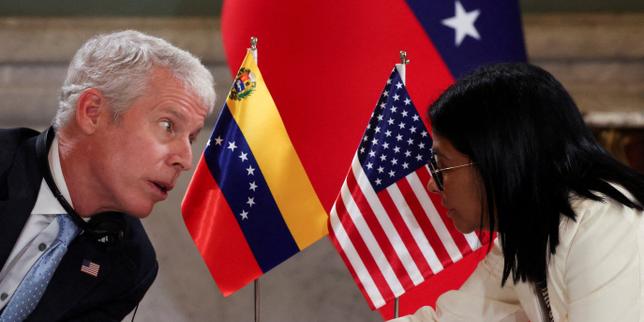
For decades, the math was simple. Drill. Pump. Sell. Cash flowed like a greasy river, funding everything from glittering skyscrapers to sprawling social programs. Then came the sanctions. Then came the decay. And now, behind the closed mahogany doors of Washington and the mirrored offices of Miraflores, a different kind of calculation is underway—one that feels less like diplomacy and more like a high-stakes poker game played in the dark.
Consider the reality of Mateo, a hypothetical floor operator who spent thirty years nursing ancient centrifugal pumps back to life. Mateo does not care about geopolitical leverage or congressional hearings in Capitol Hill. He cares about the smell of scorched insulation, the terrifying screech of a bearing running dry without lubricant, and whether his grandchildren will have rice tonight. When crude production hovers near historic lows, Mateo feels it in the grease under his fingernails and the hollow ache in his stomach.
Washington faces a brutal arithmetic. On one side sits the relentless pressure of global energy markets, where every barrel offline sends shockwaves through American gas pumps, squeezing voters already weary of inflation. On the other sits the moral and political hazard of easing the iron grip on a regime accused of authoritarian excess. To open the spigots is to grant a lifeline to a government that despises Western democracy. To keep the valves shut is to freeze millions of ordinary citizens into a slow-motion humanitarian crisis while watching Beijing and Moscow quietly step into the vacuum.
It is an impossible equation.
To understand why, we have to look past the political posturing and examine the physical decay of the infrastructure itself. Oil fields are not light switches. You cannot simply flip them off for years and turn them back on with a cheerful greeting. Reservoirs pressure-drop. Pipelines corrode from the inside out, chewed away by acidic crude and neglected maintenance.
Imagine a massive, intricate vascular system where every vein is clogged with rust and neglect. That is the Venezuelan oil patch today. Even if the United States completely lifts sanctions tomorrow, the billions of dollars required to restore production to the levels seen at the turn of the century would take years to materialize. Investors are spooked. Trust, once broken, is harder to recover than a collapsed wellbore.
Yet, necessity remains a ruthless dictator.
Global energy supplies are fragile. Every disruption in the Middle East or Eastern Europe sends tremors across the globe, forcing strategists in Washington to swallow their pride and recalculate. The temptation to quietly negotiate oil waivers is always there, dangling like forbidden fruit.
We watch these negotiations from afar, tracking the cryptic leaks to journalists, the sudden nods of approval from international energy conglomerates, and the predictable rhetorical defiance from local leaders. It is a dance of mutual assured economic frustration.
The tragic irony is that the people caught in the middle are neither the politicians drafting sanctions nor the executives cutting deals in air-conditioned boardrooms. They are the Mateos of the world. They are the teachers walking miles to work because public transport has collapsed. They are the nurses rationing sterile gauze in hospitals where the lights flicker and die without warning.
When superpowers play chess with energy, the pawns are made of flesh and bone.
The equations scrawled on whiteboards in Washington and Caracas will not be solved by a stroke of a pen or a sudden diplomatic breakthrough. Too much blood has soaked into the soil. Too much iron has rusted away.
Darkness falls fast over the Caribbean coast. Out on the lake, a lone flare burns bright against the purple sky, turning a sliver of the water into a pool of shivering blood. It wastes precious gas that could power homes, burning away into the night because there is no infrastructure left to capture it. It is a monument to waste, a beacon of a system broken beyond easy repair, casting its lonely light across an uncertain horizon.